

If you or a family member have been preparing paperwork to adjust your status, apply for a Green Card, process a work permit, or renew a visa, take a deep breath and review every document three times. The era of “half-finished” files or submitting applications with the hope that a government officer will show mercy and request missing documents is over. Under the new policy formally titled “Reinforcing Evidence Standards”, U.S. Citizenship and Immigration Services (USCIS) has dismantled the previous approach that required officers to extend a hand before closing the door.
- The anatomy of the change: Why did USCIS eliminate the safety net?
- 1. The end of “placeholder” files and the system’s collapse
- 2. The hidden danger for critical deadlines (As in the case of professionals and students)
- Table: The legal abyss — The old system vs. USCIS’s new lock
- Practical guide: How to safeguard your immigration application to avoid an instant denial
From now on, if a petition reaches their desks without all the required initial evidence or does not demonstrate eligibility from the very start, the officer has full authority to issue an immediate denial. No prior notices, no bureaucratic leniency, and no room for errors.

The pulse of the regulatory change (Snippet Bait): The USCIS directive stipulates that officers can deny any immigration benefit immediately if mandatory initial evidence is missing or the applicant does not demonstrate eligibility at the time of filing, eliminating the obligation to send a Request for Evidence (RFE) or a Notice of Intent to Deny (NOID). This measure aims to curb what the agency calls “placeholder petitions,” but it exposes regular applicants to the loss of processing fees and a devastating setback in their cases.
The anatomy of the change: Why did USCIS eliminate the safety net?
To truly understand the scope of this measure, we must look beyond the official press release and analyze the political and administrative pressure in Washington.
1. The end of “placeholder” files and the system’s collapse
During the previous administration, internal guidelines encouraged officers to request more evidence before issuing a final “no.” The idea was to humanize a highly bureaucratic process, giving families time to gather lost records or delayed translations.
- The official argument: From the current USCIS leadership’s perspective, that flexibility opened the door for thousands of people to submit deliberately incomplete applications or “benefit vacuums.” This allowed, for example, applicants to obtain temporary work permits while their main cases languished in the agency’s drawers.
- The new punitive reality: Now, the burden of proof falls squarely and relentlessly on the applicant. Did you forget an apostilled birth certificate? Was the fee payment off by a penny? Is the digital signature not the accepted one? Before, this would have warranted a 12-week RFE to correct it; today, it could mean the trash bin and a formal denial.
2. The hidden danger for critical deadlines (As in the case of professionals and students)
This new rule does not discriminate, but it punishes especially harshly those who depend on extremely narrow time windows.
- Consider work visa holders (such as H-1B) who lose their jobs and seek to temporarily switch to a tourist visa (B-2) as a bridge to get organized. Previously, if the case lacked solidity or missing details about temporary intent, the officer would send an RFE requesting explanations.
- Now, under the new directive, a weak file or one with loose ends can be denied instantly, cutting off legal grace periods before the immigrant even realizes their folder was reviewed under a microscopic lens.
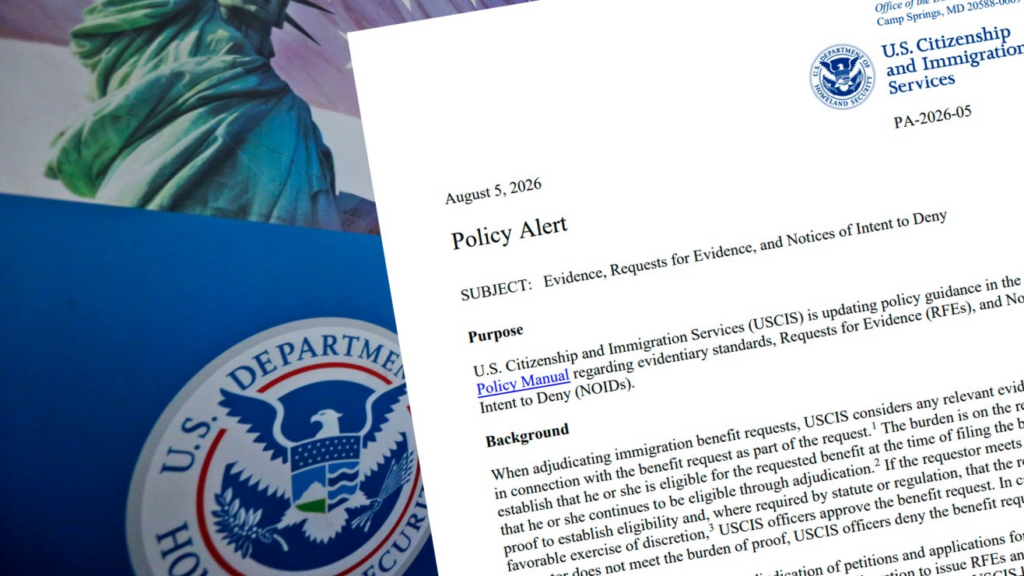
Table: The legal abyss — The old system vs. USCIS’s new lock
To clearly visualize the magnitude of this operational change, we contrast how errors were handled before this directive and how they are managed now:

| Filing Phase | The Previous Model (Flexible and Protective) | The New USCIS Model (Zero Tolerance) |
| Missing Initial Evidence | Automatic issuance of a Request for Evidence (RFE) or NOID. | Immediate denial without prior notice at the officer’s discretion. |
| Response Times | Ample margins and presumption that the error was correctable. | Full burden on the applicant; response deadlines reduced to the legal minimum (up to 12 weeks for exceptional RFEs, 30 days for NOIDs). |
| Institutional Philosophy | Prioritize adjudication of the benefit if there was willingness to comply. | Purge the system of imperfect applications and penalize administrative errors. |
| Economic Consequence | Loss of time, but retention of the fee and in-process status. | Total loss of filing fees, risk of accruing unlawful presence, and need to start from scratch. |
Practical guide: How to safeguard your immigration application to avoid an instant denial
If you plan to submit any petition to USCIS—whether it’s an I-130 for family members, an I-485 for adjustment of status, an I-765 for employment, or corporate petitions—improvisation has become a luxury you can no longer afford. Follow these steps for legal self-defense:
1. Use USCIS’s official checklists: Obsessive document audit.
Before inserting a single paper into an envelope or pressing the digital submit button, go to the official USCIS website and download the specific instructions for the current edition of your form. Do not rely on generic internet checklists. Verify one by one that every mandatory initial piece of evidence (initial evidence) is present, translated into English by a certified expert if foreign, and properly organized.
2. Avoid the danger of DIY filings: Professional legal assistance is indispensable.
With zero margin for error, attempting to assemble a complex asylum, residency, or waiver case without the supervision of an accredited attorney or a qualified legal organization is a monumental risk. A specialist knows how to detect which secondary documents can tip the scales to demonstrate full eligibility from day one, preventing the officer from applying the instant rejection criterion.

3. The small details that destroy big cases: Review payments, signatures, and formats.
A huge percentage of instant rejections do not occur due to lack of eligibility but because of silly mistakes: a check with the wrong amount, a missing signature on a supplement page, or the use of an outdated form version. Make sure to sign where required and attach the exact payment receipts. Remember that a procedural error can now be interpreted under the new rule as a failure to meet initial requirements.
The truth is that this new USCIS directive turns every immigration process into a minefield where a simple documentary oversight can cost months of waiting and thousands of dollars in lost fees. For our Hispanic community, the moral is clear: patience and perfection in document preparation are no longer optional—they are the only guarantee of legal survival in the current U.S. system. Stay informed and do not leave your future to chance.
Image: ElHispanoParaTodos/PRESS





