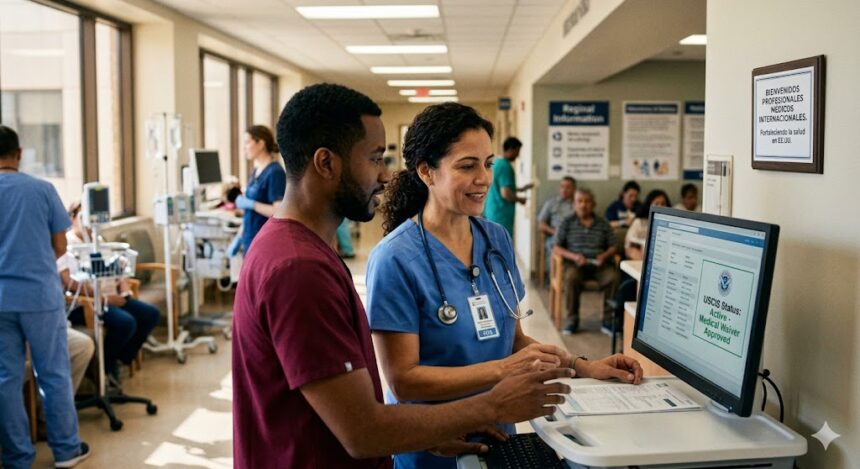
The healthcare crisis in the United States has forced Washington to concede. In a move many are calling a “national survival act,” the government has decided to lift immigration restrictions that left thousands of foreign doctors in limbo. It’s no secret: without these professionals, the healthcare system in rural areas would simply collapse.
- The “Emergency Adjustment”: Why Now?
- Impact Table: How Does Your Status Change Today?
- The 3 Golden Paths for Doctors in 2026
- 1. The Conrad 30 Program (Enhanced)
- 2. EB-2 NIW (National Interest Waiver): The “Shortcut”
- 3. Provisional State Licenses
- Warning: It’s Not All Rosy
- What Should You Do Now? Recommended Steps
What does this change really mean? Starting in May 2026, the U.S. Citizenship and Immigration Services (USCIS) has resumed processing visas, work permits, and permanent residencies for foreign doctors, eliminating the block that affected citizens from 39 nations. This includes the immediate reactivation of J-1 Waivers and H-1B visa extensions for the healthcare sector.

The “Emergency Adjustment”: Why Now?
The truth is, the White House had little choice. With a projected shortage of up to 86,000 doctors by 2036, keeping physicians out of hospitals was a recipe for disaster. The pressure from over 20 medical associations had an effect.
Here’s the interesting part: this isn’t a full immigration reform, but rather a surgical exception. While other professionals from those 39 countries remain under scrutiny or ban, doctors have been classified as a “critical national resource.” Is it fair? Maybe not for everyone else, but it’s a huge victory for the Hispanic and international medical community already here, saving lives.
The End of the “Limbo” for Medical Residencies
Many doctors who were finishing their residencies this summer faced an abyss: if their waiver application wasn’t processed before July, they would have to leave the country. This administrative change allows for:
- J-1 Waiver applications stalled since January to move forward again.
- Avoiding the controversial $100,000 USD fee that some rural clinics feared paying to bring back their specialists.
Impact Table: How Does Your Status Change Today?
| Immigration Process | Previous Status (January – April 2026) | New Status (May 2026 onward) |
| J-1 Visa (Waiver) | Frozen / Processing Suspended | Priority Resumption |
| H-1B Visa (Doctors) | Denials based on national origin | Normal Processing with Exception |
| Green Card (EB-2 NIW) | Indefinite wait for banned countries | Active Adjudication |
| Work Permits | On pause (Administrative Hold) | Immediate Approval for Healthcare Sector |
The 3 Golden Paths for Doctors in 2026
If you’re a foreign medical graduate (IMG), now is the time to make your move. The rules have changed, and flexibility is greater than ever.

1. The Conrad 30 Program (Enhanced)
This remains the most solid path. Each state can sponsor up to 30 doctors to stay in the U.S. in exchange for working in areas with a shortage of professionals.
- What’s new: Proposals are being discussed to turn it into “Conrad 35” or even “Conrad 50,” expanding the slots per state due to the current crisis.
- Watch out: If you already have a contract in a rural area, make sure your attorney files a “service motion” to reactivate any case that was rejected during the ban earlier this year.
2. EB-2 NIW (National Interest Waiver): The “Shortcut”
This is the crown jewel. Unlike other visas, the National Interest Waiver allows you to apply for a Green Card without needing a sponsor (employer).
- Why it’s worth it: The government has relaxed the criteria to consider any doctor working in underserved areas as meeting the “national interest.”
- Key fact: In 2026, processing times for doctors in this category have been reduced to less than 8 months in selected cases.
3. Provisional State Licenses
States like Illinois, Minnesota, and Florida are allowing foreign doctors to practice with limited or supervised licenses before completing all USMLE steps. This is a golden backdoor to gain clinical experience while regularizing your immigration status.

Warning: It’s Not All Rosy
“Although the ban has been lifted for doctors, security vetting remains extreme. A mistake in your travel history or an inconsistency in your DS-160 form can stall your visa for months in ‘administrative processing.'”
It’s crucial to understand that this exemption is specific to medical practice. If you try to change employers to a position that isn’t direct patient care, you could lose the protection of the “national interest” and fall back under general restrictions.
What Should You Do Now? Recommended Steps
- Contact your PCO (Primary Care Office): If you’re under a J-1 program, verify that your state has already sent the recommendation to the Department of State.
- Update your EAD: If your work permit was “on hold,” request an immediate update under the new DHS directive from May 2026.
- Don’t travel without the new receipt: Even though the ban has been lifted, don’t leave the U.S. without having the USCIS notification confirming your case has been reactivated. Customs and Border Protection (CBP) can be slow to update their systems.
Image: ElHispanoParaTodos/PRESS