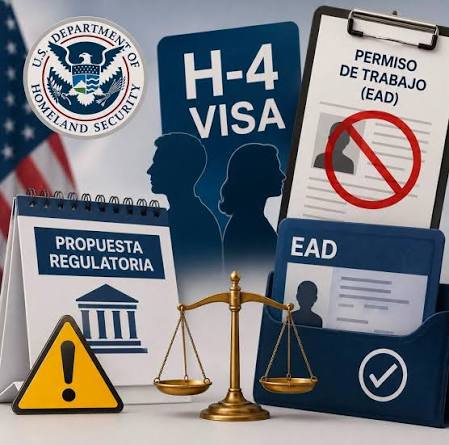
If you or your partner arrived in the United States betting on technological talent, advanced engineering, or scientific research under a temporary work visa, you know perfectly well that family balance hangs by an invisible thread. The truth is that, for years, the possibility for the spouse of an H-1B visa holder to obtain a work permit (EAD) through the H-4 visa represented a ray of hope to avoid absolute financial dependence and retain global talent in the country.
- The anatomy of the H-4 EAD program: How was this right won and who depends on it?
- 1. The historical context and the need to retain global talent
- 2. The legal offensive and the argument of the detractors
- Table: X-ray of the impact — The H-4 visa facing the threat of revocation
- Practical guide: How to protect your family stability and what steps to follow in the face of uncertainty?
- 1. The importance of advancing in the PERM and I-140 phases: Actively monitor the status of your residency (Green Card) process.
- 2. Prepare for any sudden interruption in employment: Financial diversification and a shielded emergency fund.
- 3. Where to get objective information and support the defense of the program: Specialized legal advice and participation in coalitions.
However, legal battles and shifts in direction within federal administrations have once again placed this benefit on the chopping block. The shadow of a regulatory annulment that would retroactively revoke work authorizations for thousands of spouses—mostly highly educated women—creates an unsustainable climate of uncertainty. How did this program originate, what arguments do its detractors make, and what are the real implications for the Hispanic community and the labor market? Let’s break it down thoroughly.

The pulse of visa changes (Snippet Bait): The imminent regulatory review and litigation pushed in federal courts threaten to revoke the work permit (EAD) for thousands of H-4 visa holders’ spouses, a measure that would instantly leave thousands of highly qualified professionals without legal employment. The potential annulment of the program seeks to eliminate a benefit implemented under executive criteria, unleashing a deep crisis in families that depend on a dual income to sustain the cost of living in the U.S.
The anatomy of the H-4 EAD program: How was this right won and who depends on it?
To understand the magnitude of the current crisis, it is necessary to remember that the work permit for H-4 spouses did not always exist; it was the result of a long struggle for economic equity and talent retention.
1. The historical context and the need to retain global talent
Until 2015, spouses of foreign professionals who entered the United States with H-1B visas (generally engineers, doctors, scientists, and programmers) were condemned to absolute professional isolation.
- The historical ban: Despite having advanced university degrees, master’s degrees, and years of experience in their home countries, H-4 workers’ partners were prohibited from opening a business, accepting a job, or generating their own income legally, creating deep financial dependence and personal frustration.
- The opening of the Obama era: Through an executive directive, the Department of Homeland Security (DHS) authorized the issuance of work permits (EAD) for those spouses whose partners were already in an advanced stage of the permanent residency process (waiting for the approval of their employment-based green cards). The truth is that this measure provided oxygen to thousands of households and allowed both spouses to contribute to the country’s economic growth.
2. The legal offensive and the argument of the detractors
Since its creation, the H-4 EAD program has been the favorite target of restrictive organizations and prolonged lawsuits.
- The argument of labor harm: The plaintiff groups argue that the work authorization for H-4 spouses floods the domestic market with additional foreign labor, supposedly affecting employment opportunities for U.S. citizens in the technology sectors.
- The industry’s response: Major chambers of commerce and tech giants argue exactly the opposite: in a hyper-competitive global market where specialists in STEM (Science, Technology, Engineering, and Mathematics) areas are lacking, eliminating the option to work for spouses is the equivalent of shooting oneself in the foot, forcing families to emigrate to countries like Canada or Europe.

Table: X-ray of the impact — The H-4 visa facing the threat of revocation
To visualize precisely what is at stake and how the current regulatory board is divided, we contrast the key aspects of the program:

| Program Variable | Current Scenario (With EAD Permit) | Revocation Scenario (Current Threat) |
| Spouse’s Employment Status | Right to work legally full-time in any sector or open a business. | Absolute prohibition from working, invalidation of Social Security numbers, and loss of jobs. |
| Family Economic Stability | Dual incomes essential to face the high cost of living and mortgages in the U.S. | Financial collapse of the household, dependence on a single salary, and possible decision to emigrate. |
| Corporate Competitiveness | Retention of qualified professional talent that prefers not to uproot their family. | Mass brain drain toward foreign economies that are more flexible and welcoming. |
Practical guide: How to protect your family stability and what steps to follow in the face of uncertainty?
Faced with such a volatile regulatory scenario, H-1B and H-4 visa holders must adopt a proactive and well-informed stance to shield their future. Follow these foolproof steps:
1. The importance of advancing in the PERM and I-140 phases: Actively monitor the status of your residency (Green Card) process.

The H-4 EAD work permit is intrinsically linked to the progress of the H-1B holder spouse’s permanent residency process (specifically to the approval of the I-140 petition). Ensure with your employer that the labor certification (PERM) stages advance without delays to shield the EAD’s eligibility against any administrative change.
2. Prepare for any sudden interruption in employment: Financial diversification and a shielded emergency fund.
Given the speed with which judicial rulings or executive regulatory changes can be issued, maintain a contingency fund in liquid accounts that allows you to sustain basic household expenses for several months in case a work permit is temporarily suspended during litigation.
3. Where to get objective information and support the defense of the program: Specialized legal advice and participation in coalitions.
Avoid panicking over unfounded rumors on social media. Stay in close contact with corporate immigration lawyers and non-profit organizations dedicated to the defense of qualified workers (such as Immigration Voice). To consult neutral legal updates, check the specialized reports at Associated Press.
The truth is that immigration policy in the United States continues to be a minefield of political interests where working families often pay the cost of uncertainty. For our Hispanic community and the ecosystem of foreign professionals, being prepared and organized is the only guarantee against regulatory changes.
Image: ElHispanoParaTodos/PRESS