
The end of “immunity” after the oath: What the DOJ isn’t openly telling you
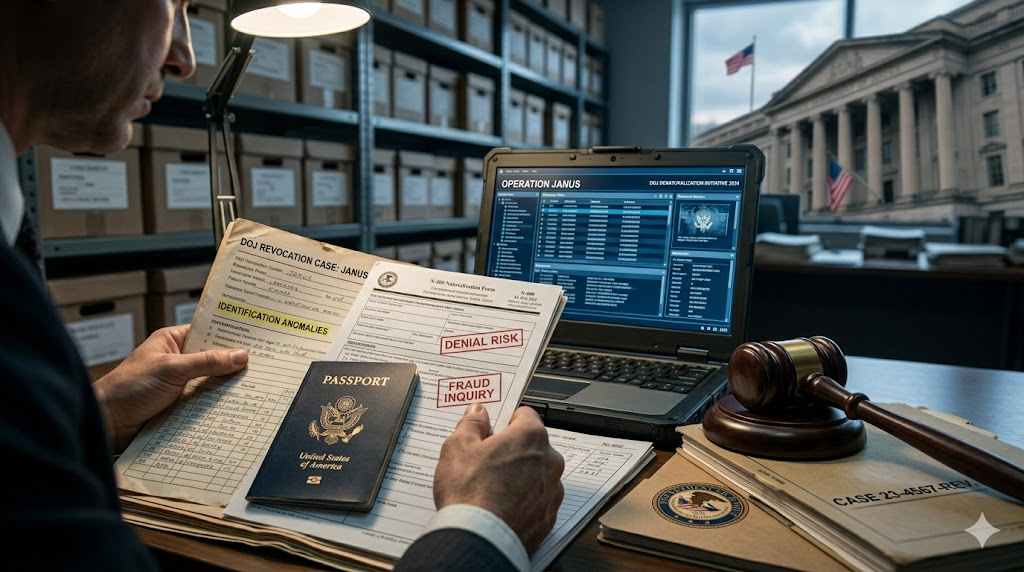
Many immigrants believe that once they’ve raised their right hand and recited the oath of allegiance, their path with USCIS is over for good. Big mistake. The reality is that the Department of Justice (DOJ) has launched a technical review mechanism designed to detect flaws in files that are years, even decades, old. This isn’t a random witch hunt, but a surgical use of data intelligence to identify material fraud.
- The end of “immunity” after the oath: What the DOJ isn’t openly telling you
- What is denaturalization, and why is the DOJ accelerating the process?
- The DOJ’s New Review Plan: Three Pillars
- Who is really in the crosshairs? (Risk Table)
- The Judicial Process: From Citizen to “Person of Interest”
- How to protect yourself: Preventive steps for the community
Critical fact: Denaturalization is not an administrative process decided by USCIS in an office; it is a complex civil or criminal judicial process that can result not only in the loss of the blue passport, but in immediate deportation.
What is denaturalization, and why is the DOJ accelerating the process?
In simple terms, denaturalization is the legal process to revoke U.S. citizenship from a person who naturalized. The Department of Justice is prioritizing cases where it suspects the individual obtained their status through intentional deception.

The straightforward answer is clear: The DOJ is using this plan to strengthen the integrity of the immigration system, focusing on individuals who concealed serious criminal records, affiliations with terrorist groups, or used false identities to enter the country (the infamous “crossed fingerprints” system). If your process was transparent, you have nothing to worry about, but if there were “strategic” omissions, the outlook changes.
The DOJ’s New Review Plan: Three Pillars
To understand why this is happening now, we must break down the strategy into three specific fronts affecting hundreds of people:
- Operation Janus and the digital trail: This program identified thousands of people whose fingerprints were linked to deportation orders under different identities but who later obtained citizenship. The DOJ is prioritizing the cleanup of these files.
- Multi-layer identity fraud: The use of false documents from countries of origin that are now, thanks to improved international cooperation, verifiable in seconds.
- National Security and Serious Crimes: Cases are being reopened for individuals who, after obtaining citizenship, have been linked to crimes committed before their naturalization that were never declared.
Who is really in the crosshairs? (Risk Table)
Not every mistake on an N-400 is grounds for losing citizenship. Here’s the breakdown:
| Type of Violation | Risk Level | Likely Consequence |
| Typographical error (dates, names) | Very Low | None or file correction. |
| Omission of minor arrest (no conviction) | Medium | Case audit, possible interview. |
| Use of false identity/alias | Critical | Denaturalization trial and deportation. |
| Ties to extremist groups | Extreme | Immediate revocation and criminal prosecution. |
| Prior marriage fraud | High | Revocation if proven to be illicit in origin. |
The Judicial Process: From Citizen to “Person of Interest”
Here’s where things get interesting… and stressful. Unlike a visa denial, denaturalization requires the government to file a lawsuit in a U.S. District Court. * The Notification: You will receive a formal complaint. You generally have 60 days to respond. If you ignore this, you lose by “default.”

- The Burden of Proof: The government carries a heavy burden. It must demonstrate with “clear, unequivocal, and convincing” evidence that the individual was not eligible for citizenship at the time it was granted.
- The “Illegality” Argument: If the DOJ proves you were not lawfully admitted as a Lawful Permanent Resident (LPR) due to prior fraud, technically you were never eligible for naturalization. It’s a devastating domino effect.
“Will the government really spend thousands of dollars on lawyers to strip someone of citizenship over a lie from 20 years ago? The short answer is: Yes, if that lie affects national security or the integrity of the system.”
How to protect yourself: Preventive steps for the community
If you feel there’s something in your past that could be interpreted as fraud, the worst strategy is to hide. Transparency (though it may sound contradictory) is your best defense.
- Audit your own file: Request a copy of your G-639 (FOIA) file to see what the government knows about you.
- Don’t travel if there’s an open investigation: Leaving the country with an ongoing denaturalization process can make it easier for authorities to permanently bar your reentry.
- Consult a “Crimmigration” attorney: Not just any visa attorney will do here; you need someone who understands federal litigation.
Image: ElHispanoParaTodos/PRESS