

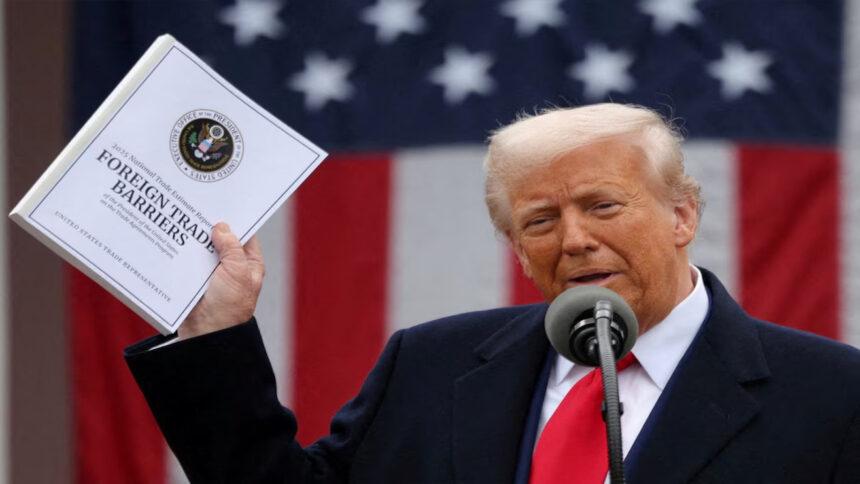
The five points that President of the United States, Donald Trump, signs an executive order establishing blanket tariffs on virtually all imports to his country, marking a turning point in the economic strategy of his administration.

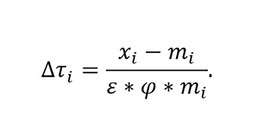
China, for example, had a trade surplus of $295 billion with the U.S. last year on total exports of $438 billion, a ratio of 68%. Divided by two according to Trump’s formula, this results in a tariff rate of 34%.
The new tariffs, which take effect on Saturday, cover more than 180 countries and constitute the largest tariff expansion applied by the White House in recent times.
During a ceremony, Trump described the measure as an “economic declaration of independence” and said it was a necessary step to revitalize the national manufacturing sector.
“We stand up for the American worker and finally put America first,” he said before signing the decree.

Below are the five key points defining the scope, goals, and consequences of this decision:
1. A 10% base tariff for all countries
The executive order establishes a 10% tariff on all imported goods, with no exceptions for country or type of product, and few exemptions. The measure is justified under the legal framework of the International Emergency Economic Powers Act of 1977, after Trump declared a national emergency in U.S. trade.
“We import practically all our computers, phones, televisions, and electronic devices. We used to dominate the sector, and now we import everything from different countries,” the president said, arguing that foreign dependence has weakened the country’s industrial capacity.

Trump also warned about the trade imbalance, which in his words affects national security. “Chronic trade deficits are no longer just an economic problem, but a national emergency that threatens our security and our way of life.”
The application of this tariff includes remote territories such as the Heard and McDonald Islands, Australian possessions in the subantarctic Indian Ocean, with no apparent commercial activity. The full scope of the measure covers 185 countries, with no distinction between strategic partners and peripheral economies.

2. Reciprocal tariffs for 60 countries with the highest trade barriers
In addition to the base tariff, the government announced additional reciprocal tariffs targeting about 60 countries identified as the most harmful to the U.S. trade balance. The logic, according to a White House official who spoke, is to impose rates equivalent to half of what these countries charge for U.S. products.
Among the most affected countries are several nations in Southeast Asia, with tariffs reaching 49% for Cambodia, 48% for Laos, and 46% for Vietnam. These are followed by China, with an additional 34% tariff, which adds to the existing 20%, raising the total to 54%; and the European Union, with a 20% tariff on its exports. India will face a new 26% tariff.
“For years, hardworking American citizens were left out while other nations grew rich and powerful, largely at our expense,” Trump declared. “But now it’s our turn to prosper,” he emphasized.
3. Exceptions for Russia, Cuba, North Korea, and Belarus
In a striking twist, four countries that do not maintain significant trade relations with the United States were exempted from the new tariffs: Russia, North Korea, Cuba, and Belarus.
According to the White House, these nations are already subject to prior international sanctions, so applying tariffs would be redundant. However, Trump again threatened Russia with new sanctions if it does not cease its military intervention in Ukraine.
The universal 10% tariffs will take effect at 12:01 a.m. on Saturday. The reciprocal tariffs, meanwhile, will begin to be applied on April 9.
Additionally, it was confirmed that this week the 25% tariffs on foreign cars and auto parts, previously announced, will take effect.
4. Mexico and Canada maintain exemptions under the USMCA
The most relevant exceptions in Trump’s tariff policy apply to partners in the United States-Mexico-Canada Agreement (USMCA).
Although both countries were subject to 25% tariffs last month, the White House confirmed that products complying with USMCA rules will be exempt from new tariffs.
The president justified the previous tariffs as retaliation for the flow of fentanyl and migration from Mexico, but agreed to exclude products covered by the regional trade agreement.
According to the official announcement, goods from Mexico and Canada that do not comply with the USMCA will remain subject to the 25% tariff, although a reduced rate of 10% will apply to products such as potash and certain energy inputs, key for agricultural production.
5. Concern and warnings of global retaliation
The announcement immediately raised concerns among economists, who warned of potential negative effects on consumption, investment, and economic stability.
“These are really high tariffs, and if fully implemented, I think they will sink the economy,” warned Mark Zandi.
“If we take those numbers at face value, I just don’t see how the economy can digest them. I think that would be the recipe for a recession,” he added.
Zandi also noted that the impact will depend on whether Trump grants exemptions or implements compensatory measures, such as subsidies for affected farmers or businesses.
Additionally, a response is expected from the U.S.’s main trading partners. The president of the European Commission, Ursula von der Leyen, was clear before the European Parliament: “Europe has many cards to play, from trade to technology and the size of our market. But this strength is also based on our willingness to take firm countermeasures if necessary.”
Regarding this, U.S. Treasury Secretary Scott Bessent warned of the risk of a trade escalation: “My advice to all countries right now is not to retaliate. Relax. Take it in. Let’s see how this evolves. Because if you retaliate, there will be an escalation. If you don’t retaliate, this is the peak,” he emphasized.
Image: Infobae





