

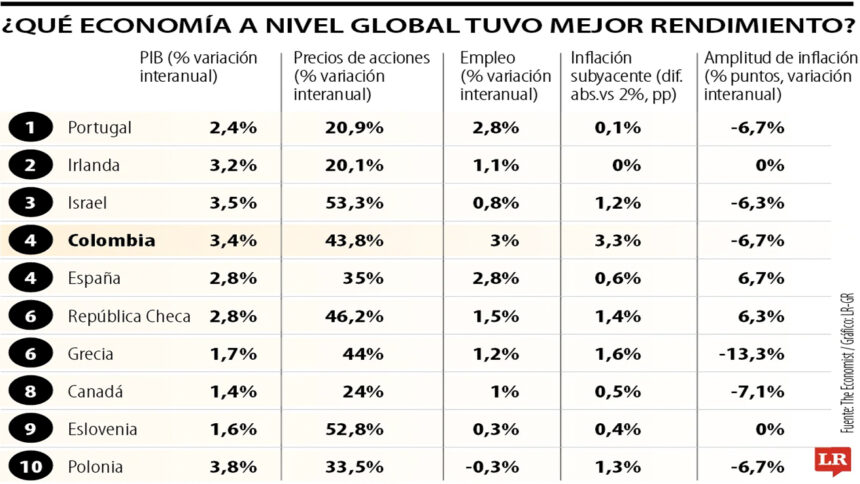
The Economist compiled a ranking of the best-performing economies using data available through the third quarter of 2025.
- The Economist noted that, after a year marked by tariffs, wars, and recession fears, one might expect the global economic outlook to be far worse.
- Among the emerging economies evaluated, Colombia stands out for its dynamism and strong stock market performance.
- The ranking’s first criterion is core inflation, which excludes food and energy, and assesses how close each country is to the 2% target.
- The breadth of inflation—how many items in the index rise more than 2%—confirms these trends.
December isn’t just the month of joy, food, and celebration—it’s also the perfect time to take stock and assess the performance of both companies and countries. This time, The Economist ranked the top-performing economies using data through the third quarter of 2025.

For this analysis, they considered data on inflation, inflation breadth, GDP growth, labor market performance, and stock market trends. Each country was scored based on its performance in these indicators, allowing for the creation of a consolidated 2025 index.
The Economist noted that, after a year marked by tariffs, wars, and recession fears, one might expect the global economic outlook to be far worse.
However, global GDP is set to grow by nearly 3% this year, virtually the same pace as last year. Unemployment remains low in most developed countries, and stock markets have closed another cycle with positive results. The exception—and the biggest concern—continues to be inflation, which remains above the 2% target set by most OECD central banks.
In this edition, The Economist once again highlights Southern European countries. After Spain’s victory the previous year, Portugal now leads the list thanks to a combination of solid growth, moderate inflation, and an expanding stock market. Greece, the winner in 2022 and 2023, and Spain also rank among the top performers. Israel maintains its recovery following the 2023 turmoil, and Ireland came just shy of first place.


Among the emerging economies evaluated, Colombia stands out for its dynamism and strong stock market performance.
In fact, it ranks fourth globally, tied with Spain, thanks to a favorable balance between growth and market momentum. Over the past year, the country recorded 3.4% GDP growth, one of the highest in the ranking, and its stock prices surged by 43.8%, reflecting strong investor optimism. While it still faces high inflation, these indicators solidify its position as one of the most dynamic economies in the group.
At the other end of the ranking, Northern European economies dominate the bottom. Estonia, Finland, and Slovakia occupy the lowest positions, while Germany shows slight improvement but remains behind due to labor market weakness. The UK’s performance has also been modest, while France surprises with a strong score despite political instability. The U.S. appears in the middle of the table, weighed down by persistently high inflation that offsets its labor market strength.

The ranking’s first criterion is core inflation, which excludes food and energy, and assesses how close each country is to the 2% target.
Turkey ranks worst, with inflation soaring due to President Recep Tayyip Erdogan’s economic policies. Estonia follows, with core inflation near 7%. The UK has reduced its core inflation compared to last year, though 4% remains too high for the Bank of England.
Some countries face the opposite issue. Sweden, for example, has virtually no core price increases—a situation that, while appealing to consumers, raises deflation concerns among economists. Finland, Switzerland, and Japan also show weak figures, though Japan remains far from the overheating seen in other nations.
The breadth of inflation—how many items in the index rise more than 2%—confirms these trends.
In the U.S., the proportion of goods with price increases above 2% has climbed, possibly due to expansionary fiscal policies. In Australia, over 85% of the basket shows increases above that threshold.
When analyzing growth and employment—two key indicators for voters—Portugal again stands out. The country has attracted a growing influx of tourists and wealthy foreign residents, boosting its economic activity well above the European average. The Czech Republic also shows notable progress in production and job creation. South Korea, however, has lost jobs, and Norway has suffered from the global trade slowdown due to its exposure to commodities and maritime shipping.
Ireland’s case is striking, as its GDP grew by over 12% year-over-year in the third quarter—a figure as impressive as it is misleading, due to the statistical impact of multinational corporations. For this reason, an alternative metric—“modified total domestic demand”—developed by Ireland’s statistics office is used, offering a more realistic view. The ranking adopts this same methodology.
The analysis concludes with stock market performance. While one might assume Wall Street would lead gains, U.S. stocks have delivered only average results, reflecting the momentum built up in previous years. France also doesn’t stand out, with its giant LVMH posting a flat year. Denmark, meanwhile, has been the biggest loser after Novo Nordisk’s stock plunged 60%, ceding ground in the competitive weight-loss drug market.
Image: LR





