
Driving in Florida might feel like an extreme sport, but what many don’t realize is that police aren’t just watching your speed. Your license plate is your vehicle’s “ID,” and in the Sunshine State, the laws about how that piece of metal should look are stricter than you might think. If you believe buying a clear cover on Amazon keeps you safe from a Florida Highway Patrol (FHP) stop, you could be making a $160—or more—mistake.
Direct Answer (Snippet Bait): In Florida, it is illegal to cover your license plate with any material, whether clear, tinted, or smoked, according to Florida Statute 316.605. Additionally, the law requires the license plate to be fully visible, free of obstructions (including bike racks or frames that cover the word “Florida” or the renewal sticker) and illuminated by a white light at night. Any alteration that hinders manual or electronic reading is grounds for a citation.
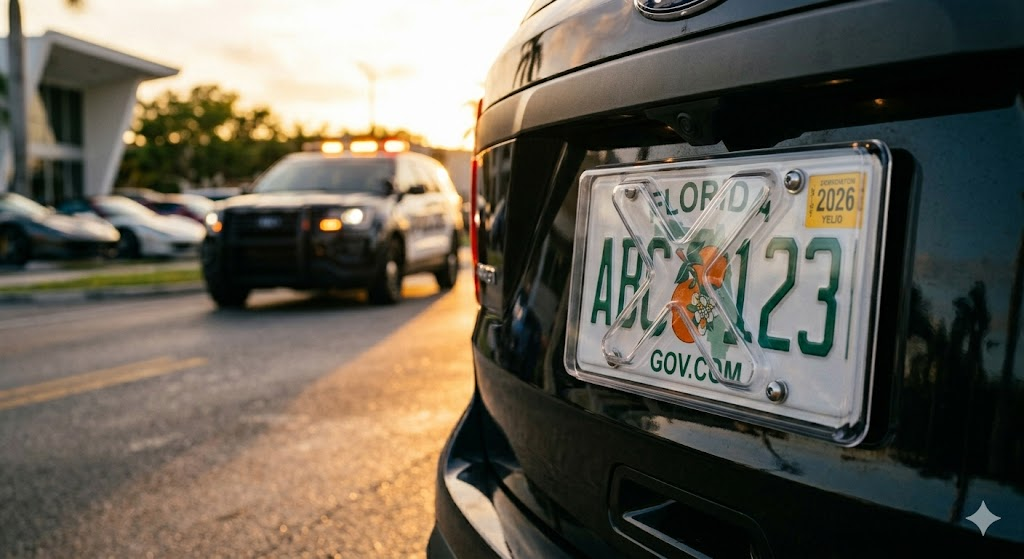
The Legal Anatomy of a License Plate in the Sunshine State
It’s not just about putting it on and forgetting it. The Florida Department of Highway Safety and Motor Vehicles (FLHSMV) has specific standards that, if ignored, are considered “defective equipment” or “registration violations.”

The Total Visibility Rule
The law is clear: the license plate must be legible from a distance of 100 feet. This includes:
- Letters and Numbers: Must be clean. Wear and tear from Florida’s sun is real; if your plate is faded, it’s your responsibility to request a replacement.
- The State Name: You cannot cover the word “Florida” at the top. Many dealership frames make this mistake.
- The Validation Sticker: That small box with the expiration month and year must be in the upper right corner and perfectly visible.
Why Police Hate Plastic Covers
Here’s the interesting part… Does it really matter if the plastic is 100% clear? According to the law, yes. Many of these covers have a coating that causes a “glare” when toll cameras (SunPass) or red-light cameras try to take a photo. The moment an officer sees an unusual shine on your plate, they have a legal reason to pull you over. (Yes, even if you just want to protect it from bugs.)
Violation and Estimated Cost Table (2026)
| Type of Violation | Severity | Estimated Fine Cost | Point Impact |
| Obscured Plate (Cover/Tint) | Non-Moving | $110 – $165 | 0 (Typically) |
| Expired Sticker (< 6 months) | Non-Moving | $120+ | 0 |
| Expired Sticker (> 6 months) | Criminal (Second Degree) | Arrest / Court | Varies |
| Missing Plate Light | Non-Moving | $90 – $115 | 0 |
| Plate on Windshield | Non-Moving | $115+ | 0 |
(Note: Costs may vary by county: Miami-Dade, Broward, and Palm Beach often have additional administrative fees.)
The Danger of Personalized Plates and Decorative Frames
We all like our cars to have personality. Florida offers more than 120 specialty plate designs (from “Save the Manatee” to sports teams). However, the problem arises with external accessories.

The Dealership Frame Mistake
Look at your car right now. Does the frame the dealer gave you when you bought the car cover the phrase “Sunshine State” or “In God We Trust”? If the answer is yes, you’re technically breaking the law. While many officers are lenient, if you’re pulled over for another reason, this becomes the perfect “added fine” to ruin your day.
Plates in the Wrong Place
Have you seen those sports cars with the plate on the dashboard, behind the windshield? In Florida, that’s an open invitation to get pulled over. The plate must be firmly attached to the rear of the vehicle in the space designated by the manufacturer. Temporary magnets or leaving it loose in the rear window are not allowed.
Renewal and Replacement: Avoid the “Misdemeanor”
Many people think driving with an expired sticker is just a “small fine.” The reality is harsher.

- Less than 6 months: Considered a non-criminal traffic violation. You pay and that’s it.
- More than 6 months: Things get ugly here. It’s considered a second-degree misdemeanor. This means you could end up with a criminal record for something as simple as forgetting a paperwork task.
When to Replace the Physical Plate?
In Florida, metal plates must be replaced every 10 years. The state will automatically send you a new one when you renew in the tenth year, as the reflective material loses effectiveness over time. If your plate is damaged before then (crashes, corrosion), you must go to your county’s Tax Collector to request a new one for a fraction of the cost of an original plate.
Myths vs. Realities (What You Hear on the Street)
- Myth: “If I have a bike rack, they can’t fine me if it covers the plate.”
- Reality: False. You’re responsible for keeping the plate visible. If the bikes cover it, you must move the plate to a visible position or risk a fine.
- Myth: “Front plates are mandatory in Florida.”
- Reality: Florida is a single-plate state. Only the rear plate is mandatory (unless you’re a heavy commercial truck).
- Myth: “I can paint the numbers on my plate if they’re fading.”
- Reality: Absolutely not. Altering an official plate is a crime. If it’s unreadable, request a legal replacement.
Image: ElHispanoParaTodos/PRESS