Florida’s law on license plates is very strict, and the use of frames is one of the most common violations. Learn what is LEGAL and what is NOT LEGAL to use on your vehicle.
The Florida Department of Highway Safety and Motor Vehicles (FLHSMV) issued a clarification on December 15, 2025, regarding the enforcement of the new law regulating the use of frames and covers for license plates.

The regulation, in effect since October 1, affects drivers and dealerships and redefines which accessories are permitted to ensure full visibility and identification of vehicles registered in the state.
The legal reform is part of a state effort to strengthen vehicle identification and combat behaviors that facilitate evasion or crimes.
The tightening of the regulation transforms behaviors previously considered administrative offenses into criminal offenses, as highlighted on the FLHSMV’s own website, by updating the penalty framework applicable since October 2025.
Florida’s law on license plates is very strict, and the use of frames (license plate holders) is one of the most common violations.

The legislation, particularly Section 320.061 of the Florida Statutes, and recent reforms (such as HB 253, which took effect in October 2025) make penalties for obstruction much more severe.
The fundamental principle is simple: All essential information on the license plate must be 100% visible, legible, and unobstructed.
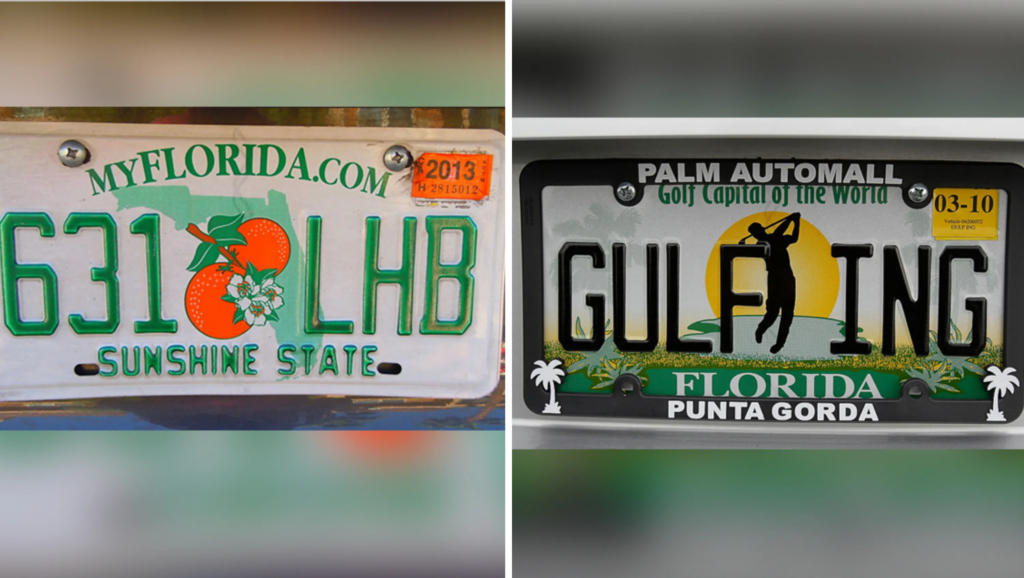
What does Florida’s 2025 license plate frame law specifically require?
HB 253, which amends Section 320.061 of the Florida Statutes, explicitly establishes restrictions for any accessory, frame, cover, or device installed on state license plates.

The FLHSMV emphasizes that the goal is to ensure that at no time are the alphanumeric number and letters, the validation sticker, and the state inscription covered. These requirements apply to all vehicles, regardless of the plate’s year or the type of car.
The legal text, quoted in full on the official website, specifies that:
- Frames installed by the manufacturer or dealership will only be legitimate if they do not cover essential data.
- Aftermarket accessories are subject to the same visibility requirement.
- The prohibition extends to plastic covers, films, vinyls, sprays, and any system that changes the color or appearance of the plate.
Below is a guide to help you identify when a frame is legal and when it could result in fines or even jail time:

A frame is legal and permitted ONLY IF it meets the following condition:
-Full Visibility: The frame is thin and does not cover any part of the printed information on the plate.
–Example of a Legal Frame: A simple frame that borders the outline of the plate, leaving visible the word “Florida,” the plate number/letters, and the validation sticker.
ILLEGAL: Covers, Sprays, and Electronic Devices
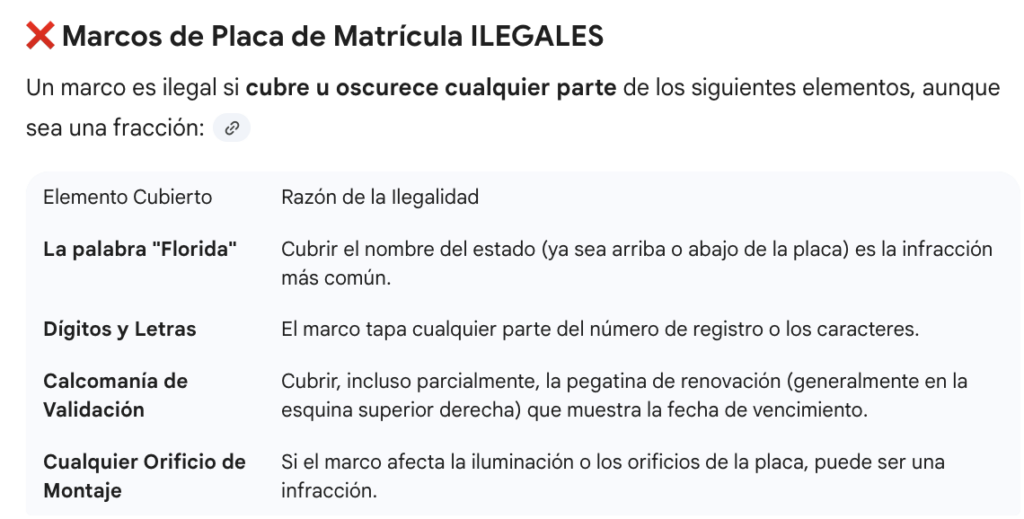
Beyond frames, there are other accessories that are strictly prohibited:
- Plastic/Smoked/Tinted Covers: Any transparent, plastic, smoked, polarized, or tinted cover that alters the color or appearance of the plate or makes it difficult to read (especially by toll or police cameras) is illegal.
- Sprays and Films: Applying any film, vinyl, or spray that reduces the plate’s reflectivity or is designed to obscure it.
- Obstruction Devices: The use of any electronic or retractable device designed to hide, darken, or alter the visibility of the plate is a serious criminal offense.

Authorities’ Recommendation
Since many frames, even those provided by dealerships, may cover parts of the plate, the recommendation from the Florida Highway Patrol (FHP) and local police departments is simple:
Remove the plate frame to avoid any issues.
If there is no frame, there is no risk of covering essential information.