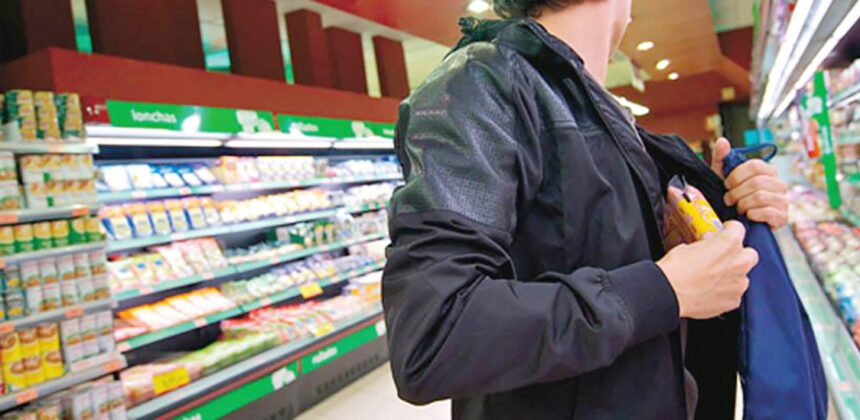
Thousands of dollars vanish from South Florida stores in seconds. Learn how theft rings operate, why you’re footing the bill, and the new state unit hunting them down.
- The Anatomy of a “Smash and Grab” (Express Looting)
- The Domino Effect: Guess Who Pays the Bill?
- The Counterattack: The Birth of “FORCE” and the Zero-Tolerance Law
- 1. The FORCE Network (Florida Organized Retail Crime Exchange)
- 2. HB 549 (Signed by Governor DeSantis)
- Protecting Your Own Business in South Florida
The impact of organized retail theft in Florida: You walk into a pharmacy in Miami, Broward, or Port St. Lucie to buy something as basic as deodorant or allergy pills, only to be met with a wall of acrylic glass. You have to press a red button and wait for an underpaid, stressed employee to come with a master key to hand over your product.

The truth is, this isn’t a logistical error. It’s the direct consequence of a silent war being waged in the aisles of our stores.
In recent years, South Florida has become the stage for a phenomenon as swift as it is destructive: mobs of criminals storming a store, clearing entire shelves in seconds, and fleeing before the security guard can even blink. But patience has run out.
What you need to know right now:
Organized retail crime (ORC) isn’t just a teenager shoplifting. These are coordinated rings stealing thousands of dollars in merchandise to resell it online. To stop this, Florida enacted HB 549 (which turns these group thefts into felonies with prison sentences of up to 5 years or more) and launched FORCE (Florida Organized Retail Crime Exchange), a state unit and database where police and retailers share real-time information to track these gangs.

Here’s the interesting part… How do they empty a store in 40 seconds, and why did Florida’s government have to step in with a heavy hand? Let’s get to the point.
The Anatomy of a “Smash and Grab” (Express Looting)
Forget the image of a thief hiding a bottle of liquor under their coat. Modern organized retail theft operates with the precision of a logistics corporation—only in the black market.
These gangs study store layouts, calculate 911 response times, and know exactly which products have the highest resale value. They enter in groups of five, ten, or even twenty people. While some distract employees or block exits, others sweep up high-end cosmetics, power tools, over-the-counter medications, and baby products.

The Role of the “Digital Black Market”
(And yes, this is where technology works against us.) What’s stolen today from a store in Hialeah or West Palm Beach is on sale tomorrow at half price on Facebook Marketplace, eBay, or private WhatsApp groups.
- The “Boosters” (Collectors): These are the ones who carry out the physical theft. They often receive a fixed payment for each garbage bag full of merchandise they manage to take out.
- The “Fences” (Distributors): These are the masterminds of the operation. They buy the stolen goods from the boosters for pennies on the dollar and resell them to the general public, sometimes even to small convenience stores that don’t ask too many questions.
The Domino Effect: Guess Who Pays the Bill?
If you think this only affects millionaire executives of big chains, think again. The impact of these thefts hits the wallets of Florida’s working-class Hispanic community directly.
“When a store loses $100,000 in inventory to organized theft, they don’t absorb the loss. They simply raise the price of eggs, milk, and medicine for the rest of us who do pay.”
Organized theft acts like a hidden inflation tax. According to retail industry data, these losses force overall price increases to offset shrinking profit margins. But the problem doesn’t end at the cash register:
- Retail Deserts: National chains have begun closing entire branches in neighborhoods they deem “unviable” due to high theft rates. When the local pharmacy shuts down, seniors and those without transportation lose access to their medications.
- Hostile Environment: Locked display cases, facial recognition cameras, and armed guards make the shopping experience feel like a visit to a prison.
- Risk of Violence: These gangs don’t hesitate to use pepper spray, knives, or firearms if an employee or customer tries to stop them.
The Counterattack: The Birth of “FORCE” and the Zero-Tolerance Law
Florida decided it wouldn’t allow its commercial streets to descend into the chaos seen in viral videos from other states. The response was aggressive and two-pronged: one technological, the other penal.
1. The FORCE Network (Florida Organized Retail Crime Exchange)
Spearheaded by Attorney General Ashley Moody and the Florida Retail Federation, FORCE is essentially a centralized intelligence database.
Before, if a gang robbed a Target in Miami and then a CVS in Fort Lauderdale, local police departments didn’t connect the dots. Now, through the FORCE app, retailers and law enforcement share photos, surveillance videos, vehicle license plates, and suspect profiles in real time. It’s a digital “death squad” against systematic theft.
2. HB 549 (Signed by Governor DeSantis)
Florida’s legislation changed the game. What was once a misdemeanor resolved with a slap on the wrist now guarantees time behind bars.
Zero-Tolerance Table (Before and After):
| Type of Crime / Action | Previous Law (General) | New HB 549 Law (Florida) |
| Group Theft (5 or more people) | Misdemeanor (if value didn’t exceed a certain threshold) | Third-Degree Felony (Up to 5 years in prison). |
| Organizing Looting on Social Media | Difficult to prosecute specifically | Second-Degree Felony (Severe penalties for incitement). |
| Theft with a Firearm or Multiple Offenses | Standard Felony | First-Degree Felony (Maximum penalties). |
| Porch Piracy (Package Theft) | Misdemeanor for low-value items | Lower thresholds for Felony charges. |
(This means if you use TikTok or WhatsApp to rally a mob to loot a store at the Dolphin Mall, state police will pursue felony charges against you, even if you didn’t steal anything personally.)
Protecting Your Own Business in South Florida
If you own a bodega, a minimarket, or a clothing store in our community, you’re not exempt from this danger. Large gangs target national chains, but copycat criminals often look for easier targets.
- Invest in high-resolution cameras at face level: Ceiling cameras only capture hats and hoods. Place a camera at eye level by the entrance.
- Redesign your store layout: Don’t place the most expensive items near the exit. Force thieves to walk through the entire store to reach the loot, giving you time to react.
- Join the network: If you have a registered business, learn how your company can interact with local authorities and the Florida Retail Federation’s information system.
The fight against mass looting in South Florida is just beginning. But with these new tools, the message is clear: the Sunshine State is no longer a discount paradise for retail crime rings.
Image: LaOpinion.com