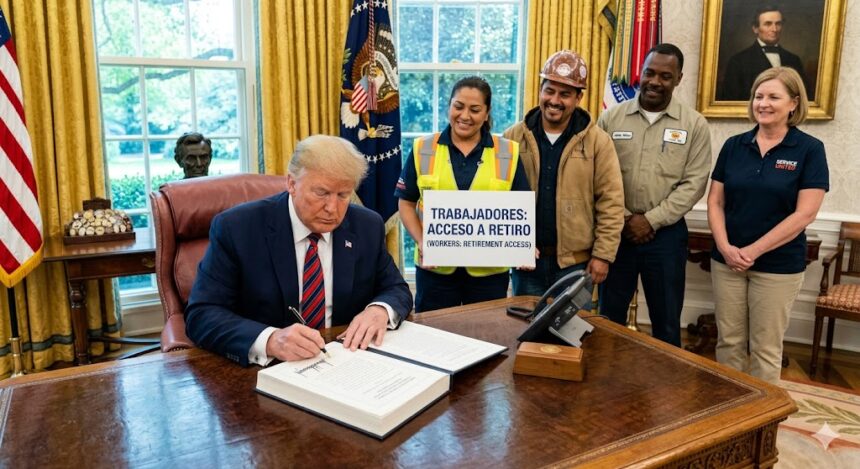
Reaching retirement age in the United States without a financial cushion isn’t just a fear—it’s a silent crisis hitting Hispanic families hard. As the cost of living rises and Social Security’s long-term stability comes into question, President Trump’s recent executive order seeks to change the rules of the game. It’s not just about “saving more” but creating a structure where the federal government steps in to facilitate and boost workers’ savings, especially for those who currently lack a 401(k) through their jobs.
Direct Answer (Snippet): The new executive order aims to democratize access to retirement savings by creating or expanding accounts where the federal government can incentivize contributions. The main goal is for independent workers, employees of small businesses, and low-income sectors to receive tax credits or direct contributions that multiply their personal savings, reducing sole reliance on Social Security.
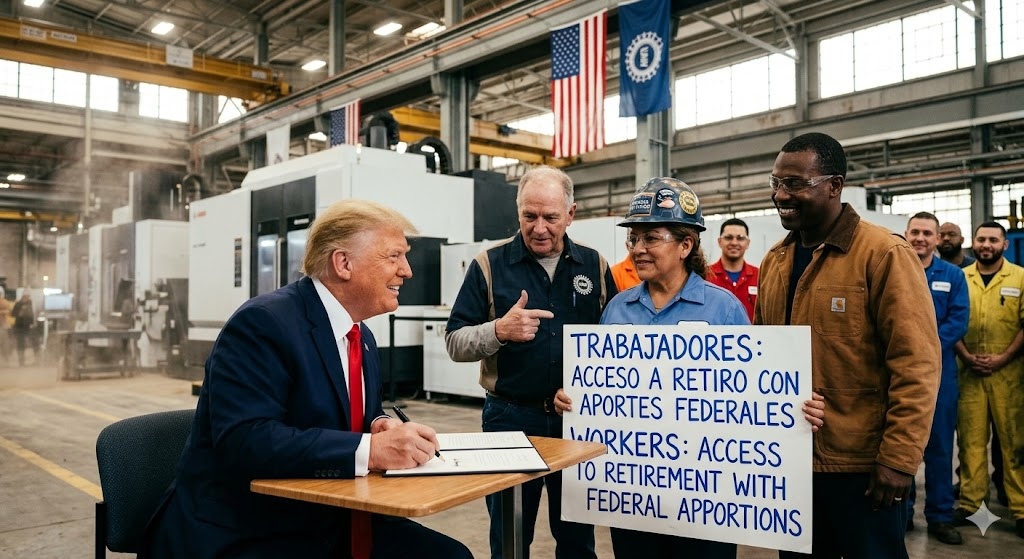
Ending the “Savings Gap”: Why This Order Changes the Landscape
Historically, the U.S. retirement system has favored those working for large corporations. If you work in construction, are a freelancer, or run a small family business, options are often limited and costly.

This measure isn’t just a bureaucratic tweak. It’s a shift toward portability and incentives. The core idea is that workers won’t lose benefits when changing jobs, and for the first time, the government will act as a “partner” in growing that capital.
How Do the Proposed Federal Contributions Work?
This is where things get interesting. The government won’t just hand you a check each month to stash under your mattress. The mechanism is built on three pillars:
- Refundable Tax Credits: Instead of a deduction (which only helps if you earn a lot), the goal is a credit deposited directly into your retirement account.
- Simplification of Multiple Employer Plans (MEPs): Allows several small businesses to join forces to offer a robust retirement plan, lowering administrative costs that were previously prohibitive.
- The Federal “Match”: A system similar to what public employees have is being studied, where for every dollar you save, the government could contribute a percentage up to a set limit.
Comparison Table: Current System vs. New Proposed Model
| Feature | Traditional System (IRA/401k) | New Model (Executive Order) |
| Access | Limited to large companies or individual savings. | Universal (Focus on SMEs and contractors). |
| Federal Contribution | Nonexistent (Only tax deferral). | Possible direct credits or shared contributions. |
| Portability | Complex (Requires constant “Rollovers”). | Designed to follow the worker, not the job. |
| Management Cost | High for small business owners. | Reduced through federal collective funds. |
Who Really Benefits from This Measure?
Let’s be clear: This order isn’t designed for Wall Street but for Main Street. The Hispanic community, with its high rate of entrepreneurship and small business participation, is at the “ground zero” of these benefits.
1. Independent Workers (Gig Economy)
If you drive for Uber, work as a graphic designer, or have a service contract, retirement often feels like a pipe dream. The order aims to let these workers open accounts as easily as a Google employee, receiving tax incentives previously out of reach.

2. Small Business Owners
Offering a retirement plan used to be a legal and financial headache. With the expansion of multiple employer plans, the owner of a corner store or auto repair shop can offer competitive benefits to retain employees without going broke.
3. Low- and Middle-Income Families
The uncomfortable truth is that if you live paycheck to paycheck, saving is nearly impossible. But what if the government matches $0.50 for every $1.00 you manage to set aside? That’s the psychology of incentives the White House aims to activate.
Analysis Note: “Will it really work? The theory is solid, but execution depends on how quickly the Treasury and Labor Departments issue final regulations. Don’t expect money in your account tomorrow, but start asking your tax preparer about ‘Expanded Retirement Savings Accounts.'”
Critical Steps to Prepare for These Changes
Though the order is signed, the rollout will be gradual. Here’s what you should be doing right now:

- Review your current status: Do you have an IRA (Individual Retirement Account)? If not, it’s time to open a basic one. The order’s infrastructure will build on existing accounts.
- Check the Saver’s Credit: This credit already exists, but the order seeks to expand it. Make sure your tax preparer claims it if you qualify based on income.
- Don’t get scammed: With news like this, scammers always emerge offering “government retirement support.” Remember: The government will never ask for money over the phone to “activate” a federal benefit.
- Stay informed locally: Florida, for example, has its own discussions about state savings. The federal plan will complement what you already have.
The Impact on Social Security: A Necessary Truth
Many wonder: “Does this mean they’re cutting Social Security?” The short answer is no. However, the implicit message is that Social Security alone is no longer enough to maintain a dignified lifestyle. These retirement accounts with federal contributions are designed to be the second engine of your economy in old age. Relying solely on the government to take care of you at 70 is a risk you shouldn’t take anymore.
Image: ElHispanoParaTodos/PRESS