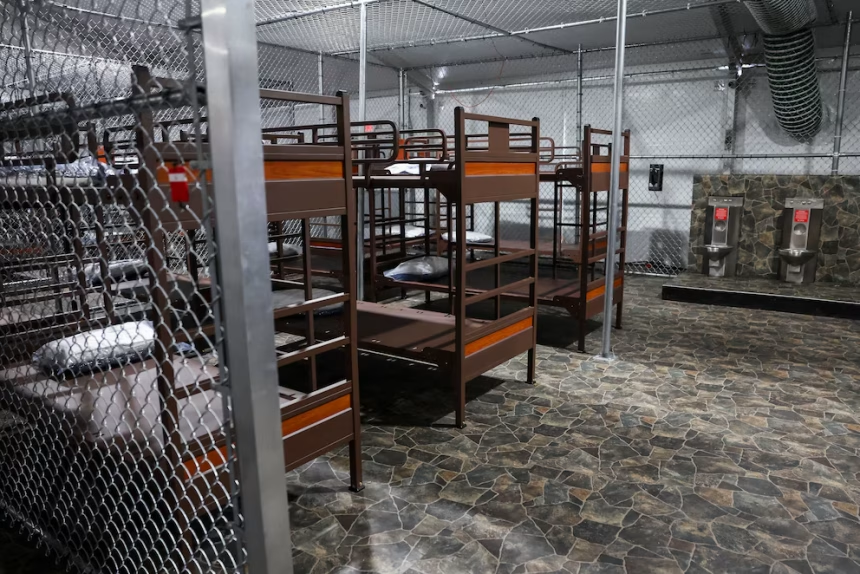
Carlos Martín González, a 26-year-old Mexican national with a tourist visa, remains detained in Florida. The young man was unexpectedly arrested on July 7 after a traffic stop in which the vehicle he was traveling in lacked valid registration, and since then his life has been marked by brief calls and the absolute impossibility of receiving visits or direct legal counsel.
While the incident that led to González’s arrest was a minor traffic violation, authorities immediately issued an “immigration hold”, placing González in federal immigration custody. After the operation, he was transferred to the detention center known as Alligator Alcatraz, located in a hard-to-access area in the heart of the state’s swamplands.

Since that day, González has been incommunicado, unable to receive visits from family or lawyers, nor has he been able to directly contact Mexican consular authorities.

Arrested in Florida and Transferred to the State’s Most Feared Detention Center
Additionally, the young man has only been able to make prepaid calls lasting no more than five minutes. His family, powerless in the situation, traveled from Mexico seeking answers and any possibility of in-person contact.
Not even Carlos’s father, who traveled specifically to Florida, managed to see him in person. They explain that the main barrier lies in the delay by immigration authorities in assigning a case number to the detainee.
“The problem is that until he is assigned an immigration case number, no one can legally intervene in his defense,” his relatives stated.

The Mexican consulate in Orlando is attempting to mediate, but efforts are moving very slowly because the formal file has yet to be completed. As a result, not even the consul has been able to effectively represent him in administrative or judicial proceedings.
“We don’t understand why they’re treating him like an undocumented migrant. He has a valid visa and entered legally. Why lock him up in a place like that?” Carlos’s father complained to the U.S. media, expressing his frustration and bewilderment.
U.S. authorities have not issued public comments on González’s case, nor have they provided information clarifying the reasons for his prolonged detention beyond the initial report related to the traffic violation.

“The problem is that until he is assigned an immigration case number, no one can legally intervene in his defense,” a family representative told Univision.
Where Is Alligator Alcatraz, and What Makes It So Formidable
In Carlos’s specific case, the fact that his file has not been formalized means his right to a defense—and even to receive Mexican consular assistance—remains on hold until the case number is registered in the federal database.
The family’s account insists on the absolute legality of Carlos’s stay in U.S. territory. He has no criminal record or reports that would justify his confinement in a high-security detention center for immigrants. In the eyes of his family, the detention is solely due to the automatic application of immigration protocols following a civil traffic violation. “His presence in the United States is completely legal,” his relatives repeatedly emphasized to the media.
“Alligator Alcatraz,” the facility where González is being held, is located at the former Dade-Collier Training and Transition Airport, west of Miami, between Miami-Dade and Collier counties.
Thousands of American alligators and snakes live in the area surrounding the facility, along with other species such as birds, jaguars, and manatees.
James Uthmeier, Florida’s attorney general, stated that its location “represents an efficient and low-cost opportunity,” since, in the event of an escape, “they won’t find much more than alligators and pythons.”
Image: Infobae