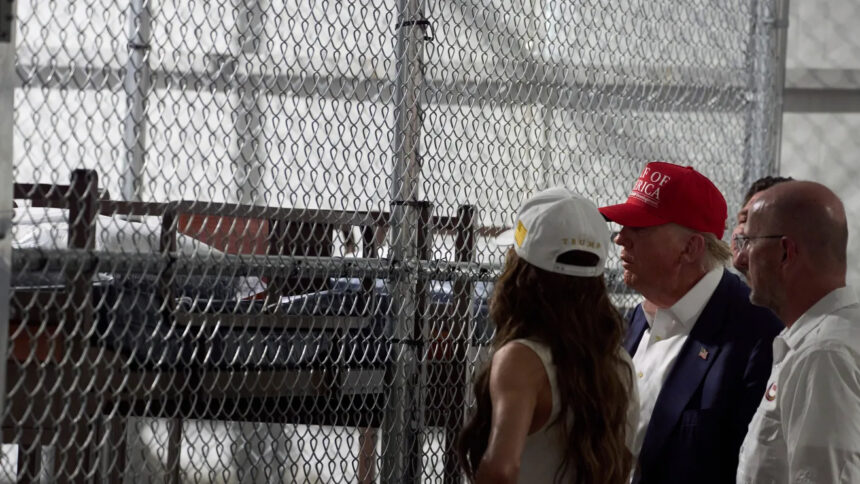
Last Tuesday, the Donald Trump administration opened Alligator Alcatraz in Florida, a detention center where undocumented immigrants will be surrounded by alligators measuring up to 13 feet.
“We’re going to teach them how to flee from an alligator if they escape from the prison. Don’t run in a straight line—run like this (while making zigzag motions). And you know what? Their chances go up by about 1%,” Trump joked before inaugurating the new detention center.

On Wednesday night, Alligator Alcatraz began receiving its first immigrants, amid complaints and criticism over the inhumane conditions in which these undocumented individuals will be held.
The first group of immigrants has arrived at the new detention center, located in Florida’s Everglades. Officials stated that they will later be sent back to their countries of origin, though they did not provide details on the number of detainees.
The facility, built on an airport used for training, will have an initial capacity of about 3,000 detainees. The center was constructed in 8 days and features over 200 security cameras, more than 28,000 feet of barbed wire, and 400 security personnel.

How detainees will be distributed
The Alligator Alcatraz regulations state that “minors must be separated from unrelated adults at all times during transport and seated in an area near officers under close supervision.”

Additionally, it specifies that minors, pregnant women, and detainees with medical conditions will be provided snacks and water as needed while being transferred to Alligator Alcatraz.
The center, which will have the capacity to hold around 3,000 detainees, experienced flooding last Tuesday, raising new concerns about the impact of climate conditions on immigrant safety.
According to information provided by local authorities, immigrants may be held at the facility for days, weeks, or even months and will have access to medical care, air conditioning, recreational areas, and clergy support.

Images shared on social media show large puddles on the ground inside some of the detention center’s tents, the result of heavy rains that hit the area a day before its opening.
Another concern among activists and human rights advocates is whether the detained population will have access to attorneys, be able to see their families, or if a third party will oversee their treatment.
Florida Attorney General James Uthmeier has promoted an ‘Alligator Alcatraz’ merchandise website on social media, selling T-shirts, caps, mugs, stickers, and even golf balls featuring the detention center’s name and images of an alligator and a python.
Image: Opinion