What Do Glades’ Walls Hide? Justice Demands Answers.
Let’s be honest: This judicial blow comes as no surprise—the trust in the immigration system has been broken for a long time.
- What Do Glades’ Walls Hide? Justice Demands Answers.
- The Verdict: Shedding Light on the Shadows
- Why Do They Call It ‘Alligator Alcatraz’? The Painful Context
- The Battle for the Files: What Justice Seeks
- Reality Check: What They Claim vs. What They Fear
- The Human Impact: Beyond the Paperwork
- The Future of Detention in Florida
But every now and then, a small victory feels enormous. Imagine a place so isolated, surrounded by swamps, where Florida’s humid heat mixes with the desperation of hundreds of detained immigrants. That place exists. They call it “Alligator Alcatraz.” And for years, what happened behind those walls stayed behind those walls.

Until today.
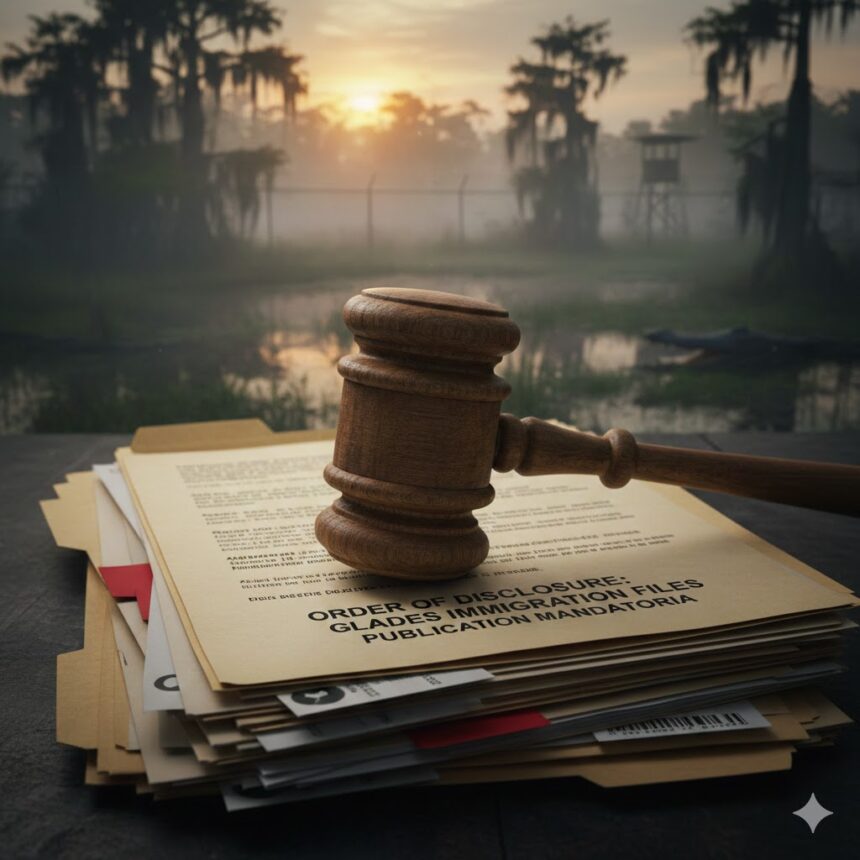
A federal judge has slammed his gavel—a decision that has echoed from Tallahassee to Washington, D.C.: Florida must release the files. Secrecy is over. If you have family in detention or simply care about humane treatment, you need to read this carefully.

The Verdict: Shedding Light on the Shadows
A federal judge has ruled that the government and operators of the Glades County Detention Center (infamously known as “Alligator Alcatraz”) can no longer hide key information about living conditions, medical treatment, and security protocols inside the facility.
This court order mandates the release of thousands of documents that activists and human rights organizations have demanded under the Freedom of Information Act (FOIA). This is not a suggestion—it’s a legal mandate to open the “black box” of immigration detention in Florida.

Why Do They Call It ‘Alligator Alcatraz’? The Painful Context
You’ve probably heard the name, but do you really know why this place has such a fearsome reputation in the Hispanic community?
The Glades County Detention Center, located in Moore Haven, is no ordinary jail. Its nickname, “Alligator Alcatraz,” isn’t just because it’s in the middle of nowhere, surrounded by alligators and swamps. It’s a metaphor for its total isolation.
For a lawyer, getting there is an odyssey. For a family, visiting is nearly impossible. And for a detainee, it’s like being erased from the map.

Raw Fact: In recent years, Glades has racked up complaints that would shock anyone—from severe medical negligence to the indiscriminate use of chemical sprays in enclosed spaces during the pandemic.
The question the judge asked (and we all ask) is simple: If everything is in order, why the desperate effort to hide the reports?
The Battle for the Files: What Justice Seeks
This is where things get technical, but I’ll break it down. The plaintiff organizations weren’t asking for a favor—they were demanding a right. The state’s argument often hides behind “security” or “privacy” to redact (censor) entire documents.
The judge has said “enough.” The order to release the files aims to uncover three fundamental pillars that have been kept in the dark:
- Health Protocols: How were viral outbreaks really handled? Were preexisting conditions of detainees ignored?
- Use of Force: Reports of incidents where guards may have exceeded their authority against people who aren’t criminals but civilians in administrative proceedings.
- Administrative Complaints: The real record of how many times detainees asked for help and were ignored.
We’re not talking about rumors. We’re talking about documentary evidence that could be used for future class-action lawsuits or legislative reforms.
Reality Check: What They Claim vs. What They Fear
Sometimes, it’s hard to sift through the truth amid all the bureaucracy. Let’s break down both sides of this legal conflict:
| Official Narrative (ICE/Glades) | What Activists Suspect (and the Judge Wants to See) |
| “We maintain high standards of care.” | Incomplete or altered medical records to hide negligence. |
| “Use of force is a last resort.” | Routine use of solitary confinement and chemicals as punishment. |
| “We are transparent with the community.” | Deliberate delays in releasing documents to avoid public scrutiny. |
| “Failures are isolated incidents.” | A systemic pattern of abuse tolerated due to lack of external oversight. |
The Human Impact: Beyond the Paperwork
Look, reading about laws and judges can feel cold. But behind every file set to be released, there’s a name. There’s a father who was deported without receiving his diabetes medication. There’s a mother who spent months without seeing sunlight.
This court order is vital not just to punish what happened but to prevent what’s coming.
If Florida is forced to air its “dirty laundry,” other detention centers in Texas, Arizona, and California will take notice. It’s a domino effect. Transparency is the best disinfectant, as they say. And Glades desperately needs disinfecting.
What Does This Mean for Your Immigration Case?
Pay attention. If you have a family member currently detained in Glades or who has been there:
- Potential Evidence: The released documents could corroborate stories of abuse that were previously “their word against ours.”
- Power for Attorneys: Your legal defense will have real ammunition to fight for better conditions or even humanitarian releases.
- Validation: For many victims, the simple fact that a judge acknowledges “something smells wrong” is an immense moral relief.
The Future of Detention in Florida
Will Glades close tomorrow? Probably not. Bureaucracy is slow, heavy, and resistant. But this crack in the wall is significant.
The state government and federal agencies (ICE) now know they don’t have a blank check to operate in the dark. Judicial oversight is active. And we, as a community, must keep up the pressure. It’s not enough for the files to be released—they must be read, shared, and used to demand consequences.
The truth hurts, but silence kills. And in “Alligator Alcatraz,” silence has reigned for too long.
Image: ElHispanoParaTodos/PRESS