
Florida is dismantling the controversial “Alligator Alcatraz” center due to extreme cost overruns. Discover the fiscal hole and what will happen to the 1,400 detainees.
Imagine working from dawn to dusk, paying your taxes on time in Florida, and suddenly finding out that part of your money is being burned at a rate of over a million dollars a day. (Yes, you read that right: a million a day). That has been the real cost of the so-called “Alligator Alcatraz,” the migrant detention camp hidden deep in the Everglades. Today, this political experiment is crumbling.

The initial promise was simple: a tough stance at zero cost to the state, since Washington was supposedly going to foot the bill. But reality has just come knocking. The state of Florida plans to close and dismantle this controversial center by early June 2026.
Let’s get to the point. The closure of “Alligator Alcatraz” isn’t happening due to a sudden bout of government empathy, but because of brutal financial suffocation. Keeping this complex operational costs over $1.2 million daily. Although Florida requested $608 million in federal reimbursements, legal challenges have frozen those funds. Worse still, the state has racked up an additional $300 million with no guarantee of repayment—a black hole that, if unresolved, will come straight out of Florida taxpayers’ pockets.
Here’s what’s interesting (and what affects us most as a community). Behind the numbers are lives, separated families, and a silent blow to our state’s economy.
The Fall of the “Everglades Alcatraz”
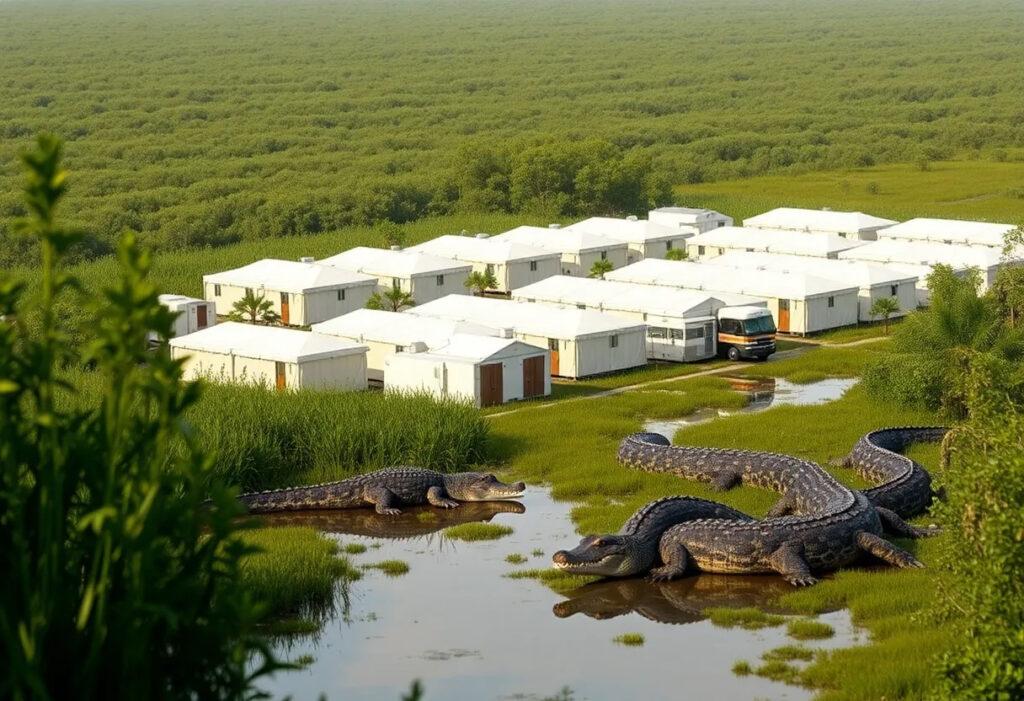
Built in just eight days in mid-2025 under the direction of the Florida Division of Emergency Management, this place seemed straight out of a dystopian movie.

Located 37 miles west of Miami, deep in the Big Cypress National Preserve, its geographic isolation was no accident; it was a strategy. To isolate detainees from their lawyers, the press, and the public eye.
What exactly is this place?
The center, officially named South Florida Detention Facility but sarcastically dubbed “Alligator Alcatraz” by the state government itself, is the first state-run facility in the U.S. designed exclusively to hold migrants under federal custody.
We’re talking about a complex in the middle of a subtropical wetland. It’s not a shelter. Reports from human rights groups over the past year have been chilling: 24-hour high-intensity lighting, lack of quick access to medical care, and deeply questionable sanitary conditions.

The real reasons for the closure
The official version will tell you the center “was temporary.” The truth is the numbers blew up in the administration’s face.
The Department of Homeland Security (DHS) has been clear: the cost is unsustainable. Private contractors and suppliers were officially notified on Tuesday, May 12, 2026: it’s time to pack up. The $250 million facility will be dismantled within weeks.
Was it pressure from human rights organizations that achieved this? Probably not. As often happens in politics, money speaks louder than morality. When the bill neared a dangerous $1 billion, the rope snapped.
The Economic Black Hole: Will It Impact Your Family?
This is the point no one wants to explain clearly. When you hear “millions of dollars,” it sounds like government money, as if it were magic. It’s not. It’s your sales taxes, your state contributions, the money that should go to your children’s schools or road repairs.
Federal Promises vs. Reality
Governor Ron DeSantis pushed this project, assuring that the federal government (FEMA and DHS) would reimburse every cent. It seemed like a perfect deal: Florida executes, Washington pays.
But the plan collided with bureaucracy and the courts.
Florida submitted an initial bill for $608 million. Although approved, the money is “tied up” due to multiple environmental lawsuits (they built on a protected natural reserve) and litigation over human rights violations.
“Every day this center remains open, it’s the state’s taxpayers who are paying the cost. This is a financial hemorrhage.”
— Anonymous internal source cited by CBS News Miami.
The direct impact on Florida taxpayers’ wallets
While the state waits for those $608 million, the machine didn’t stop. Since that initial request, Florida has spent approximately $300 million in additional operational costs.
And here’s where things get ugly. There’s no legal guarantee that the Trump administration, or Congress, will approve reimbursement for those extra $300 million. If Washington turns off the tap, the state of Florida will have to absorb that massive loss.
How do you absorb a $300 million hit? By cutting budgets in other vital areas or quietly raising state fees. The political whim of “Alligator Alcatraz” could end up costing Florida’s hardworking Hispanic families dearly.
[CRISIS TABLE: The Real Cost of “Alligator Alcatraz”]
| Expense Concept | Estimated Amount | Payment Status | Who’s Covering It Now? |
| Express Construction (July 2025) | $250 Million | Paid | State of Florida |
| Initial Operation (Reimbursement) | $608 Million | Approved (But Frozen) | State of Florida |
| Operational Cost Overruns (2026) | $300 Million | NOT Guaranteed | Florida Taxpayers |
| Current Spending Rate | > $1.2 Million / Day | Active Bleed | State of Florida |
The Human Side: What Will Happen to the 1,400 Migrants?
Beyond the money, there’s an urgent human drama. As of April 2026, ICE’s official records showed the center held an average of 1,400 people. Among them, parents, workers, and even DACA recipients who ended up trapped in local raids.
Shadow transfers by June 2026
Contractors have already been ordered to transfer all detainees before the first week of June. Where to? That’s the big unknown.
The federal government has an extensive network of private detention centers in other states (like Louisiana or Texas). The immediate risk for our community is that these people will be transferred thousands of miles away from their lawyers and families in Florida, practically destroying their chances of winning their asylum cases or fighting deportation.
The legacy of complaints and pain
“Alligator Alcatraz” won’t be remembered just for its cost, but for what happened behind its fences.
- Lack of due process: The geographic isolation made it nearly impossible for pro bono lawyers to travel to the facility.
- Deplorable conditions: Operating without adequate sanitary infrastructure in a swamp led to disease outbreaks that were silenced.
- Psychological terror: The use of temporary tents and the pressure of a hostile environment were classified by international organizations as “inhumane treatment.”
Let’s be honest, the center’s closure is a relief for civil rights advocates. But the trauma it left on those who passed through there isn’t dismantled by packing up a few tents.
A Victory for the Community or a Financial Disaster?
The end of “Alligator Alcatraz” leaves a bitter taste.
On one hand, it’s a moral victory. It shuts down a place that should never have existed—a camp that treated human beings like cattle in the middle of nowhere, violating basic standards of dignity. Media pressure, the work of immigration lawyers, and frankly, economic reality, brought down the project.
On the other hand, it’s a monumental financial disaster. It’s clear proof of what happens when legislation and governance are driven by extremism without looking at the bank account.
Florida’s Hispanic community gets up every morning to drive this state’s economy: we build the houses, harvest the fields, run the restaurants, and open businesses. It’s frustrating to know that the taxes generated by that sweat have ended up funding a $300 million black hole in the Everglades—a place designed, ironically, to punish our own.
The state now has a few weeks to clean up the swamp. But the economic bill and the moral damage will take years to erase.
Stay alert. If you have family members facing immigration proceedings in South Florida, now is the time to contact their legal representatives before the mass transfers begin in June.