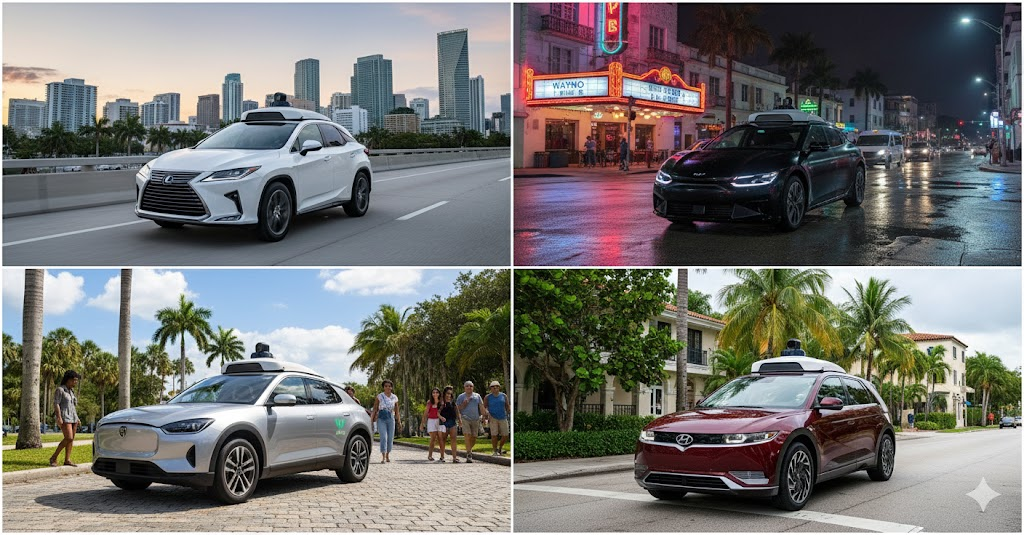
Waymo in Miami: Would You Trust Your Life to a Driverless Taxi? (Real Guide)
Waymo is already driving in Miami without a driver. We analyze prices, coverage areas, safety, and whether it’s really worth giving up the wheel. Could this be the end of Uber? Read this before you get in.
Miami has a new “driver” (and it doesn’t yell or honk)
Let’s be honest for a second. Driving in Miami isn’t an activity; it’s a contact sport. Between the endless construction in Brickell, people crossing three lanes without warning on the Palmetto, and the torrential rains that flood the streets in ten minutes, you need nerves of steel.
And now Google is telling us a robot can do it better than we can?
Advertisement
Well, yes. That’s exactly what’s happening. Waymo in Miami, Google’s sister company under Alphabet, has deployed its fully electric Jaguar I-PACE vehicles—and, most shockingly, they’re completely empty in the driver’s seat. No one. Not a “safety driver,” not a hidden person. It’s a steering wheel turning on its own.
If you’ve seen one of those white cars with a spinning dome on the roof driving around Wynwood or Coconut Grove, you’re not hallucinating from the heat. It’s the future arriving suddenly, and here we’ll break down whether this is a technological marvel or the start of a sci-fi movie gone wrong.
What exactly is Waymo?
To cut to the chase: Waymo is a Level 4 autonomous taxi service. This means the vehicle can operate without human intervention in specific conditions and areas. Unlike Tesla’s “Autopilot” (which requires you to stay alert), here you’re 100% a passenger. You get in the back, close the door, and the car takes you. Period.
Why Miami? (The chaos stress test)
You might be wondering: “Why choose Miami?”
Tech companies usually test their toys in quiet, orderly places, like the suburbs of Phoenix, Arizona (where Waymo has been operating for years). But Miami is… different. Miami is chaotic.
Advertisement
And that’s exactly what artificial intelligence needs.
For these cars to truly learn, they need to face the “unexpected.” And let’s admit it, nothing is more unexpected than a Miami driver at 5 p.m. on a Friday. Waymo has been meticulously mapping our streets. Its LiDAR sensors (those laser “eyes” spinning on the roof) create a real-time 3D map, detecting pedestrians, other cars, cyclists, and even small objects hundreds of meters away, day or night.
(Yes, they see better than you and me. Much better.)
Advertisement
Where you can already see them
Currently, the rollout isn’t citywide, but it’s growing fast. If you’re in these areas, grab your phone because you’ll likely see one:
Downtown Miami & Brickell: The financial hub and the densest traffic.
Wynwood & Edgewater: Tourist and street art zones.
Coconut Grove & Coral Gables: More residential areas but with complex streets and lots of vegetation.
Expansion to Miami Beach and the airport is the next logical step, but the company is moving forward with the calculated caution of someone who doesn’t want to make headlines for a viral accident.
The User Experience: What’s it like riding with a ghost?
Forget the awkwardness of having to talk to your Uber driver about the weather or listening to their music at full volume. Here, the experience is private. But how does it work?
It’s simpler than it seems, though the first time is a little unnerving.
The App: Download the “Waymo One” app (available on iOS and Android). It’s almost identical to Uber or Lyft. Enter your destination and request the ride.
The Pickup: The car arrives. And here comes the mental shock: You look out the window, and there’s no one. To open the door, you use the app on your phone (this prevents strangers from getting into your ride).
The Ride: You sit down, buckle up, and press a button on a rear touchscreen that says “Start Ride.” The car talks to you (you can set the language—yes, it speaks Spanish) and starts moving.
The Feeling: At first, seeing the steering wheel turn on its own gives you chills. After 10 minutes, you get bored and check your phone. The car drives like a cautious grandma: It fully respects stops (a rarity in Miami), doesn’t exceed the speed limit, and uses turn signals.
Key Fact: If you have problems during the ride or feel unsafe, there’s a “Support” button on the screen and in the app that connects you immediately to a real human from Waymo’s operations team, who can monitor the car and talk to you.
Brutal Comparison: Waymo vs. Uber/Lyft vs. Your Own Car
This is where things get interesting for your wallet and your patience. I’ve put together this table so you can see the real differences, not the ones marketing sells you.
Feature
Waymo (Robotaxi)
Uber / Lyft (Human)
Your Own Car
Price
Competitive (sometimes cheaper to gain market share).
Variable (surge pricing spikes).
“Free” (but you pay for gas, insurance, parking).
Privacy
Total. No one listens or watches (except security cameras).
Low. Depends on the driver’s discretion.
Total.
Road Safety
360° sensors, no fatigue or alcohol.
Depends on the human (fatigue, distraction).
Depends on you.
Driving Style
Conservative, slow, robotic.
Sometimes aggressive to arrive quickly.
Your style.
Tips
ZERO. No tipping the robot.
Expected (15-20%).
N/A
Availability
Limited to current service areas.
Universal (takes you anywhere).
Universal.
The “Tip” Factor (The Low Blow to the Gig Economy)
Let’s talk money. One of Waymo’s biggest advantages is that it eliminates tipping. On a $20 Uber ride, you usually end up paying $24 or $25 with the tip. With Waymo, $20 is $20.
This is great for the user, but it raises a dark and necessary question: What will happen to the thousands of Hispanic drivers who rely on Uber and Lyft in Miami?
It’s the other side of the coin. Automation doesn’t ask for vacations, doesn’t get sick, and doesn’t accept tips. In the long run, this technology is coming to replace human labor in transportation. It won’t happen tomorrow, but the trend is irreversible. If you work in the sector, it’s time to diversify.
Is It Really Safe? (What the numbers say vs. the fear)
Google claims its cars are statistically safer than humans. And they have a point: 94% of traffic accidents are due to human error (alcohol, texting, drowsiness, road rage). The robot doesn’t get drunk or text its girlfriend while driving on I-95.
However, they’re not perfect.
There have been incidents (few, but they exist) where autonomous vehicles get confused by construction cones, police officers directing traffic manually, or extreme weather conditions. In San Francisco, there were complaints about cars blocking fire trucks.
But in Miami, so far, the record is clean. The technology has matured a lot since those early mistakes. The driving is “defensive.” If a car cuts in front of it abruptly, the Waymo brakes before you even realize the danger.
What happens if there’s a crash?
This is a huge legal question. If a Waymo hits you (or you hit it), who’s at fault?
Liability falls on the company (Waymo/Alphabet). They have massive corporate insurance policies. As a passenger, you’re covered. But the bureaucracy of filing a claim against a giant tech corporation is a whole other story. Fortunately, since the car records everything in 360 degrees, there’s no “your word against mine.” There’s pure data.
Who is this for?
Waymo in Miami isn’t just a novelty for tourists. It has very practical uses:
Women traveling alone: Eliminates the risk of harassment from unknown drivers. It’s a controlled and monitored environment.
Nightlife outings: If you’re drinking in Wynwood, it’s the safest option. Zero DUI risk and cheaper than a late-night Uber with surge pricing.
People who don’t speak English: The app and interface can be set to Spanish. No language barrier or misunderstandings about the address.
The Hispano Nexus Verdict
Waymo’s arrival in Miami isn’t just another pilot program; it’s the consolidation of a new era. The technology is impressive, the sense of freedom is real, and economically, it makes perfect sense by eliminating tipping.
But let’s not kid ourselves. Seeing an empty car driving down Flagler Street reminds us the world is changing fast. For consumers, it’s a win in convenience and safety. For the local job market, it’s an early warning sign.
My advice? Try it. Download the app and take a short ride. Even if just for the story of being driven by a robot for coffee. The first time is impressive, the second feels normal, and by the third, you’ll wonder why we still let humans drive two-ton machines.
Welcome to the future, Miami. Try not to crash into the robot.