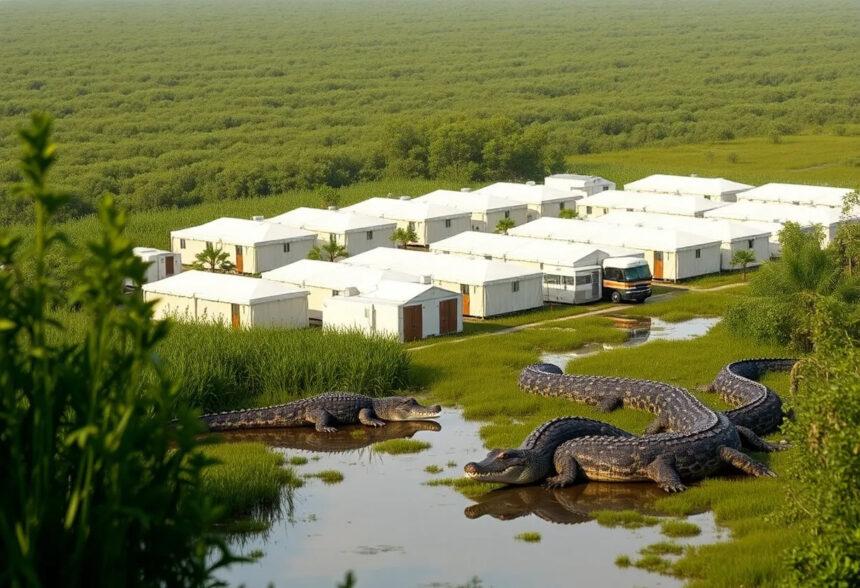
Construction of new immigrant detention center surrounded by alligators proposed in Florida, dubbed “Alligator Alcatraz” by State Attorney General James Uthmeier, has been approved by the Federal Government.
The federal government, through the Department of Homeland Security (DHS), announced the approval for the construction of an isolated temporary detention center to house detainees from U.S. Immigration and Customs Enforcement (ICE) in a remote area of Florida’s Everglades.

It is important to clarify that this is not an existing facility, but rather a project that has begun to generate considerable debate.
What is “Alligator Alcatraz”?
“Alligator Alcatraz” is the informal name given to a proposed detention center to be built in Florida’s Everglades, on the site of a former airport.
The name, coined by its proponents, alludes to the infamous high-security prison “Alcatraz,” suggesting that the remote location and swampy environment, inhabited by alligators and pythons, would act as a natural barrier to prevent escapes.
The stated purpose of this facility is to house immigrants, particularly those with criminal records, as part of a strategy to facilitate mass deportations.

According to recent reports, the federal government has approved Florida’s overall detention center plan, and construction could begin shortly on an accelerated timeline.
Projected Capacity
Figures regarding the capacity of this facility have varied in initial statements:
- Center capacity: Most reports indicate that the “Alligator Alcatraz” center would be designed to hold 1,000 people.
- Expanded capacity: The Attorney General has mentioned the availability of up to 5,000 beds by early July, suggesting that “Alligator Alcatraz” is part of a broader plan that includes other facilities in the state.
The project is in its early stages, and these figures could change as it develops.

Economic Effects and Controversies
The economic impact of the “Alligator Alcatraz” project is presented from different angles and is surrounded by controversy:
Costs and Financing:
- Operational Costs: It is estimated that the annual operational cost for the state could exceed $450 million. Proponents suggest that part of this expense could be reimbursed by the Federal Emergency Management Agency (FEMA).
- Land Acquisition: There is a significant discrepancy in the land’s value. While the state reportedly offered $20 million for the parcel, Miami-Dade County appraisals value the land at $195 million due to its location in a nature reserve.
Impact and Controversy:
- Job Creation: Like any large infrastructure and operations project, the construction and management of the center are expected to generate jobs in the area, primarily in construction and corrections.
- Opposition and Environmental Costs: Environmental groups, such as Friends of the Everglades, strongly oppose the project. They argue that construction in this protected area could have a “devastating” impact on the fragile Everglades ecosystem. This same area was protected in the 1960s to prevent the construction of what would have been the world’s largest airport, underscoring its ecological importance.
In summary, “Alligator Alcatraz” is a recent and controversial project that, if realized, would involve significant state spending, with a direct economic impact on the local community through jobs and contracts, but also with potential environmental and social costs that are the subject of intense debate.