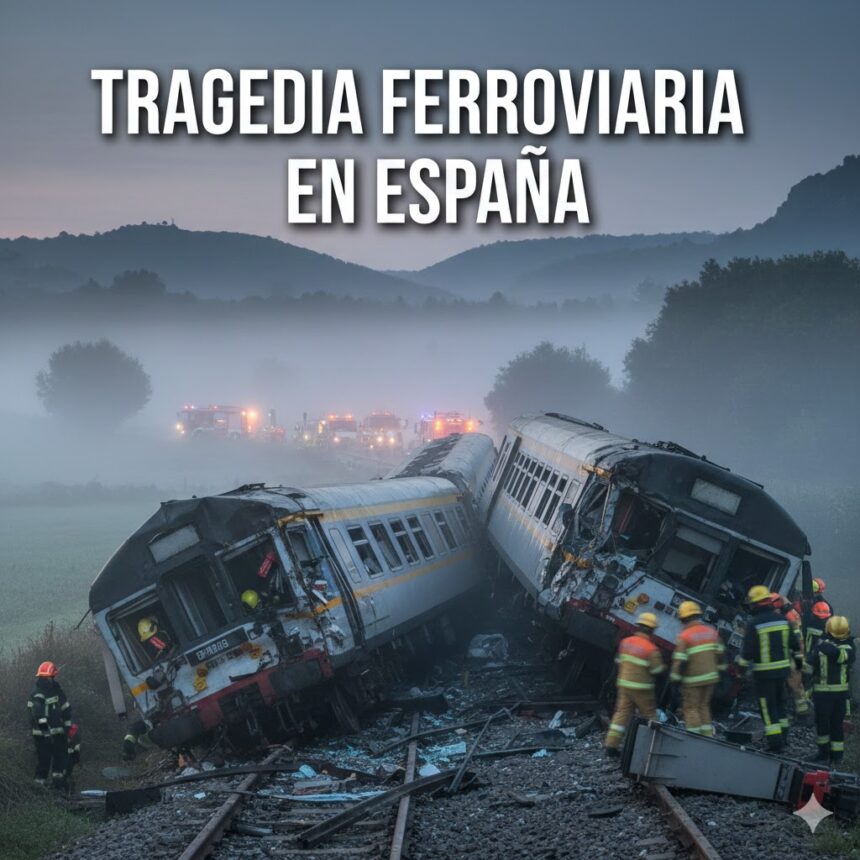
Mourning grips the south: The worst nightmare or rail tragedy. The sound of twisting metal still echoes across the fields of southern Spain. This was not a simple incident; it was a massacre that has left, so far, a devastating toll of 39 people dead and dozens of injured fighting for their lives in local hospitals. As families wait for news in sepulchral silence, the question arises that no one at the Ministry of Development wants to answer: How is it possible that in 2026 two trains end up colliding head-on in one of Europe’s most advanced rail networks?
Quick Response (Snippet Bait): The train crash in southern Spain occurred due to a high-impact collision that has resulted in 39 confirmed fatalities. Preliminary investigations point to a critical failure in remote signaling systems or human error in track coordination, which caused both units to travel on the same track in opposite directions.

Breakdown of the Disaster: What We Know Minute by Minute
The timeline of events is unclear, but technical data is beginning to shed light on the magnitude of the disaster. The impact was not a side swipe; it was a direct collision that turned the first cars of both trains into a twisted mass of steel and glass.

- Exact location: The collision point is on a single-track section with reduced visibility due to the terrain’s topography.
- Units involved: A medium-distance passenger train carrying local commuters and a freight train that, according to reports, should not have been in that sector at that time.
- Emergency response: Over 50 ambulances, medical evacuation helicopters, and specialized firefighting units worked through the night to rescue trapped survivors.
Technical Failure or Human Error? The Hypotheses on the Table
This is where the situation becomes murky. Spain prides itself on its ERTMS (European Rail Traffic Management System), designed precisely to prevent two trains from sharing the same space-time in a disastrous way.
1. The Collapse of the Blocking System
Experts suggest there may have been a failure in the Automatic Single-Track Blocking (BAU) system. If sensors fail and in-cab signals are not updated, the engineer blindly trusts that the track is clear. The truth is, if the system failed, we are facing an unprecedented maintenance scandal.
2. Pressure on Transit Times
Sometimes, the rush to meet schedules leads to skipping waiting protocols at sidings. Did either of the engineers receive a verbal order contradicting visual signals? It wouldn’t be the first time, but it would be the most costly in human lives.
Impact Table and Emergency Status
| Victim Status | Estimated Number | Observations |
| Deceased | 39 | Identification in process via DNA. |
| Critically Injured | 14 | Transferred to Intensive Care Units. |
| Minor/Moderately Injured | 45 | Treated at field hospitals and local centers. |
| Missing | 3 | Debris removal underway in car 1. |
Impact on the Community and Political Response
For us as Hispanics, seeing a tragedy of this magnitude in the “motherland” cuts deep. Rail connectivity is the backbone of life in Spain; many of the deceased were students and workers making their daily commute.

What is the government saying? Official mourning has been declared, but empathy does not erase negligence. The opposition is already demanding urgent hearings. The truth is, while politicians trade blame, there are 39 empty chairs tonight. It is outrageous that technology fails when it is needed most.
What Should Affected Families Do?
If you have family or friends who may have been on that route, the action protocol is as follows:
- Call the dedicated emergency number. Do not overload general police lines.
- Go to psychological support centers: Post-traumatic support is vital, even for those who were physically unharmed.
- Early legal advice: Before signing any “immediate assistance” documents from rail insurers, it is crucial to consult with transportation law experts.
Image: ElHispanoParaTodos/PRESS