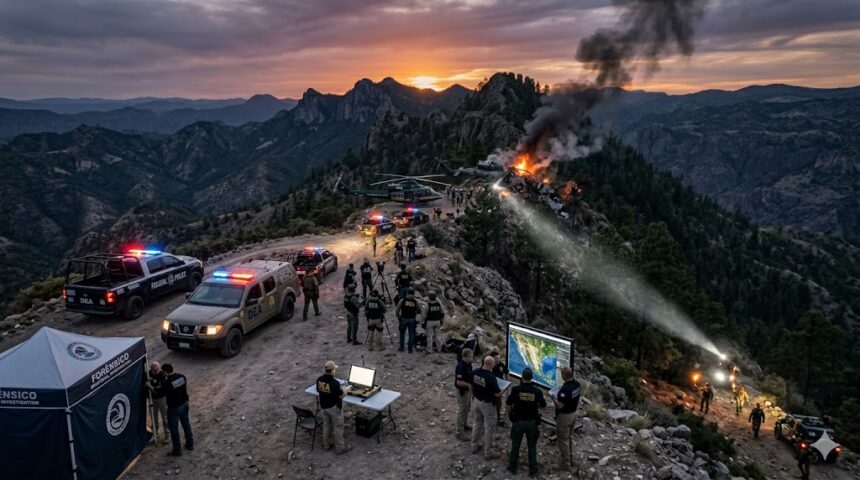
The war on drug trafficking isn’t fought only with bullets; sometimes, the most relentless enemy is geography and technical chance. The recent crash of an aircraft in the mountains of Chihuahua isn’t just another statistic in the local morgue. It’s a direct blow to the core of bilateral cooperation between Washington and Mexico City.
What exactly happened during the Chihuahua operation?

The accident occurred after the conclusion of a tactical incursion into high-risk zones, resulting in the confirmed deaths of four high-level officials (two American and two Mexican). Initial investigations point to a mechanical failure worsened by the region’s weather conditions, though official secrecy has raised doubts about the safety of the units used in these critical missions.
The Scene: The Sierra Tarahumara and the Risk Factor
Chihuahua isn’t for beginners. The terrain where the crash occurred is known by intelligence agencies as the “Golden Triangle” of criminal logistics. Operating here means flying at low altitudes in conditions where the wind can shift in seconds.
The truth is, while operations are usually planned months in advance, the aerial infrastructure used in joint cooperation often shows signs of fatigue. Are the right resources really being allocated to protect those on the front lines? Probably not as much as official press releases claim.
Profile of the Victims and the Weight of Cooperation
The loss of agents from both countries isn’t something that goes unnoticed at the State Department or Mexico’s Foreign Ministry. We’re talking about tactical intelligence experts who served as a bridge at a time when pressure to stop fentanyl trafficking is at its peak.

Critical Note: This accident occurs during one of the most politically tense weeks regarding border security. The absence of these profiles will leave an operational void that will take months to fill.

Technical Analysis: Accident or Something More?
In events like this, speculation spreads faster than the aircraft itself. However, there are three pillars investigators are scrutinizing:
- Aircraft Maintenance: Did it belong to the Sedena fleet, the National Guard, or was it a U.S. asset? The origin determines who assumes political responsibility.
- Workload: Anti-drug operations in Chihuahua often involve 18- to 24-hour shifts. The human factor (fatigue) is a variable rarely acknowledged in final reports.
- External Interference: Though there’s no evidence of hostile fire, the area is controlled by factions of the Sinaloa Cartel and remnants of the Juárez Cartel. The risk of an “accidental shootdown” is always on the intelligence table.
Table: Comparative Risks in Binational Operations
| Risk Factor | Impact on the Mission | Level of Exposure |
| Hidden Geography | Hampers immediate rescues | Critical |
| Mechanical Failures | Leading cause of deaths in the last decade | High |
| Crossfire | Unpredictable in extraction zones | Moderate/High |
| Bilateral Coordination | Language and protocol barriers | Low/Medium |
Political Implications: Washington Reacts
Don’t expect this story to fade into the news briefs. When U.S. agents lose their lives on Mexican soil during official duties, a security review protocol is triggered that often “freezes” other ongoing operations.
Here’s the interesting part: sources suggest this team was tracking specific routes linking chemical precursor labs to exit points toward El Paso, Texas. The disruption of this work could give local criminal groups a tactical breather. It’s a double blow: loss of lives and loss of strategic intelligence.

What’s Next for the Agents’ Families?
Binational support in these cases is usually administrative and cold. Despite honors, families face slow bureaucratic processes for repatriation and compensation. At El Hispano Para Todos, we understand that behind every badge is a family left with an empty chair in a war that seems endless.
Image: ElHispanoParaTodos/PRESS