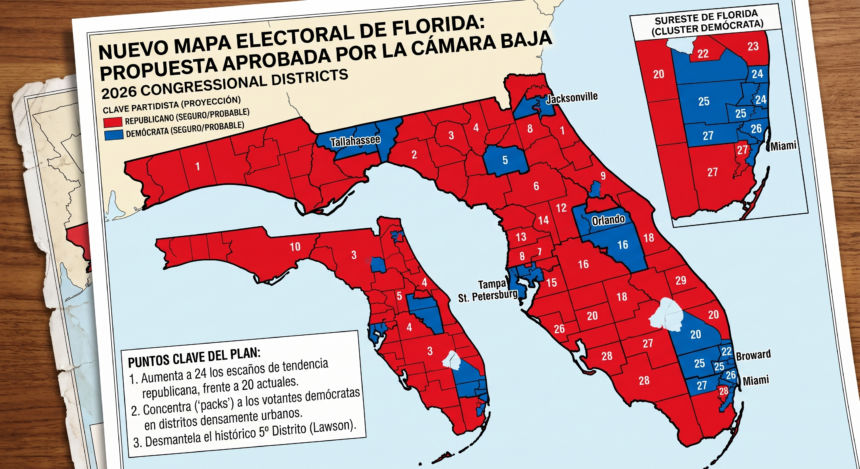
Florida’s Legislature approved a new electoral map on Wednesday that is expected to give the Republican Party four additional seats ahead of the midterm elections.
The district design, which has sparked intense debate in the state capitol, provides a significant advantage to the Republican Party for the crucial midterm elections in November.

The vote unfolded strictly along partisan lines, marking a decisive step in the redistricting process and setting the stage for the battle over control of Congress.
Details of the new map
The redesigned map alters the boundaries of several key districts, diluting the concentration of Democratic-leaning voters in some cases and strengthening conservative areas.
- District consolidation: The new distribution is expected to secure a more comfortable majority for Republicans in the state’s delegation, protecting vulnerable incumbents and creating new opportunities in previously competitive districts.
- Impact on urban areas: Critics argue that the state’s largest and most diverse cities have been fragmented (gerrymandering), scattering minority votes into districts dominated by rural or suburban conservative majorities.
What does this mean for the November elections?
The approval of this map carries implications beyond Florida’s borders. Given its size and its historic role as a swing state (though increasingly leaning right), what happens in Florida impacts the national balance of power.
- Control of the national Congress: The net Republican gains in Florida could be the decisive margin the party needs to secure or expand its control in Washington.
- Challenge for Democrats: The Democratic Party will face a much steeper path to regain ground, forcing them to reallocate financial and campaign resources toward districts they once considered safe but are now highly competitive or unfavorable.
- Minority representation: Civil rights organizations have warned that the new map reduces the ability of African American and Hispanic communities to elect representatives who reflect their interests, an issue likely to be central in future disputes.
Reactions and the inevitable legal battle
The legislative session was marked by sharp rhetorical clashes.

On one side, Republican leaders defended the map, arguing that it complies with the state’s constitutional mandates, reflects Florida’s population growth, and is a “clean and legal” design free of unconstitutional bias.
On the other, the Democratic caucus and various civil organizations called the measure an “assault on democracy.”
It is anticipated that the map will face immediate lawsuits in state and federal courts.

Opposing groups will seek injunctions, arguing violations of Florida’s “Fair Districts” amendments, which explicitly prohibit drawing lines to favor a political party or diminish the voting power of minorities.
Next steps
This redistricting in Florida is part of a national strategy driven by the Republican Party to secure control of the federal Congress in the upcoming elections.
Florida joins other states that have redrawn their electoral maps mid-decade, a practice that was uncommon until recently.