


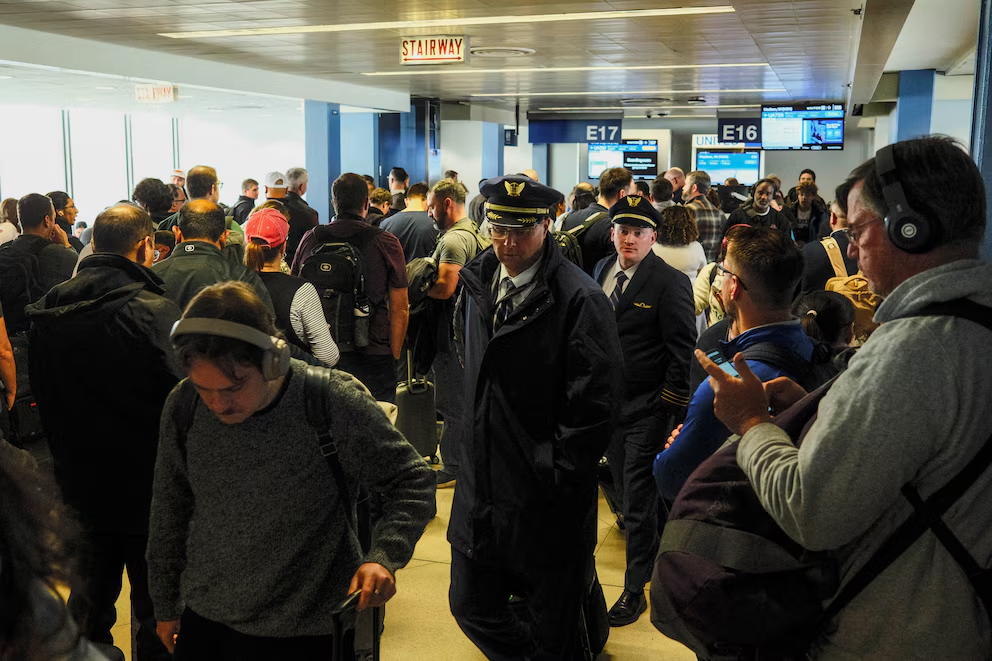
The longest federal government shutdown in U.S. history has paralyzed parts of the country, with its impact stretching from airports to the homes of millions of workers. The Federal Aviation Administration (FAA) implemented flight cuts at 40 of the busiest airports, causing thousands of cancellations and delays. On Monday alone, airlines canceled over 2,300 flights, and officials anticipate the numbers will rise as the week progresses. A shortage of air traffic controllers, many of whom have not received paychecks in over a month, has led authorities to label the situation “critical” for aviation safety.
President Donald Trump publicly urged controllers to return to work, promising a $10,000 bonus for those who do and penalties for those who don’t. These remarks drew backlash from lawmakers in both parties and the controllers’ union, which accused the administration of using workers as “political pawns” amid the budget dispute. Meanwhile, the Senate approved a proposal to reopen the government, though a final vote in the House of Representatives could be delayed for several days.

Air travel disruptions reflect just one part of the damage caused by a shutdown now stretching over six weeks.
Millions of federal employees and contractors have seen their paychecks suspended, food assistance programs remain blocked, and the lack of economic data has complicated the Federal Reserve’s (Fed) work. The Congressional Budget Office (CBO) estimates that fourth-quarter growth will be cut in half and that roughly $11 billion in economic activity will be permanently lost.
Below, six of the main economic consequences of the shutdown:
- 1. Unpaid wages and reduced consumer spending
According to CBO estimates, federal employees will have missed out on roughly $16 billion in wages by mid-November. This delay in income has reduced spending at stores, restaurants, and on travel, as well as postponed major purchases. While back pay will be issued once the government reopens, much of the lost spending will not be recovered.
The impact has been especially severe in the Washington, D.C. area, where unemployment already exceeded 6% before the shutdown, and in states with a high proportion of federal workers, such as Maryland, Alaska, and New Mexico. Additionally, contractors—who may number up to 5.2 million people, according to Oxford Economics data cited by the AP—are not guaranteed back pay.

- 2. Flight cancellations and tourism losses
The FAA ordered the cancellation of over 7,000 flights between Friday and Monday due to staffing shortages and overworked air traffic controllers. According to Tourism Economics, the shutdown has caused $63 million in daily losses in tourism spending, totaling roughly $2.6 billion over six weeks.
The consequences extend to hotels, restaurants, and transportation services tied to tourism. J.D. Power notes that reassigning aircraft and crews will take several days even after the FAA lifts restrictions, potentially delaying the full normalization of air traffic.
- 3. Decline in consumer confidence
The shutdown has hurt Americans’ economic expectations. According to the University of Michigan survey, the consumer confidence index fell to 50.4 points in November, its lowest level in three years, marking a 6.2% drop in a month and a 30% decline from the previous year.

This pessimism about personal finances and business conditions could translate into reduced spending in the coming months. While consumers have maintained high spending levels in recent years despite uncertainty, economists warn that the prolonged crisis may change this behavior.
- 4. Halt in federal spending and suspended contracts
The shutdown has stopped the awarding of new contracts and equipment purchases, affecting companies reliant on federal funds. According to Bernard Yaros, an economist at Oxford Economics cited by the AP, each day of the shutdown means roughly $800 million in unawarded contracts.
The hardest-hit agencies include the Department of Defense, NASA, and the Department of Homeland Security. “The federal contract pipeline has essentially been shut off,” Yaros wrote in a corporate note.
- 5. Delays in food assistance
The shutdown delayed $8 billion in payments for the Supplemental Nutrition Assistance Program (SNAP), which assists 42 million people. The interruption has strained the finances of low-income households and reduced their immediate spending power.
In some states, partial payments were issued early, though the Trump administration continues to litigate over full implementation of the benefits. The agreement being debated in Congress includes restoring full funding for the program once government operations resume.
- 6. Uncertainty for the Federal Reserve
The shutdown disrupted the release of key indicators on employment, inflation, and retail sales—essential inputs for the Fed’s monetary policy decisions. Facing a lack of data, Fed Chair Jerome Powell indicated the central bank may keep interest rates unchanged at its December meeting.
“What do you do when driving in the fog? You slow down,” Powell said at a press conference, alluding to the committee’s caution. The absence of official data complicates assessments of inflation and growth and could delay further decisions on interest rates.
According to the CBO, a six-week shutdown will reduce fourth-quarter growth by 1.5 percentage points, cutting it in half compared to the previous quarter. While reopening the government will boost activity at the start of next year, an estimated $11 billion in economic activity will not be recovered.
Image: Infobae





