The Final Breath of an Era: Jesse Jackson and the Echo of His ‘Rainbow Coalition’
The news hit like a hammer in Washington and every corner where social justice remains a pending task: Reverend Jesse Jackson has died at 84. Not just an activist has passed; the man who, after the assassination of Martin Luther King Jr., took up the mantle of hope in the streets of America is gone.
For our community, Jackson was no stranger. He was the architect of unity among minorities, the one who understood that “Black Power” and “Latino Power” were two sides of the same coin in the struggle. His death is not just a biographical fact; it is a reminder that today’s achievements bear the scars of decades past.
Advertisement
Quick Response: Jesse Jackson died at 84 after a lifetime dedicated to defending civil rights. His greatest legacy was the Rainbow PUSH Coalition, his two presidential campaigns in the 1980s, and his tireless work mediating international crises and electoral rights.
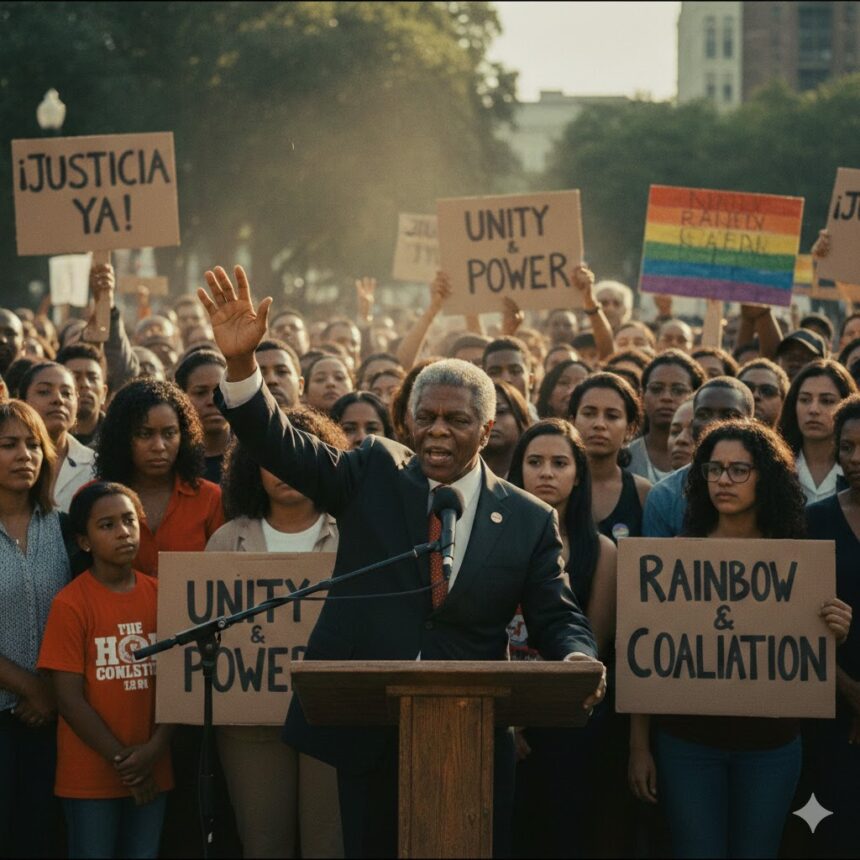
Jesse Jackson was the voice of the voiceless for over five decades
Credit: ElHispanoParaTodos/PRESS
A Trajectory Forged in Fire: From Selma to the White House
You cannot understand Jesse Jackson without looking at the balcony of the Lorraine Motel in 1968. He was there when King fell, and though controversy always surrounded the details of that moment, what is undeniable is what he did afterward.
The Birth of the Rainbow Coalition
Long before diversity became a marketing slogan, Jackson founded the Rainbow Coalition. His vision was disruptive for the time: uniting poor white workers, African Americans, Hispanics, and marginalized communities under a single political front.
1971: Founded Operation PUSH in Chicago to combat economic inequality.
1984 and 1988: Shattered the glass ceiling with two presidential campaigns that, while unsuccessful, registered millions of new voters, including a record number of Latinos.
The Diplomat of Lost Causes
Jackson had a gift (or audacity) few politicians possessed: direct diplomacy. While the State Department crossed its arms, he traveled to Syria, Cuba, or Iraq to free prisoners of war. “Keep Hope Alive” was not just a slogan in his speeches; it was his working methodology.
Why Jackson’s Legacy Matters to Hispanics Today
It is often forgotten that Jackson was one of the first prominent national African American leaders to embrace immigration reform as a human rights issue. He understood that the system oppressing a young person in the Bronx was the same one exploiting a farmworker in California.
Advertisement
Historic Achievement
Impact on the Hispanic Community
Voter Registration
Empowered minority voting in key states like Florida and Illinois.
Alliance with César Chávez
Strengthened the bond between the Latino labor movement and civil rights.
Economic Inclusion
Pressured corporations to hire minority suppliers (including Latino businesses).
The truth is, without the path Jackson paved in the 1984 and 1988 Democratic primaries, figures like Barack Obama or even today’s Latino coalitions in Congress would have faced a much steeper climb. Was he perfect? Of course not. He had his shadows and controversies, but his final balance is that of a bridge-builder in a country that specializes in erecting walls.
His Final Years: The Battle Against Parkinson’s
In the last decade, we saw a physically frailer Jackson, but with the same fiery gaze. Diagnosed with Parkinson’s in 2017, his body began to fail, but his presence at Black Lives Matter protests or polling places never ceased.
The interesting part? Despite his health, he never stopped being a must-consult figure. Presidents came and went, but the Reverend remained, reminding them that democracy is a muscle that atrophies if not exercised.
Advertisement
The Void He Leaves and the Uncomfortable Question
With his passing, a reasonable doubt arises: Who will take up the mantle? We are in a time of extreme polarization. The coalitions he helped forge are under pressure. Jesse Jackson’s death should serve as a call to action for new generations of Hispanic and African American leaders. It is not enough to remember his speeches; we must replicate his ability to bring to the same table groups that, despite their differences, share the same hunger for justice.
“Our children were not born to be criminals; they were born with the potential to be whatever they choose if the system leaves the door open.” — One of his recurring phrases in working-class neighborhoods.