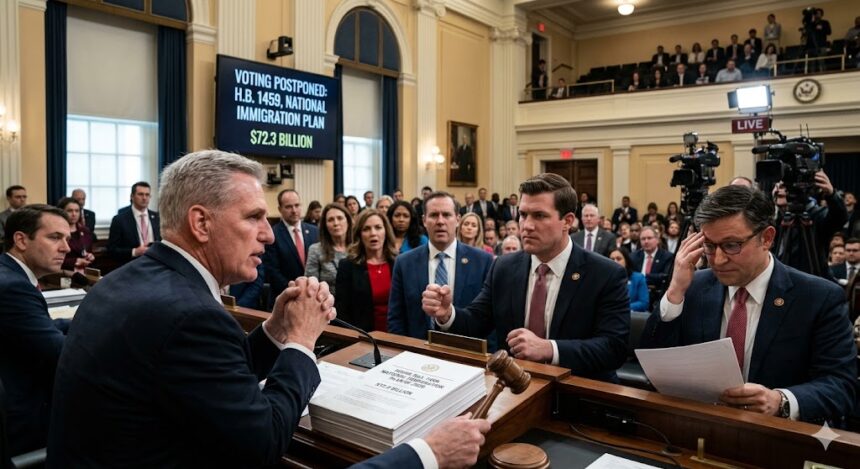
If you thought Washington’s deportation machinery was moving full steam ahead, U.S. politics just threw us a plot twist. Millions of Hispanic families have been living with their hearts in their throats after the announcement of an unprecedented capital injection for immigration enforcement agencies. That image of the congressional scoreboard showing the vote on the over $72 billion package postponed has spread across the country, sparking a mix of temporary relief and deep confusion.
What really happened behind closed doors? Did lawmakers have a sudden change of heart, or is this just a tactical maneuver? The truth is this legislative halt isn’t a surrender—it’s a tactical recalculation. And if you’re an immigrant, have undocumented family members, or simply care about the future of our community, you need to understand exactly what pieces are moving on the board before the clock starts ticking again.

Quick Answer (What You Need to Know Now): Congressional Republicans have temporarily postponed the vote on Trump’s $72 billion immigration plan due to complex internal negotiations over the exact distribution of funds. However, President Trump has set an unmovable deadline of June 1, 2026 for his party to pass this law, which would allocate most of those billions directly to the Border Patrol and ICE.
Anatomy of a Mega-Budget: Where Would the $72 Billion Go?
Let’s get to the point. Seventy-two billion dollars is an astronomical figure. To put it in perspective, it’s more money than entire economies of several Latin American countries manage in a year. We’re not talking about hiring a few extra agents to patrol the desert; we’re looking at the creation of a militarized logistical apparatus designed to locate, detain, and deport people on an industrial scale.
Most of this historic budget would go toward strengthening the muscles of the two agencies most feared by the undocumented community: Immigration and Customs Enforcement (ICE) and the Border Patrol (CBP).
Here’s what’s interesting (and most concerning for human rights advocates). This package isn’t just about putting more boots on the ground. The money is meticulously earmarked for several operational phases:
- Massive expansion of detention beds: A large portion of the capital aims to drastically increase the physical capacity to hold families and individuals before deportation.
- Resurgence of the 287(g) program: These agreements allow ICE to delegate immigration enforcement functions to local police and county sheriffs. To give you an idea of the scale, nearly 300 such agreements have been signed in Florida alone since January 2025. With $72 billion on the table, this local-federal cooperation model would spread like wildfire across the country.
- Surveillance and transportation technology: Millions allocated for charter flight logistics for express deportations and facial recognition or tracking technology in sanctuary cities.
The June 1 Ultimatum: Why Republicans Hit the Brakes
If this plan is the crown jewel of the Trump administration, why did Republicans—under pressure from their voter base—decide to postpone the vote?

Don’t be fooled into thinking there was a sudden burst of compassion. Politics on Capitol Hill is a game of interests. Internal sources suggest the delay is due to a tug-of-war over how to justify and distribute that money in a year when the economy is also squeezing U.S. citizens.
Trump isn’t willing to wait indefinitely. In fact, he has strongly pressured his party’s ranks and set June 1, 2026 as the absolute deadline for Republicans to approve this massive capital injection for immigration law enforcement.
The Reconciliation Mechanism
Democrats, for their part, are hamstrung. Since they lack the votes to stop the measure through traditional blocks (the famous filibuster), Republicans are maneuvering to pass immigration budgets using fast-track procedures or budget reconciliation packages that require only a simple majority. However, drafting a $72 billion law that complies with the Senate’s strict parliamentary rules without being rejected takes time. Hence the pause.

“A budget of this magnitude isn’t just a spreadsheet; it’s a statement of intent that targets millions of working families who sustain entire sectors of our economy.”

The Dark Factor: Privatization and ‘Bounty Hunters’
There’s a chilling detail in the subtext of this immigration offensive that few media outlets are analyzing in depth. When you inject $72 billion into a bureaucratic system, federal agencies simply don’t have the human capacity to spend and operate all that money overnight.
What’s the government’s solution? The privatization of immigration enforcement.
ICE is currently evaluating the possibility of outsourcing to massive private security corporations and even using “bounty hunters” to locate, arrest, and process the deportation of undocumented immigrants in exchange for lucrative federal contracts.
What Does This Privatization Entail?
- Less transparency: Private companies are not subject to the same public records laws (FOIA) as government agencies.
- Perverse incentives: If a company is paid per “head” or per “occupied detention bed,” its corporate goal will be to arrest as many people as possible, regardless of minor offenses, to maximize shareholder profits.
- Danger in the streets: The idea of bounty hunters operating in Hispanic neighborhoods creates a high risk of brutality, mistaken identity, and due process violations.
What Does This Pause Mean for Our Hispanic Community?
The vote’s postponement is, without embellishment, a momentary breath of fresh air. But it would be a grave mistake to let our guard down. The June 1 deadline is just around the corner, and the political machinery is being oiled at this very moment.
If you have irregular immigration status or live in a mixed-status household (citizens and undocumented individuals under the same roof), this is the exact moment to act—not to panic.
Action Plan (While the Clock Ticks)
- Organize an “Emergency Plan”: Draft powers of attorney so someone you absolutely trust can take care of your minor children, bank accounts, and assets in case of sudden detention.
- Consult an accredited attorney NOW: Don’t rely on notaries or “paper fillers.” Seek legal advice to check if you qualify for any status adjustment, cancellation of deportation, or special visas (like the U or T Visa) that you may not be aware of.
- Know your constitutional rights: Every individual in the U.S. has rights. If ICE knocks on your door, you don’t have to open unless they present a judicial warrant signed by a judge—not just an administrative immigration form.
Comparison: The Before and Now of Immigration Budgets
| Aspect | Previous Historic Budgets | Trump’s $72 Billion Plan | Community Impact |
| ICE Funding | Gradual annual increases | Massive and immediate injection | Increase in workplace raids. |
| Local Police Role | Limited in blue jurisdictions | Aggressive expansion of 287(g) Agreements | Fear of reporting crimes to local police. |
| Arrest Enforcement | Sworn federal agents | Possible use of contractors and bounty hunters | Lack of accountability and potential abuses. |
The pause in Congress doesn’t mean the storm has passed; it means the hurricane is gaining strength offshore. Staying informed, united, and legally prepared is the only real barrier between the community and this $72 billion tsunami.
Image: ElHispanoParaTodos/PRESS