
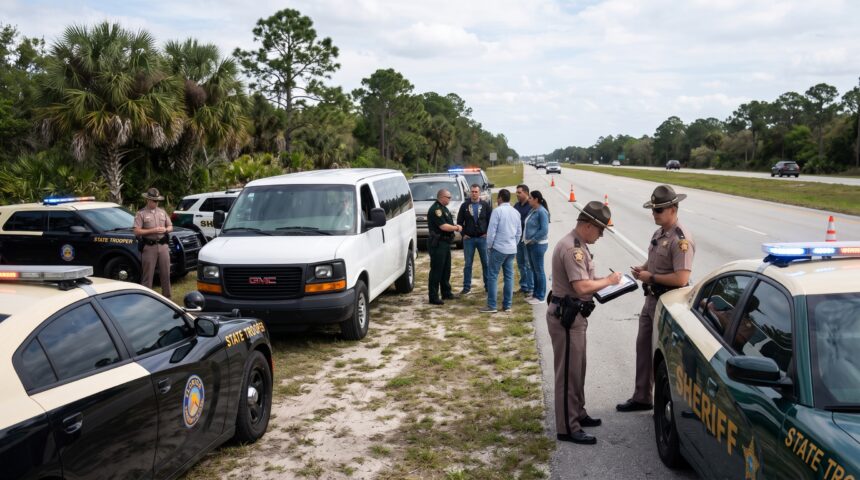
An analysis by FWD.us shows Florida police agencies could exceed $1 billion in federal funds under the 287(g) program, alarming immigrant advocates.
FLORIDA — Florida law‑enforcement agencies could receive more than $1 billion in federal funds between the current fiscal year and the next by working with the Department of Homeland Security (DHS) on immigration enforcement, according to projections from a new study by the organization FWD.us.

A FWD.us investigation warns the state leads the nation in arrests and projected reimbursements under the 287(g) program, raising alerts over lack of oversight and possible abuses during traffic stops.
The figure places Florida far above any other state in potential federal incentives for police and sheriff offices participating in the 287(g) program, a mechanism that authorizes state and local agents to perform immigration functions on behalf of Immigration and Customs Enforcement (ICE).
How federal and state financing works
The strong flow of resources responds to the financial‑incentive scheme launched by DHS in September 2025, backed by the federal budget law passed in July of that year, which allocated $170 billion to border and immigration security —including $14 billion specifically to support cooperation with state and local agencies through 2029—.
For departments enrolled in the so‑called Task Force Model of 287(g), the federal government offers:

- Salary reimbursement: Coverage of the annual salary of agents certified for immigration tasks.
- Equipment and fleet: Up to $7,500 per agent for gear and up to $100,000 per agency for new vehicle purchases.
- Performance bonuses: Quarterly payments tied to locating undocumented individuals and operational support provided to ICE.
These federal resources are added to the $250 million that Florida itself allocated through its Immigration Grants Program for Local Agencies (IGP), administered by the State Immigration Control Board and the Florida Department of Law Enforcement (FDLE), and valid through June 2027.
Why Florida holds the bulk of the program
Unlike most states, since February 2025 Florida requires all its police agencies to maintain active 287(g) agreements with ICE. That massive rollout is reflected directly in the statistics analyzed by FWD.us:
| Indicator (2025–2026) | Recorded / projected figure |
| Projected national federal funds (Task Force Model, FY 2026) | Between $1.9 billion and $2.2 billion |
| Future national annual federal projection | Between $1.6 billion and $2.0 billion |
| Potential federal projection for Florida agencies (through next year) | More than $1 billion |
| 287(g) arrests nationwide (Jan 2025 – Aug 2026) | More than 47,000 |
| 287(g) arrests in Florida | More than 15,000 (nation’s top) |
| 287(g) arrests in Texas | More than 9,000 (nation’s second) |
| Local and state agents accredited by ICE in 30 states | Between 26,000 and 33,000 (more than double the 11,600 direct ICE deportation officers) |
The report details that monthly arrests through the 287(g) program grew 2,100 % between January 2025 and July 2026 —rising from about 300 to over 6,600 per month—, eventually representing between 14 % and 15 % of all ICE detentions in the United States. Florida, which consistently maintains over 1,000 monthly detentions under this scheme, and Texas together account for roughly half of all those arrests.

Alarm among immigrant advocates and experts
The volume of money involved and the speed of the program’s expansion have generated deep concern among researchers, civil‑rights groups and immigrant‑community advocates.
- Lack of transparency and accountability: Felicity Rose, vice president of research and policy at FWD.us and co‑author of the report, warned that unlike traditional federal police grants, these funds are being disbursed with minimal public oversight and without clarity on how performance bonuses are calculated or how spending is audited.
- Immigration control at routine stops: Rose noted that using local police enables a less visible strategy than high‑profile urban raids, shifting immigration detection to routine traffic stops on highways and local streets.
- Risk of racial profiling: Organizations such as the American Civil Liberties Union (ACLU) caution that tying million‑dollar payments to operational outcomes incentivizes arbitrary detentions. The Task Force Model of the 287(g) program was previously suspended in 2012 after the Justice Department found evidence of racial profiling.
- Impact on community trust: Immigrant advocates and local academic studies warn that police participation in deportation tasks creates widespread fear in low‑income, Latino and African‑American communities —including mixed‑status families and citizens—, which may deter victims and witnesses from contacting authorities.
Officials’ stance
At the federal level, the Department of Homeland Security has defended the 287(g) program as an essential tool for combating crime and reducing illegal immigration through coordination with local law‑enforcement.
Meanwhile, several police chiefs and sheriffs in Florida have backed the federal‑reimbursement scheme, arguing it is a fiscally responsible measure that covers personnel, patrols and equipment costs without shifting the entire burden onto local taxpayers, while maintaining that their agents conduct checks primarily during ordinary procedures and traffic stops.
As state and municipal agencies continue processing reimbursements under the expanded federal agreement, civil‑rights groups and critical lawmakers insist on establishing strict public‑audit mechanisms for the use of resources and the real impact of the program on Florida’s community safety.