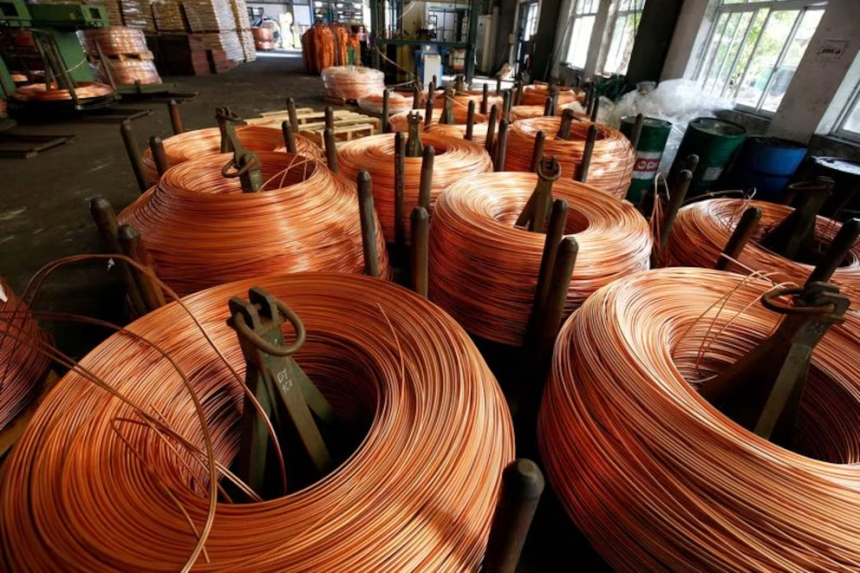
A wave of copper thefts sweeping across several regions of the United States is having a severe impact on essential services, causing communication outages, disruptions to emergency calls, and millions of dollars in losses for companies. Soaring metal prices have intensified these crimes, forcing businesses and authorities to bolster security measures.
The NCTA (Internet & Television Association) revealed that between January and June of this year, 9,770 incidents of theft or sabotage in communication networks were reported—double the number from the previous six months. This surge left over eight million customers nationwide without service.


Increase in Copper Consumption
The phenomenon is partly driven by the rising demand for copper in sectors such as renewable energy and the tech industry. The price of this metal reached $11,146 per ton on the London Metal Exchange last month—a record high fueled by demand for wind turbines, electric vehicles, and data centers for artificial intelligence.
Attacks have grown increasingly sophisticated. Criminals access sewers, pose as authorized workers, or scale utility poles at night to remove cables. In some cases, as Alcutt recounted, thieves observe technicians at work, only to return shortly after to steal again. “It hurts to see what the city has become,” lamented the AT&T specialist.
The damage is not limited to the West Coast. In Missouri, targets included wind turbine sites, while in Kentucky, authorities arrested seven people thanks to a tip from a scrapyard.
An FBI agent, Amir Ehsaei, warned about the organized nature of many gangs and noted that the agency is actively collaborating with local law enforcement to identify and arrest those responsible.

The cost to companies is high. AT&T reported losses of $76 million in the first ten months of the year, as disclosed by the company. In response, operators like Verizon Communications have installed GPS trackers on their cables and reinforced the perimeters of their infrastructure, while also offering rewards in critical areas.
Legislation in Response to the Crisis
Legislative responses are growing as the crisis escalates. Fourteen states have passed new laws to combat copper theft, focusing on oversight of recycling depots and collecting data on metal sellers.
According to Todd Foreman of the Institute of Scrap Recycling Industries, between 10 and 15 thefts are reported daily to a shared database—a system that helped recover $18,000 worth of cabling in Indiana during July.

Telecommunications operators are moving toward fiber optics to replace copper—a technology less vulnerable to theft and without value on the black market.
Charter Communications and Optimum use cables labeled “Fiber Only” to deter thieves from cutting them. However, attacks continue to disrupt connectivity for thousands of users and critical services.
For now, companies, authorities, and citizens must adapt to the enormous challenges of protecting and rebuilding a communications infrastructure under persistent threat. Pressure on lawmakers and cooperation between agencies is emerging as the primary strategy to contain a crisis that, as the Federal Communications Commission described, constitutes a “growing epidemic.”
Image: Infobae