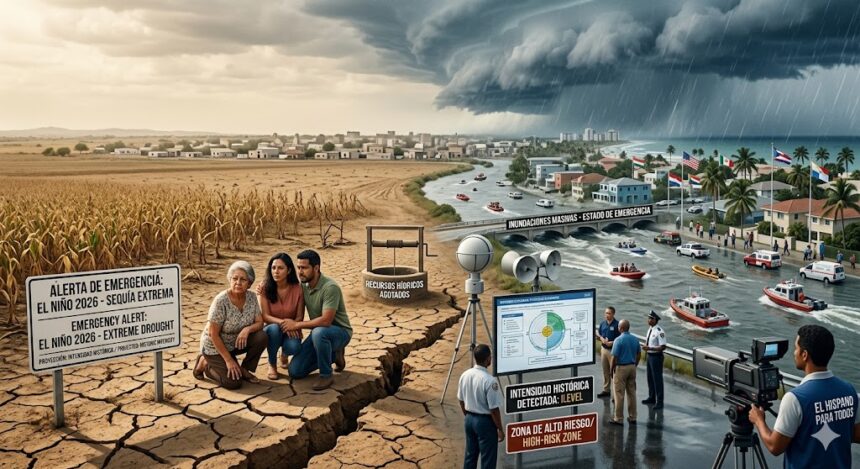
If you think the weather over the past few months has been strange, brace yourself for what’s coming. This is not just another passing heatwave or a typical summer storm. The thermometers in the deep Pacific Ocean have just triggered an alarm that scientists haven’t seen at this strength in generations. For our Hispanic community, this is not just a lab finding; it directly translates to the price of food at the supermarket, the cost of air conditioning, and the real risk of flooding in our neighborhoods. The climate time bomb has exploded. Meteorologists warn that the intensity of the 2026 El Niño phenomenon will cause a drastic climate imbalance, splitting the continent between prolonged droughts and severe flooding.
The truth is that meteorologists’ worst fears have been confirmed. On Thursday, June 11, 2026, global climate authorities delivered a definitive verdict that will change the landscape for the second half of the year.

The Global Alert (Snippet Bait): The National Oceanic and Atmospheric Administration (NOAA) has officially declared an El Niño Advisory. Predictive models and satellite data confirm that El Niño 2026 is already here, and the probability that it will evolve into a “very strong” category reaches an alarming 63%. If this trend consolidates during the Northern Hemisphere winter, this event will position itself as the most intense and devastating recorded in over 70 years, threatening to unleash climate chaos and unprecedented socioeconomic impacts worldwide.
The Anatomy of a Climate Monster: Why This Year Is Different
To understand why scientists are using terms like “Super Niño” or “Godzilla” in the halls of NOAA, we must debunk the myth that this is just warm water at the beach. El Niño is a recurring climate pattern where the trade winds that normally push warm water toward Asia weaken. As they weaken, that massive body of warm water returns toward the coasts of the Americas, completely altering the atmospheric jet stream.
Here’s the interesting part: the current rate of warming is what has experts on edge.
- Extreme Subsurface Heat: At depths of between 50 and 150 meters in the Pacific, thermal anomalies have reached local peaks of up to 6°C above normal.
- Ocean Heat Content: The volume of heat accumulated in the ocean doubles the levels recorded in May 2023, a year that already broke global climate records.
- The Ghost of 1950: Historical records show that the wildest events occurred in 1982, 1997, and 2015. However, the acceleration of this El Niño 2026 suggests it could surpass those three precedents and return us to extremes not seen since the mid-20th century.
Should we really care that water thousands of miles away is heating up? Absolutely. The ocean is the engine of global climate, and when its temperature is altered in this way, the atmosphere responds with a global meteorological backlash.
Geographic Impact: A Planet Divided by Extremes
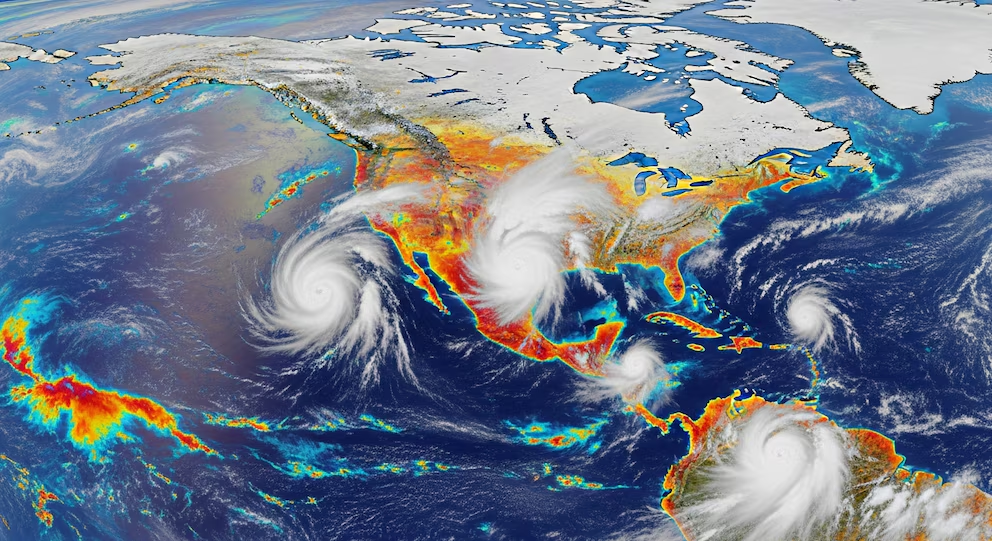
The impact of this phenomenon is not uniform. While some regions drown in torrential downpours, others will see the land crack under relentless droughts. It’s the perfect definition of a two-faced climate collapse.

Regional Impact Table and Economic Alerts
| Geographic Region | Expected Meteorological Effect | Impact on the Community and Wallet |
| Southern U.S. (Florida, Texas, California) | Much wetter winters, intense storms, and risk of high-tide flooding. | Infrastructure damage, rising home insurance costs, and construction delays. |
| West Coast of South America (Peru, Ecuador) | Torrential rains, massive flooding, and collapse of fisheries. | Millions in agricultural losses and higher prices for imported fruits. |
| Caribbean and Northern South America (Colombia, Venezuela) | Severe droughts, extreme heatwaves, and risk of power rationing. | Drop in agricultural production and drastic increases in energy bills. |
| Southeast Asia and Australia | Extreme drought, wildfires, and loss of rice crops. | Global supply crisis that will drive up food inflation worldwide. |
The Hurricane Paradox: The Trap of False Security
Let’s get straight to a vital technical detail for those of us living in coastal areas like Florida’s Treasure Coast. Historically, El Niño tends to suppress hurricane formation in the Atlantic because it generates strong wind shear (crosswinds in the upper atmosphere that tear storms apart before they form).
(Does this mean we can relax and forget about storm preparations? Absolutely NOT).
Here’s the catch for 2026: the Atlantic Ocean is also recording record temperatures due to global warming. This battle of titans between the hot Atlantic (which fuels hurricanes) and El Niño (which tries to stop them) creates an extremely unstable scenario. Even in seasons with low overall activity due to El Niño, a single historic-category hurricane that manages to break through and make landfall in a coastal community is enough to cause total catastrophe. Additionally, NOAA warns that the shift in the jet stream will push more winter storms toward the mid-Atlantic, causing massive coastal flooding even without tropical cyclones.

Family Contingency Guide: How to Shield Yourself from the “El Niño Effect”
If you wait until the water reaches your ankles or the price of the basic food basket rises another 20% to take action, it will already be too late. The margin of error in the face of this 70-year collapse is zero. Follow this immediate action plan:
1. Audit Your Insurance Policy and Coastal Infrastructure: Home Safety.
El Niño will increase high-tide flooding on the Atlantic and Gulf coasts. Review your home insurance policy today. Remember that standard insurance does NOT cover flood damage; it requires a separate policy from the NFIP that takes 30 days to activate. Clear your property’s drains and ensure your pumping systems work before the wet winter begins.
2. Prepare Your Budget for Food Inflation: Household Economy.
With droughts threatening rice, corn, sugar, and coffee production in South America and Asia, the price of imports will inevitably rise in the coming months. Adjust your family budget. Avoid unnecessary credit card debt and start smartly stocking up on non-perishable staples before supermarkets pass on agricultural losses to consumers.
3. Shield Your Utility Bills from the Heat: Energy Efficiency.
Heatwaves induced by the phenomenon will keep energy demands at record levels, driving up electricity costs. Invest in sealing air leaks in your windows, install smart thermostats, and perform preventive maintenance on your air conditioning unit. Reducing your energy consumption today will prevent unaffordable bills by the end of the year.
El Niño 2026 is not a sci-fi prediction for the future; the waters of the Pacific are already warming at a rate that even scares scientists. This meteorological monster will test the resilience of our infrastructure, our economies, and the stability of our homes. While local and federal governments coordinate contingency plans to mitigate the impact, the best defense for the Hispanic community is individual and family preparedness. Stay informed through reliable scientific sources, protect your assets, and do not underestimate the power of nature when it warns so clearly.
Image: ElHispanoParaTodos/PRESS