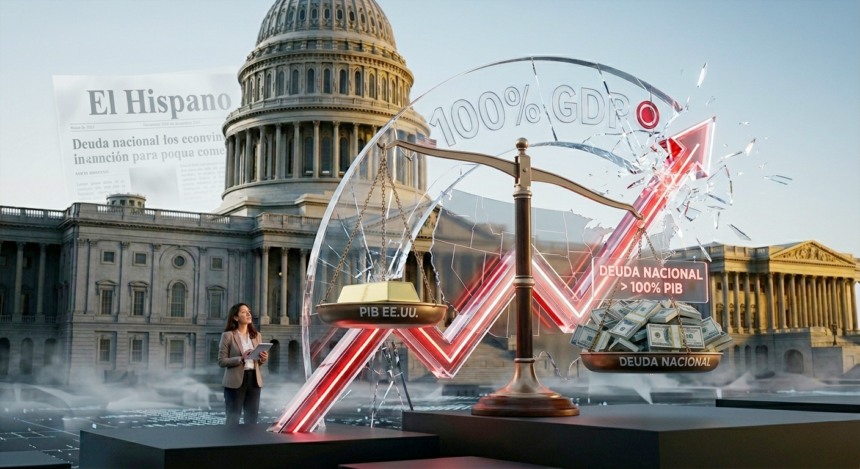
A Giant with Feet of Clay: Why U.S. Debt Is Now Larger Than Its Own Wealth
Imagine you earn $50,000 a year, but your credit card shows a debt of $55,000. It doesn’t mean you’ll lose your home tomorrow, but it does mean every dollar coming in already has a name—and it’s not yours. For the first time since World War II, the U.S. has reached that point: federal public debt has exceeded 100% of Gross Domestic Product (GDP).
For generations, the U.S. economy has operated under an implicit premise: “We can spend whatever we want; the world will always finance our debt.” That era has officially ended. As spring 2026 closed, we’re faced with a figure that isn’t just an economic statistic but a declaration of national vulnerability: U.S. federal debt now surpasses 100% of its Gross Domestic Product (GDP).

Washington has crossed a global confidence red line. This isn’t a time for panic but for a deep recalibration of our personal and community finances.
What does this mean in real terms? Essentially, if the country decided to use everything it produces in a year—from iPhones to Washington apples—to pay what it owes, it would still come up short.
Critical Data: As of the end of March 2026, public debt reached 100.2% of GDP. We’re talking about over $31.27 trillion compared to an economy worth $31.22 trillion.
The Quick Answer: Should I Worry Right Now?
Yes and no. The U.S. government isn’t going bankrupt tomorrow because it has the “money-printing machine” (the Federal Reserve), but this milestone marks the end of an era of cheap money. For the average citizen, this translates into higher interest rates for longer, inflation that refuses to drop, and public services that could see cuts to pay the interest on that massive debt.
The Road to Ruin: How Did We End Up Owing So Much?
It wasn’t a single event but a perfect storm of political decisions and global crises. Looking back, in 2011, the debt was around $14 trillion; today, in 2026, it has risen by 164%.

- The COVID-19 Hangover Effect: The trillions injected into stimulus checks and business aid saved the economy but passed the bill to the future.
- Rising Military Spending: With current global conflicts and arsenal modernization, the defense budget continues to break records.
- The Interest Problem: Here’s where it gets interesting (and terrifying). Since the debt is so large and interest rates rose to curb inflation, the government now spends nearly 20% of its tax revenue just on paying interest. That’s money that doesn’t go to schools, roads, or healthcare.
Table: The Evolution of Debt vs. GDP (Approximate Figures)
| Year | Total Debt (Trillions $) | % of GDP | Historical Context |
| 1946 | $0.27 | 106% | Post-World War II |
| 2008 | $10.0 | 68% | Great Financial Recession |
| 2020 | $27.7 | 98% | Global Pandemic |
| 2026 | $31.27 | 100.2% | Current Milestone: Debt > Economy |
How Does This Affect Hispanic Families? (Real Effects)
This is where macroeconomics hits your dinner table. It’s not just a number in the news; it’s why your cost of living could rise.
1. The End of Cheap Mortgages
When the government owes so much, it has to compete for money. This pushes Treasury bond rates higher, which in turn raises rates on mortgages, auto loans, and credit cards. If you were hoping rates would return to 3%, the reality of the debt suggests the “new normal” will be much higher.
2. “Silent Inflation”
Do we really need another spending bill? Probably not, but Washington keeps spending. To finance the debt, indirect money printing is sometimes used. This dilutes the value of your savings. The dollar you saved in 2020 buys 20-25% less today, and this trend could accelerate if confidence in the country wavers.

3. Pressure on Social Security and Medicare
If you’re nearing retirement, this matters to you. With debt service consuming such a large slice of the national budget, social benefit programs are under scrutiny. They’re not going to disappear, but reforms (like raising the retirement age or reducing benefits) are closer than ever to the negotiating table.
Are We Facing a “Default”?
The truth is, it’s highly unlikely the U.S. will default on its debt. The entire world uses the dollar as a safe haven. However, the loss of confidence is the real enemy. If investors (and other countries) start doubting Washington’s ability to pay, they’ll demand even higher interest rates, creating a vicious cycle that’s hard to break.
“The current fiscal trajectory is one of the most serious warning signs of our generation,” warn experts from the Committee for a Responsible Federal Budget. This isn’t alarmism; it’s basic arithmetic.
Pro Tips for Navigating This Era:
- Prioritize Paying Off Variable Debt: If you have credit cards with rising rates, now is the time to pay them off. The cost of money won’t drop soon.
- Diversify Your Savings: Don’t rely solely on cash. Consider assets that hold value against inflation (real estate, gold, or diversified investment funds).
- Watch Out for Taxes: Sooner or later, someone will have to pay the bill. We’ll likely see tax increases in the coming years to try to balance the budget.
Image: ElHispanoParaTodos/PRESS