


A car has more than 30,000 parts. Some of those components cross the borders between Mexico, Canada, and the United States multiple times before entering the final assembly process.
- Why is car production so complex?
- A car uses several pistons, and their main function is to create the energy that drives the vehicle’s movement.
- In Michigan, United States, the piston is finally placed inside the engine, as shown in the illustration.
- Finally, the finished vehicle is shipped from Canada to the U.S. or Mexico, where it will be sold.
- What effects could the tariffs have on the auto industry?
- Auto parts have been spared, for now, from tariffs.
- Car prices
- What is currently happening is that U.S. consumers are buying more cars in anticipation of projected price increases.
The production chains among the three countries are so intertwined that the region’s automotive market has depended on commercial integration between these nations for over 30 years, since the creation of a free trade zone in 1992 through the NAFTA agreement, which later became the current USMCA.

Throughout this time, North American automakers did not pay tariffs. But that is about to change now that the White House has unilaterally decided to impose tariffs of up to 25% on all cars not manufactured in the United States starting April 2.
In practice, this means that U.S. importers of cars—and their components—will have to pay the tariff at customs each time they bring in a foreign vehicle.
Trump has said the measure will generate “tremendous growth” for his country’s auto industry, boosting employment and investment within its borders.
“This is permanent,” Trump stated a few days ago. “But if you manufacture your cars in the U.S., there is no tariff.”

Analysts have noted that the measure is likely to cause significant disruptions in manufacturing chains, increase consumer prices, and strain relations with U.S. allies.
This commercial shake-up will be felt both inside and outside the U.S.
Why is car production so complex?
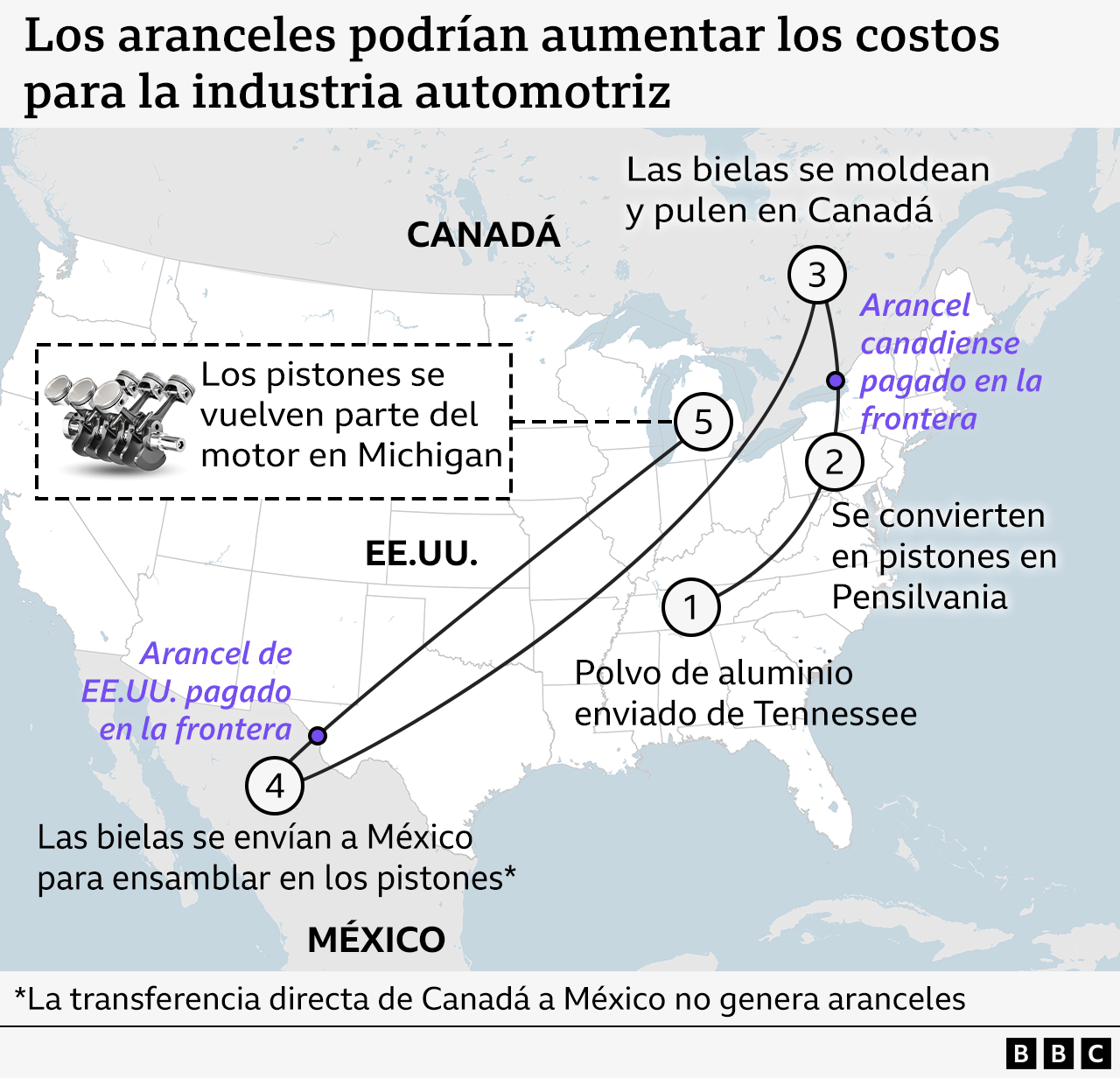
Production is complex primarily due to the high level of industrial integration in the vehicle manufacturing process, and the best way to understand this is through an example, as shown in the following map.

The illustration traces the journey of an auto part from the purchase of the basic material for its manufacture to the moment the piece is finally assembled.
In this case, it involves an aluminum piston, one of the most important mechanical parts in an engine.
Like many other auto parts, the piston travels several times between the three countries before reaching the final consumer.
A car uses several pistons, and their main function is to create the energy that drives the vehicle’s movement.
Here’s an explanation of each point shown on the map:
- Point 1: Aluminum powder shipped from Tennessee
In this map, the piston’s journey begins with aluminum powder, a lightweight metal with high thermal conductivity and easy to cut. The aluminum is transformed into a metal bar from which the piston will be manufactured.
- Point 2: Pistons are made in Pennsylvania
In Pennsylvania, the metal is melted or forged, depending on the piston manufacturing method. Aluminum alloys with other metals are typically used.
- Point 3: Connecting rods are molded and polished in Canada
The piston manufactured in Pennsylvania crosses the border to Canada, where a key part of the mechanism called the connecting rod is molded and polished.
- Point 4: Connecting rods are sent to Mexico for assembly
In Mexico, the piston and connecting rod are assembled. These parts are joined through the crankshaft, an axle that converts linear motion into circular motion and vice versa to reach the car’s wheels.
- Point 5: Pistons enter the engine in Michigan
In Michigan, United States, the piston is finally placed inside the engine, as shown in the illustration.
In this example, the piston crosses North American borders three times: first, it travels from the U.S. to Canada, then from Canada to Mexico, and from Mexico back to the U.S.
However, there are other examples involving more border crossings, depending on the raw material used for the auto part, the number of companies involved in the industrial chain, where the entire vehicle is assembled, and the final destination country of the product.
This explains why a piston may follow a different route than the one shown in the illustration and, in some cases, cross borders up to six times.
This is the case with pistons using aluminum shipped from Michigan to Ontario (crossing the U.S.-Canada border).
In Ontario, the aluminum is melted and transformed, then sent back to Michigan and from there to Mexico for finishing.
From Mexico, it is shipped to Wisconsin, where it is assembled with connecting rods and rings, then travels to an engine plant in Michigan, and from there back to a plant in Ontario.
Finally, the finished vehicle is shipped from Canada to the U.S. or Mexico, where it will be sold.
This complex back-and-forth of a single part is part of a well-oiled commercial mechanism with a long history, on which many small companies providing other services and components during the process depend.
This is the case with a car’s transmission modules, which can cross borders up to seven times, or a seatbelt manufactured in Mexico that may cross North American borders up to nine times.
Thus, with all the auto parts inside a vehicle, tariffs have become a headache for companies located in the three countries involved in the production chain.
What effects could the tariffs have on the auto industry?
The tariffs imposed on the automotive sector add to the 25% duties the Trump administration placed on steel and aluminum in March, amplifying the impact of U.S. tariff policy on its trading partners.
Despite the negative reaction from its neighbors, the White House’s measure includes some exceptions for automotive products from those two countries, such as a clause allowing the “U.S. content” of a vehicle to be deducted from the tariff rate.
Under this exception, cars from those two nations would only have to pay the 25% tariff on their non-U.S. content.
This is determined through a certification process that establishes the origin of the components in the final product.
Therefore, the effect of the tariffs will vary depending on the make and model of the car crossing the border, as not all have the same percentages of foreign and U.S. content.
Some analysts have estimated that cars imported from Mexico may end up paying an average tariff rate of around 15%, but other experts believe it is still too early to determine the actual final percentage.
These conditions will apply to fully imported cars entering the U.S. However, Mexican auto parts are part of a different story.
Auto parts have been spared, for now, from tariffs.
This is because the White House has given auto components a temporary reprieve while it defines a methodology to certify their origin.
Until it does, auto parts will continue to cross borders without tariffs, according to information provided by the Trump administration.
Regardless of the final tariff an auto importer pays, experts have warned that car prices will rise. And Donald Trump himself has said that if prices go up, “he couldn’t care less.”
In the U.S., economists warn that rising vehicle prices could increase inflation, especially since the auto industry tariff comes alongside duties imposed on other products.
The combined effect of these tariff measures is unlikely to keep inflation under control, they argue.
Experts explain that higher car prices could reduce consumer demand and affect the country’s economic growth, potentially leading to a recession.
Economic growth in Mexico and Canada could also be affected, though the situation is even more critical on the Mexican side given the size of its auto industry and the significant weight of its exports in the national economy.
Mexico’s President, Claudia Sheinbaum, has expressed concern about potential job losses from the measure. Many small factories could go bankrupt if they cannot withstand the impact.
There is also concern in Mexico that the White House’s tariff policy could reduce investments, increase unemployment, and affect the overall economy.
Car prices
Mexico is the leading exporter of cars to the U.S., followed by South Korea, Japan, Canada, and Germany.
In 2024, the Latin American country shipped nearly 3 million finished vehicles, worth close to $78.5 billion.
When including auto parts and engines, total exports exceed $182 billion, according to figures from the U.S. Department of Commerce.
Due to the deep regional integration of the auto industry in North America, analysts say car prices will rise.
How much will they rise? That remains to be seen. Different studies estimate prices could increase between $4,000 and $10,000 depending on the model.
What is currently happening is that U.S. consumers are buying more cars in anticipation of projected price increases.
Those who have received the news about the tariffs with satisfaction are workers in the U.S. auto industry. United Auto Workers union leader Shawn Fain, who had opposed Trump in the elections, has praised the president’s actions, saying he was “stepping up to end the free trade disaster that has devastated working-class communities for decades.”
Beyond the auto industry, the widespread application of tariffs on a range of imported products in the U.S. is part of Trump’s strategy, which, according to the president, aims to protect American companies and boost manufacturing.
In Mexico’s case, the president has also used the tariff threat, arguing that the country has not done enough to curb migration and fentanyl trafficking to the U.S. across their shared border.
Whatever the justification, signs point to the White House moving forward with its plan, ignoring warnings about potential economic damage to the country.
“Tariffs are meant to make America rich and great again. And that is happening, and it will happen fairly quickly,” Trump declared in March.
“There will be a little disruption, but we’re fine with that,” he added. “It won’t be much.”
The new taxes on car imports will take effect the same day the “reciprocal tariffs” announced by Trump for the rest of the world are applied.
Image: DiarioNY





