Hollywood’s Earthquake: Why Netflix Let the Deal of the Century Die
The battle for the entertainment throne has taken a turn no one—or almost no one on Wall Street—saw coming with such cold precision. Netflix has officially announced it is withdrawing from the bidding to acquire Warner Bros. Discovery (WBD), rolling out the red carpet for Paramount Skydance, led by David Ellison, to take full control of the empire that owns Batman, Harry Potter, and CNN.
The decision wasn’t impulsive. It was a surgical execution of what the corporate world calls “financial discipline.” While Paramount raised the stakes to stratospheric levels, Netflix decided that owning the industry wasn’t worth it if the price destroyed its balance sheet.

Quick Response: Netflix abandoned its bid to buy Warner Bros. Discovery on February 26, 2026, by refusing to match the “superior” offer of $31 per share presented by Paramount Skydance. The streaming giant deemed the deal no longer financially attractive, paving the way for an $111 billion merger between Paramount and Warner.
The Anatomy of a Withdrawal: “Nice to Have, But Not Essential”
Ted Sarandos and Greg Peters, Netflix’s co-CEOs, didn’t mince words. In a statement already spreading like wildfire, they made it clear that acquiring Warner was a “nice to have”, but never a “must have.”
What really happened behind the scenes?
- Paramount’s Offer: David Ellison, backed by his father’s fortune (Larry Ellison, founder of Oracle), put $111 billion on the table.
- Netflix’s Limit: The Los Gatos, California-based platform stood firm on its original December 2025 agreement, valued at around $83 billion.
- The Risk Factor: Paramount offered a $7 billion breakup fee if regulators blocked the deal. Netflix, already under antitrust scrutiny, wasn’t willing to match that level of “suicidal” commitment.
Did we really need Netflix to get even bigger? Many users feared that absorbing HBO Max under Netflix’s red banner would dilute the quality of “prestige” content. For now, that fear has faded, but a new one has emerged: the rise of a Paramount-Warner mega-conglomerate.
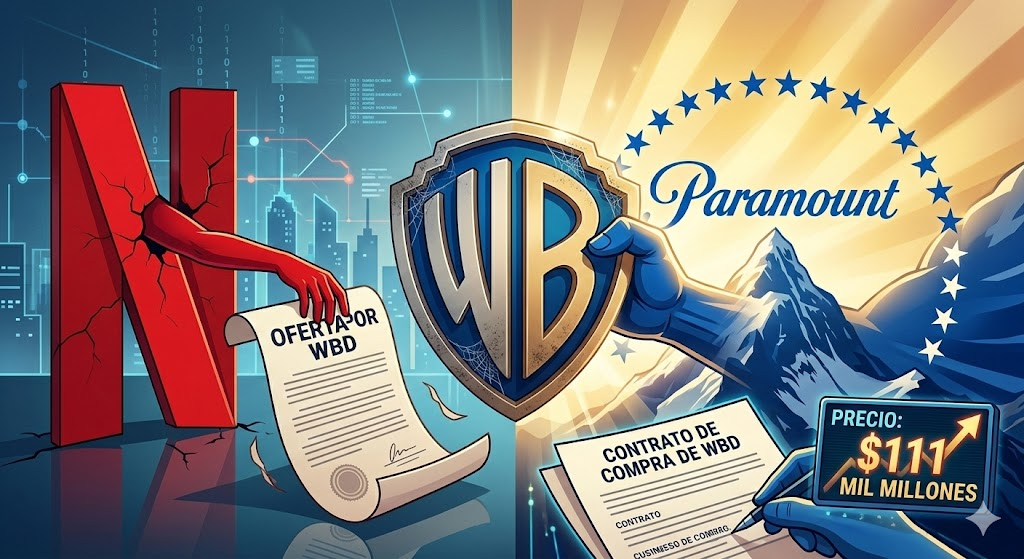
Credit: ElHispanoParaTodos/PRESS
Comparison Table: The Giants’ Duel for Warner
| Feature | Netflix’s Proposal (Withdrawn) | Paramount’s Proposal (Winner) |
| Price per Share | $27.75 | $31.00 |
| Total Value | ~$83 billion | ~$111 billion |
| Scope | Studios and streaming only (HBO/WB) | 100% of the company (includes CNN) |
| Breakup Clause | Standard | $7 billion (Full guarantee) |
| Strategy | Integration into current ecosystem | Massive infrastructure merger |
The “Ellison Effect”: The New Entertainment Landscape
David Ellison isn’t just buying a movie studio; he’s buying a permanent seat at the global culture table. By acquiring all of Warner Bros. Discovery, Paramount will now control:

- Warner Bros. Studios’ legacy (film and TV).
- The DC Universe and Harry Potter.
- HBO and the Max platform.
- CNN, the news giant Netflix didn’t want to touch with a ten-foot pole.
This move positions Paramount as the most formidable competitor to Disney and Netflix itself. The twist? Netflix’s stock rose 10% after the announcement. The market rewarded prudence over unchecked ambition. Sometimes, winning means knowing when to walk away.
What Does This Mean for You as a Viewer?
If you’re a fan of The Last of Us or Dune movies, get ready for more interface changes. It’s almost certain that in the next 18 months, we’ll see a new mega-platform combining Paramount+ with Max.
- Step 1: Regulatory approval (2026’s biggest hurdle).
- Step 2: Catalog consolidation.
- Step 3: Possible price hikes to finance the $111 billion debt.
Image: ElHispanoParaTodos/PRESS