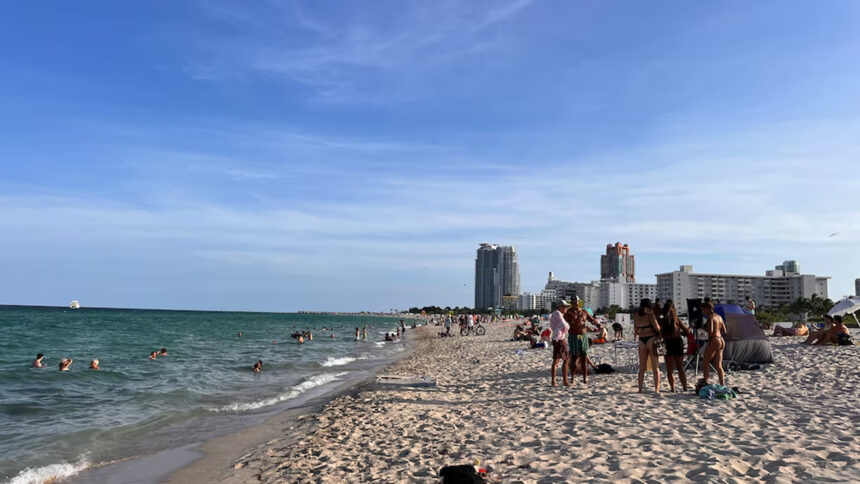
Governor Ron DeSantis signed SB 1622, a law that redefines public access to beaches and coastal restoration procedures in specific Gulf of Mexico counties. According to information from the Governor’s Office and the Florida Senate, this legislation repeals a 2018 rule that had restricted local recognition of the traditional recreational use of beaches. Under the new law, local authorities can more easily adopt ordinances supporting customary recreational activities such as walking, fishing, or swimming on the sandy shore without the need for exhaustive legal processes for each property.
The legislation establishes that, for Gulf counties with fewer than 275,000 residents and at least three municipalities, erosion control will be determined by the mean high-water line (MHWL), based on an official survey conducted by the Board of Trustees of the Internal Improvement Trust Fund.

This will allow restoration projects to proceed on critically eroded coasts without the prior need to establish a specific erosion control line through additional procedures, as previously required.
The legislative action also grants the Florida Department of Environmental Protection (DEP) the authority to carry out restoration projects in areas identified as critically eroded in the official August 2024 report, according to information released by the Office of Ron DeSantis. This measure eliminates the requirement for public easements for restoration projects under this new regulation, but clarifies that any land added to the shoreline by these projects will continue to be considered sovereign state property.

Recreational Use of Beaches
The legal text formally repeals Section 163.035 of the Florida Statutes, which required local governments to obtain individualized court rulings to uphold the “customary recreational use” of beaches, according to the Florida Senate. With its repeal, autonomy is returned to municipal and county governments to endorse traditional public access to the shoreline, which had been limited since 2018 due to legal reasons and disputes between private parties and local entities.
The law states that the state’s intent is not to expropriate or restrict the legitimate use of private property along the shore or submerged land. There is no intention on the part of the Florida government to deprive property owners of their rights to use and enjoyment as recognized by the state Constitution. This clarification aims to ensure that reforms to restore beaches and preserve public access will not result in an extension of state property beyond what is already stipulated by law.

Erosion Control Limits in Florida and Beach Investment
The regulation determines that the mean high-water line will be the reference point for defining the boundary between public and private property on eroded beaches in the selected counties. For areas where a formal erosion control line has not yet been established, the Board of Trustees must adopt it by resolution, recording both the decision and the respective map in the official records of the affected county.
Since 2019, Florida has allocated over $550 million to beach recovery and maintenance. Following the passage of hurricanes Ian, Nicole, and Idalia, the state mobilized additional funds to address the damage. The 2025 state budget includes an extra $53 million for coastal restoration after the impact of hurricanes Helene, Milton, and Debby.
According to the Governor’s Office, beaches and adjacent marine areas generate over $50 billion annually in tourism revenue, support more than 900,000 jobs, and serve as the first natural barrier against tropical storms and hurricanes. The new legislation establishes a stable framework to efficiently respond to the effects of climate change and extreme weather events affecting the state’s coastline.

Image: Infobae