Watch Out Above! The Truth About the “Iguana Rain” Paralyzing South Florida
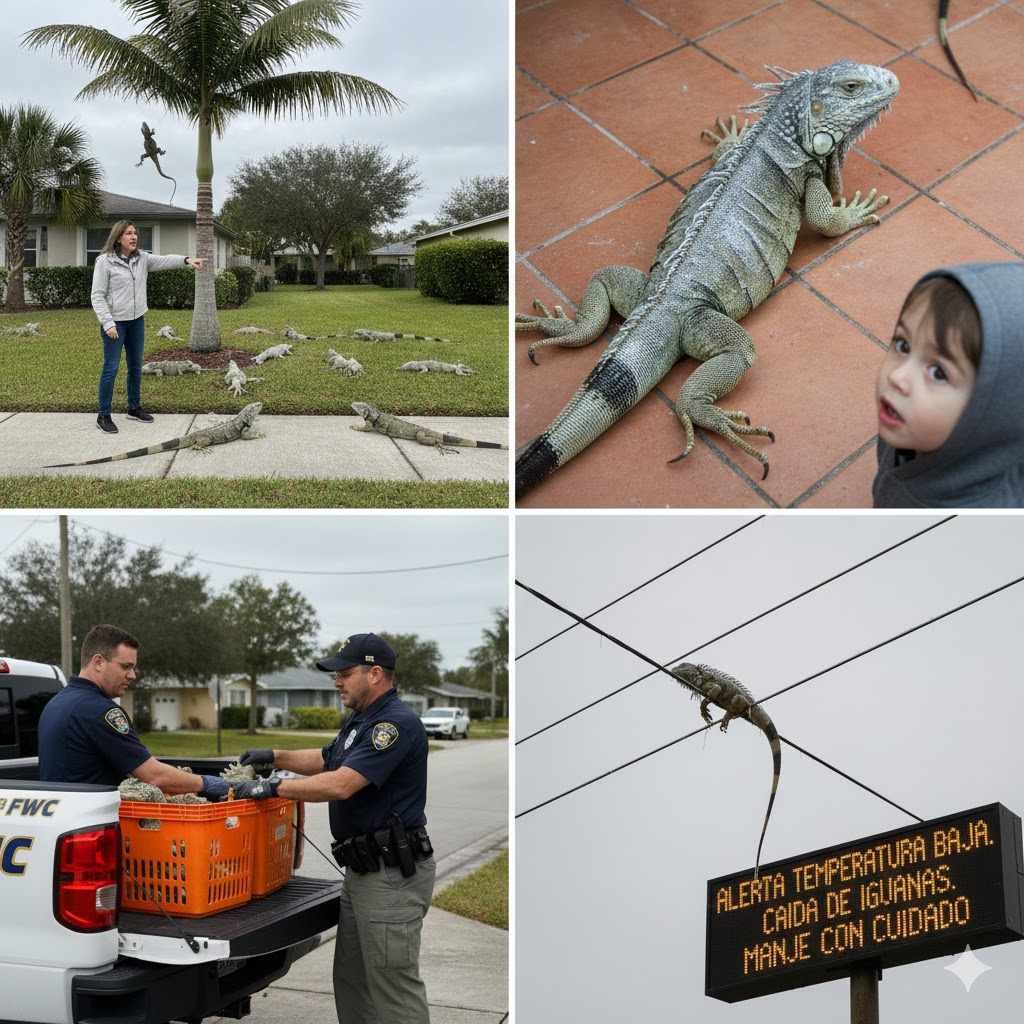
If you live between Miami and Palm Beach, you’ve probably already seen it on social media or, worse, heard it hit the roof of your car: green iguanas plummeting from trees like ripe fruit. This isn’t a sci-fi movie—it’s the biological response of an invasive species to an Arctic cold front that has literally shaken the Sunshine State.
But we’re not just here for the spectacle. There are real risks, temporary laws you need to know, and a scientific reason why that iguana lying motionless in your yard might bite you as soon as the sun comes out.

The Phenomenon in a Nutshell: Why Do They Fall from the Sky?
When temperatures in Florida drop below 50°F (10°C), the metabolism of iguanas shuts down; as they near freezing, their muscles paralyze, they lose their grip on branches, and they fall into a deep state of torpor (they’re not dead, just “suspended”).
⚖️Executive Order 26-03: You Have 48 Hours to Act
The situation is so unusual that authorities have had to take action. The Florida Fish and Wildlife Conservation Commission (FWC) has issued an exceptional measure.
- Window of opportunity: Citizens are now allowed to collect and transport live iguanas to control centers without the usual permits.
- Why the time limit? Once the sun warms the pavement, these reptiles “resurrect.” If you have a 15-pound iguana in the backseat of your car and it wakes up at 75 degrees, you’ve got a serious safety issue.
- The harsh reality: As an invasive species that destroys local infrastructure (seawalls and foundations), the FWC allows their humane removal but prohibits releasing them back into public areas.
Editor’s Note: Don’t be fooled by their harmless appearance when they’re stiff. They’re wild animals with sharp claws and can transmit salmonella. Wear thick gloves or, better yet, don’t touch them.
Anatomy of a Freeze: What Happens to an Iguana’s Body?
Unlike us, iguanas are cold-blooded (ectothermic) animals. They can’t generate their own internal heat. Here’s the step-by-step “freezing” process:
- Alert Phase (50°F): They start moving slowly. Their digestion stops.
- Torpor Phase (45°F – 40°F): Their muscles become rigid. This is when the wind knocks them from palm trees.
- Shock State (Below 40°F): Their heart beats at a fraction of its normal rate. They look like stone statues.
- Risk of Death: If the cold persists for more than 8-10 hours below freezing, smaller and younger iguanas die. Larger ones usually survive to tell the tale.
Risk Table for Residents
| Element | Risk | Pro Recommendation |
| Car roofs | Dents from impact | Avoid parking under palm trees during freezes. |
| Pets | Bites or infections | Keep dogs away; iguanas that “wake up” are aggressive. |
| Pools | Contamination | Check the bottom; they often fall into water and defecate upon waking. |
| Pipes | Structural damage | Iguanas seek warmth near ventilation grates. |
What You Should NEVER Do (Avoid Rookie Mistakes)
I’ve seen it all during these cold spells, and believe me, this is what separates a seasoned Floridian from one who ends up in the ER:

- Don’t bring them inside: “Poor thing, it’s cold.” Wrong! As soon as the AC or heating kicks in, you’ll have a miniature dinosaur running through your living room, smashing vases and trying to bite the first thing it sees.
- Don’t put them in your car: It’s happened before. Drivers find an iguana that appears “dead,” toss it in the trunk, and halfway down I-95, the animal wakes up, causing accidents.
- Don’t try to “revive” them with hot water: The sudden temperature change can kill them or trigger a violent metabolic shock.
How to Protect Your Property
If your yard looks like a reptile graveyard, the best approach is to use a shovel to move them to a brushy area away from where your kids walk. If you decide to remove them, do so following FWC guidelines to avoid unnecessary cruelty.
The Impact Beyond Reptiles
This 2026 cold snap isn’t just affecting iguanas. Farmers in Miami-Dade are reporting risks to mango and avocado crops. Ironically, over-irrigation (used to create a protective ice layer) could be worse than the freeze itself if the soil becomes saturated.
It’s a reminder that even though we live in a tropical paradise, nature always has an ace up its sleeve. Stay warm, watch your trees, and above all, keep an eye on the sky.

Image: ElHispanoParaTodos/PRESS