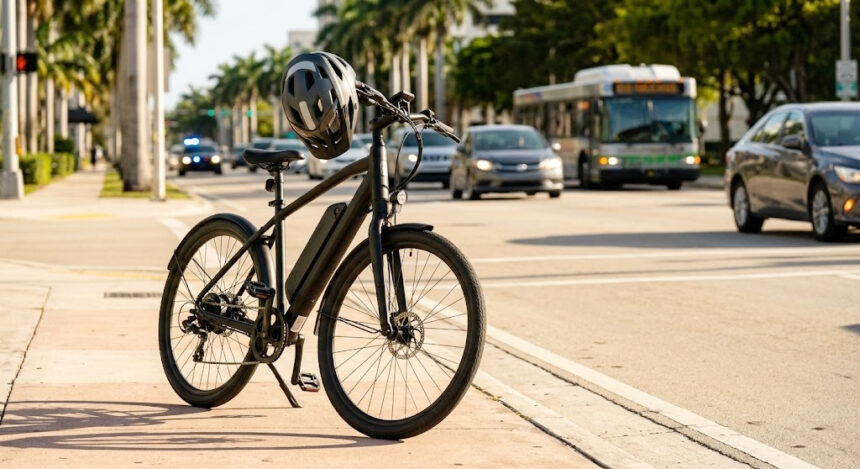
The e-bike boom has triggered a spike in serious accidents in Florida. Discover the new rules on helmets and age limits that will change how your kids get around.
- The dark side of the electric “boom” on our streets
- What exactly does the new Florida law proposal require?
- 1. Drastic extension of mandatory helmet use
- 2. Strict regulation by e-bike “Class”
- 3. Civil liability and confiscation
- The real impact on Hispanic families
- How to protect your loved ones (and your wallet) starting today
Just take a look at any street, from the quiet neighborhoods of Port St. Lucie to the congested avenues of Miami, to see it.

They’re everywhere. Twelve-year-olds weaving through traffic at 25 miles per hour, teenagers blowing through intersections without looking, and adults dodging pedestrians on sidewalks. Electric bicycles (e-bikes) were supposed to be the future of eco-friendly, affordable transportation, but reality has hit us hard.
The truth is that our emergency rooms are seeing the results of combining powerful motors with inexperience and a lack of protective gear.
What exactly is happening in Florida? Faced with a alarming rise in head injuries and traffic accidents involving electric bicycles, state lawmakers in Tallahassee are pushing a package of urgent measures in 2026. The central proposal seeks to drastically expand current regulations: raising the mandatory minimum age for helmet use and reclassifying where these vehicles can operate.
Let’s get to the point. If you bought an electric bicycle for your teenage child, or use one to commute to work, the rules of the game are about to change completely.

The dark side of the electric “boom” on our streets
Let’s be honest. An e-bike is not the traditional bicycle we learned to ride. They have motors (and sometimes throttles) that allow them to reach speeds typical of a light moped, but without requiring, until now, a license, registration, or insurance.
This legal loophole created the perfect storm. Hispanic families have widely adopted e-bikes as a brilliant solution to inflation and high gas prices. However, (and this is where it hurts), many parents are unaware of the real power of the “toy” they’ve just put in their children’s hands.
“We’re treating injuries we used to see only in high-speed motorcycle accidents. Severe maxillofacial fractures, serious traumatic brain injuries. And the worst part: the vast majority of these young patients arrive without wearing a helmet.”
— Dr. Carlos Méndez, trauma specialist in Florida’s hospital network (An example of the current clinical reality).
The statistics that forced politicians’ hands
It’s no secret that Florida frequently tops the nation’s worst lists for road safety. But the rise of e-bikes has tipped the scales to the extreme. According to preliminary reports from state traffic agencies for the end of 2025 and early 2026, collisions involving micromobility vehicles have increased by nearly 40% in urban and suburban areas.

The common factor? The lack of specific regulations and the absence of helmets among riders under 21.
What exactly does the new Florida law proposal require?
Until now, Florida law (statute 316.2065) required cyclists under 16 to wear helmets. Electric bicycles, thanks to previous federal and state regulations, operated in a gray area where they were treated essentially the same as pedal bicycles, regardless of whether their motor could propel them at 20 or 28 mph.
The new legislation being debated in the halls of Tallahassee aims to cut this problem at the root with three fundamental pillars:
1. Drastic extension of mandatory helmet use
The current proposal seeks to raise the minimum age for riding without a helmet from the current 16 to 18, or even 21 years old, specifically when operating an electric bicycle. Fines for non-compliance would no longer be mere “warnings” but direct traffic violations for parents or legal guardians.
2. Strict regulation by e-bike “Class”
Lawmakers want to stop treating all e-bikes the same. Understanding this is crucial to avoid fines of hundreds of dollars:
| E-Bike Class | How It Works | Maximum Speed | Proposed Regulation (2026) |
| Class 1 | Motor assists only when pedaling. No throttle. | 20 mph | Allowed in bike lanes. Helmet mandatory for riders under 18. |
| Class 2 | Has a throttle (moves without pedaling). | 20 mph | Banned on pedestrian sidewalks. Use restricted to streets/bike lanes. |
| Class 3 | Motor assists while pedaling (high power). | 28 mph | Banned for riders under 16. Helmet mandatory for all ages. |
3. Civil liability and confiscation
One detail sparking controversy is the clause allowing local police to temporarily seize Class 2 and 3 bicycles if operated recklessly by minors, forcing parents to appear in order to retrieve them. (Harsh? Maybe. But authorities argue it’s the only way to stop the deaths.)
The real impact on Hispanic families
Here’s what’s interesting (and what affects our community the most). Many undocumented Hispanic workers, or those who simply can’t afford Florida’s high auto insurance costs, rely on electric bicycles to get to their jobs, construction sites, or restaurants.
While stricter regulations are focused on youth safety, they will bring collateral damage. Police surveillance of these vehicles will increase. If you use an e-bike for your daily commute, it will be essential to know your bike’s class, ensure helmet compliance, and obey traffic signals exactly as if you were driving a Toyota Corolla. Authorities will no longer turn a blind eye.
How to protect your loved ones (and your wallet) starting today
Don’t wait for the governor to sign the law to take action. If you have an electric bicycle at home, apply this protocol immediately:
- Identify the “monster” in your home: Check the label on the bike’s frame. By federal law, all must indicate whether they are Class 1, 2, or 3. If it’s Class 3, your 14-year-old simply shouldn’t be using it.
- Invest in a helmet with NTA 8776 certification: (A pro tip that will save you headaches). A regular bike helmet you bought at the supermarket for $15 won’t cut it for a 25 mph crash. Look for helmets certified for e-bikes (NTA 8776); they cover more of the neck and temples.
- Talk about responsibility, not play: Sit down with your kids. Make it clear that cars’ blind spots are deadly. A driver turning right at a red light never expects a “bicycle” to cross their path at nearly 30 mph on the sidewalk.
Technology has advanced much faster than our laws. Electric bicycles are wonderful tools, but the time to use them as toys without rules is over in Florida. It’s time to buckle up and take control before a fine, or worse, a family tragedy, knocks on our door.
AI-generated image for illustrative purposes.