

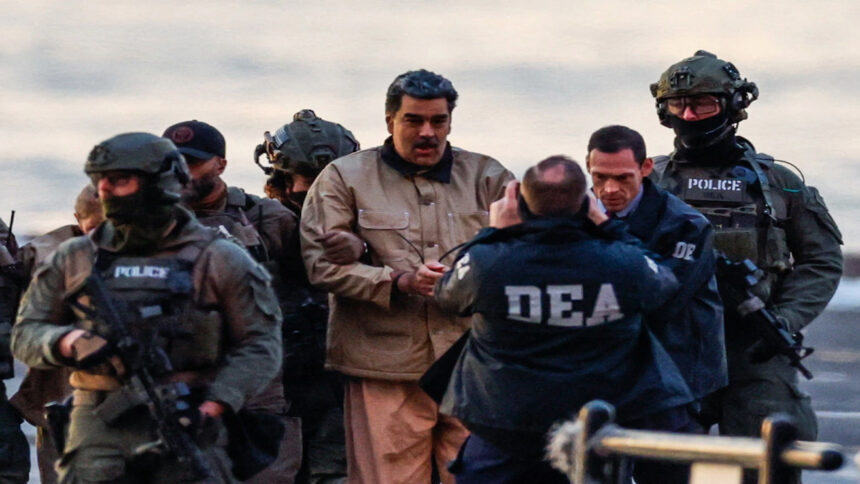
Former Venezuelan dictator Nicolás Maduro appeared Monday before a federal court in New York, where he faces drug trafficking charges that could result in the death penalty if he is found guilty.
- Federal capital offenses primarily include murder, treason, or espionage, and drug-related crimes that do not involve murder. However, death sentences for drug offenses are rare in the U.S. judicial system.
- Maduro and other Venezuelan leaders were originally named in a 2020 drug trafficking indictment.
- Venezuela holds the world’s largest proven oil reserves. However, analysts warn that significantly increasing the country’s oil production will not be easy, fast, or inexpensive.
Maduro, 63, arrived at the courthouse escorted by heavily armed agents. He was transported by helicopter and armored vehicles from the Metropolitan Detention Center in Brooklyn, where he is being held with his wife, Cilia Flores.

Both were captured Saturday in a U.S. military operation in Caracas that included commandos, combat aircraft bombings, and naval support.
Under U.S. federal law, a defendant found guilty of violating the Controlled Substances Act “as part of a continuing criminal enterprise”. May be eligible for the death penalty, according to information from the Library of Congress.
Federal capital offenses primarily include murder, treason, or espionage, and drug-related crimes that do not involve murder. However, death sentences for drug offenses are rare in the U.S. judicial system.
Attorney General Pam Bondi promised Saturday on social media platform X that Maduro and Flores “will soon face the full force of American justice on American soil in American courts.” She did not specify what sentence the Department of Justice would seek if they are convicted.


The case has been compared to the 1989 capture of Panamanian dictator Manuel Noriega, when President George H. W. Bush ordered a similar military intervention. In that case, the U.S. chose to imprison Noriega rather than seek the death penalty.
Maduro and other Venezuelan leaders were originally named in a 2020 drug trafficking indictment.
A federal grand jury addednew charges this year, including narcoterrorism conspiracy, conspiracy to import cocaine, and two charges related to possession of machine guns.

The new indictment also includes “Nicolasito,” Maduro’s son, Venezuelan Interior Minister Diosdado Cabello, and a fugitive drug lord.
President Donald Trump insisted Sunday that the United States is “in charge” of Venezuela and said he is in talks with the country’s new authorities led by interim President Delcy Rodríguez.
“We need full access. We need access to the oil and other things in your country that will allow us to rebuild your country,” Trump said when asked what he needed from the interim leader.
Venezuela holds the world’s largest proven oil reserves. However, analysts warn that significantly increasing the country’s oil production will not be easy, fast, or inexpensive.
Rodríguez, who initially took a defiant stance, shifted her position Sunday by offering to work with the Trump administration. “We extend an invitation to the U.S. government to work together on a cooperation agenda,” said the former vice president.
The Venezuelan military recognized Rodríguez as interim president and called for calm, while about 2,000 Maduro supporters, including armed men on motorcycles, demonstrated Sunday in Caracas.
No official death toll has been announced in Venezuela, but Defense Minister Vladimir Padrino López stated that “a large part” of Maduro’s security team was “cold-bloodedly murdered”, along with military personnel and civilians. Cuba confirmed that 32 of its citizens died in the operation.
The UN Security Council will hold an emergency session Monday at Venezuela’s request. China, Russia, and Iran, which have long-standing ties with Maduro’s government, quickly condemned the operation, while some U.S. allies, including the European Union, expressed alarm.
Image: Infobae





