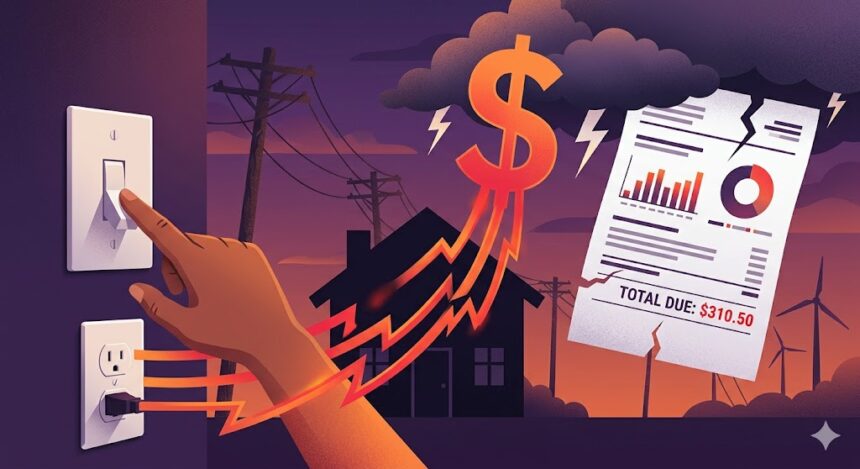
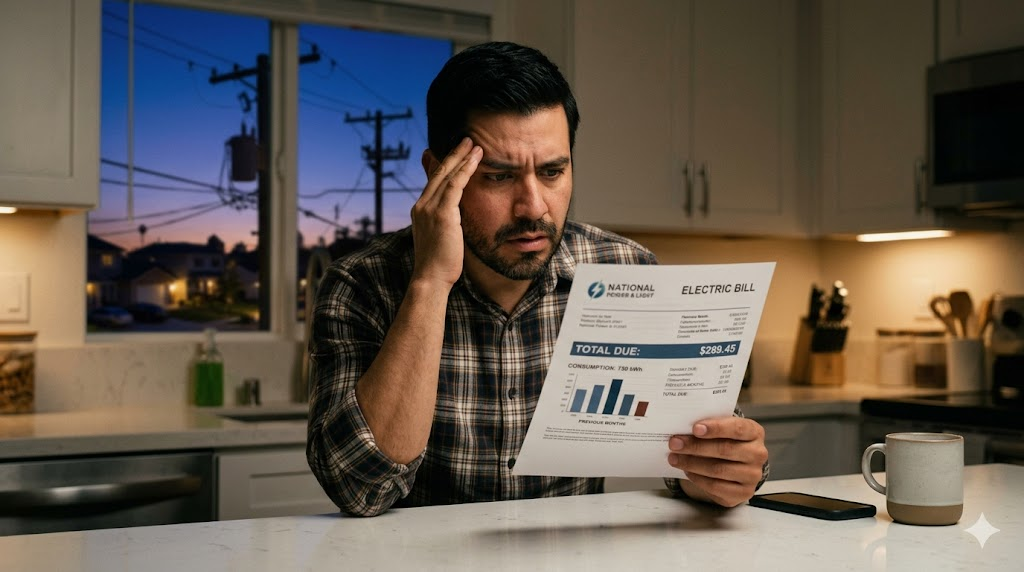
You open the envelope (or email), glance at the total due, and freeze. $250, $300—or even more. The first thing you do is blame your family for leaving the lights on or the air conditioning running, but the reality is far more frustrating: you can be saving energy and still see your electric bill keep rising.
- The Silent Rip-Off: Fixed Charges and Base Rates
- Why Now? The 3 Culprits Behind the 2026 Electricity Crisis
- 1. The Bill for Natural Disasters
- 2. The Hunger of Artificial Intelligence (AI)
- 3. 1970s Infrastructure
- Table: Projected Rate Increases by Region (2026)
- How to Read Your Bill So You Don’t Get Tricked
- “Phantom Consumption”: The Enemy You *Can* Control
It’s not your imagination. It’s a national trend hitting Hispanic communities especially hard in 2026.

Quick Answer (Snippet Bait): The rise in your U.S. electric bill, despite steady usage, is mainly due to higher fixed charges approved by states, billion-dollar investments in upgrading outdated infrastructure, recovery costs from climate disasters, and pressure from demand driven by AI data centers.
Credit: ElHispanoParaTodos/PRESS
The Silent Rip-Off: Fixed Charges and Base Rates
Most of us only look at the “Total Due,” but the secret lies in the breakdown. Utilities have been pressuring state regulators to increase delivery charges and fixed fees.
What does this mean? Before you turn on the first light in your home, you already owe the company money just for being connected to the grid. In states like New York and Florida, these charges have risen between 5% and 12% in just the past year.
- Transmission Cost: The fee for delivering power from the plant to your neighborhood.
- Grid Maintenance: Repairing old wires that are over 40 years old.
- Local Taxes: Often hidden under technical names no one understands.
Why Now? The 3 Culprits Behind the 2026 Electricity Crisis
To understand why your money is disappearing, you need to see the full picture. There’s no conspiracy here—just cold math and political decisions.
1. The Bill for Natural Disasters
If you live in Florida, Texas, or California, part of your electric bill is paying for wildfires and hurricanes from past years. Utilities pass reconstruction costs directly to consumers. It’s a kind of “climate tax” in disguise that has nothing to do with how many hours you leave the TV on.

2. The Hunger of Artificial Intelligence (AI)
Here’s what no one tells you: data centers. The U.S. is filling up with massive warehouses of computers processing AI. These facilities consume industrial amounts of energy, straining the national grid. To prevent a collapse, utilities must invest in new plants and power lines—and guess who pays for that expansion? That’s right: you.
3. 1970s Infrastructure
Much of the U.S. power grid is outdated. We’re trying to power electric cars and smart homes with technology from the vinyl record era. The shift to clean energy (wind and solar) also requires a massive upfront investment that shows up in residential rates.
Table: Projected Rate Increases by Region (2026)
| Region | Average Increase (%) | Main Reason |
| Northeast (NY, NJ, PA) | 7% – 9% | Modernization and Resilience |
| South (FL, TX, GA) | 6% – 11% | Storms and Data Centers |
| West (CA, NV, AZ) | 5% – 8% | Wildfire Prevention |
| Midwest (IL, OH) | 4% – 6% | Transition to Renewables |
How to Read Your Bill So You Don’t Get Tricked
If you want to protect your wallet, you need to learn how to decode the hieroglyphics utilities send you. Look for these sections:

- Supply/Generation: The cost of electricity itself. If you have a private provider (ESCO), this is where they often “inflate” prices.
- Delivery/Distribution: What they charge for wiring. This is the fee that’s rising and you can’t avoid it.
- Riders/Adjustments: Temporary charges for fluctuations in natural gas prices or disaster recovery.
Pro Tip: If you see a disproportionate increase in the “Supply” section, call your company and ask if you’re on a fixed or variable rate plan. Variable plans are a death trap when demand spikes.
“Phantom Consumption”: The Enemy You *Can* Control
While most of the increase is external, there’s a 5% to 10% of your bill you could save by eliminating phantom consumption. Did you know cell phone chargers, video game consoles in “standby mode,” and modern coffee makers still draw power even when “off”? In today’s high-rate environment, those $10 or $15 a month add up more than ever.
Image: ElHispanoParaTodos/PRESS