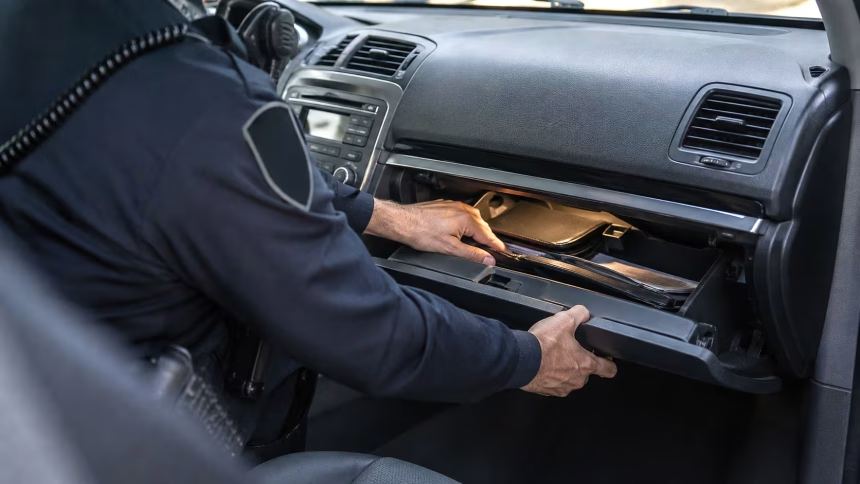
If you’ve ever seen red and blue lights flashing in your rearview mirror, your heart likely skips a beat. Your hands grip the steering wheel, your breathing quickens, and a mix of respect and fear fills the car. For millions of Hispanic drivers in the United States, that moment of tension comes with a silent question: “How far can they search? Do I have to obey every order to the letter, even if it invades my privacy?” The glove compartment is, for many, a catch-all where we keep everything from the vehicle’s registration and insurance to sunglasses, old receipts, cash, or personal items we don’t want to display to strangers. The idea of a police officer ordering you to open that closed compartment without your consent creates a legitimate sense of vulnerability. But what exactly does the law say? Can an officer open it by force? Let’s get to the point.
- The Anatomy of Vehicle Searches: What the Fourth Amendment Says on the Road
- 1. The Legal Standard: Consent, Warrant, or Probable Cause
- 2. The Danger of Inventory After Towing (Impound Inventory)
- Table: Your Rights When Police Make Requests During a Traffic Stop
- Practical Guide: How to Act Smartly and Safely During a Traffic Stop
The Heart of Constitutional Protection (Snippet Bait): As a general rule, a traffic officer CANNOT force you to open your glove compartment or center console without a warrant, your explicit consent, or “probable cause” (such as smelling marijuana, seeing a weapon in plain view, or detecting drugs or evidence of a crime). The Fourth Amendment of the U.S. Constitution protects your vehicle from unreasonable searches and seizures, though there are very narrow operational exceptions that police often use on the road.
The Anatomy of Vehicle Searches: What the Fourth Amendment Says on the Road
To understand your rights during a traffic stop, we must abandon the false belief that a car has the same level of privacy protection as a home. It doesn’t, but it’s also not a rights-free zone where police can do as they please.

1. The Legal Standard: Consent, Warrant, or Probable Cause
The jurisprudence of the U.S. Supreme Court has established that vehicles have a “diminished expectation of privacy” compared to a residence because they travel on public roads and are highly regulated. However, this does not turn your glove compartment into a free-access zone for an officer.
- The Power of Consent: If the officer politely asks, “May I check the glove compartment?” and you respond with a “Yes, of course” or nod your head, you have just voluntarily waived your constitutional protection. Anything the officer finds inside can be used against you in court, even if they had no prior legal reason to suspect you. The golden rule on the road is clear: never give voluntary consent for a search if you are not legally required to do so.
- The Weight of Probable Cause: If the officer does not ask for permission but instead orders you to open the glove compartment, that order must be based on objective, observable facts that give them reasonable belief that evidence of a crime exists in that specific compartment. An officer cannot rely on a “hunch” or “suspicious nervousness” (common but legally weak arguments); they need concrete elements, such as seeing the butt of a gun protruding, smelling illegal substances, or observing erratic movements and clear attempts to hide something just as the vehicle is stopped.
2. The Danger of Inventory After Towing (Impound Inventory)
There is one circumstance where the rules change dramatically: the seizure and towing of the vehicle.
- If the officer decides to arrest the driver (for example, for driving under the influence – DUI, or for not having a valid license in states where this warrants arrest), the car will be towed to the municipal impound lot.
- Under standard police procedure policies, officers are permitted to conduct a “vehicle inventory” before the tow truck takes the car. The official purpose of this inventory is not to search for evidence of a crime but to make a detailed record of valuable items inside to prevent later lawsuits for theft. During this inventory, it is common for them to open the glove compartment and center console. If they find anything illegal there, even if it was not the original reason for the inventory, the discovery is usually legally admissible in court.
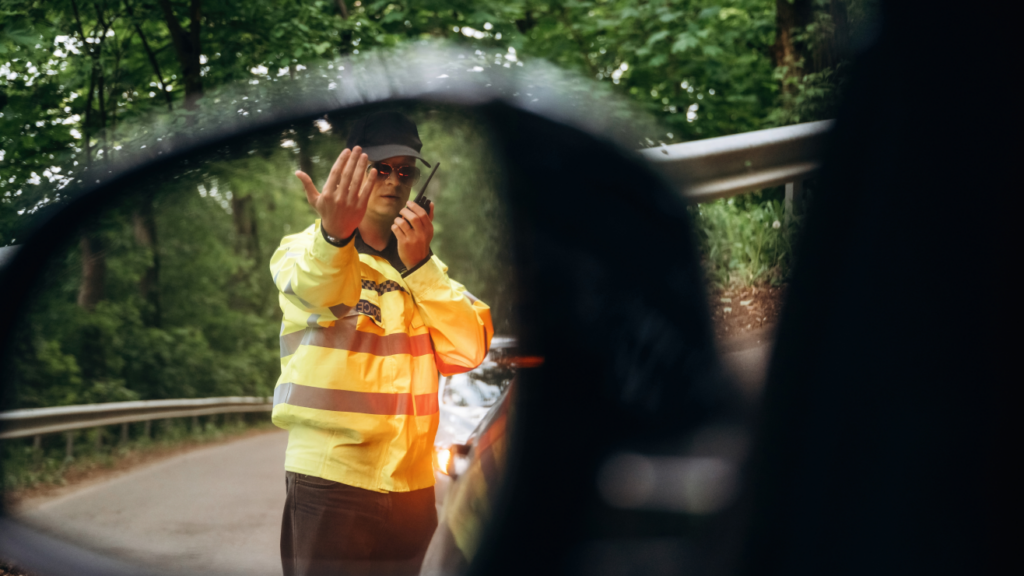
Table: Your Rights When Police Make Requests During a Traffic Stop
To clearly visualize what you should and should not do when an officer stops you, we compare the different situations that may arise inside your car:
| Traffic Stop Situation | Can the officer demand to open the glove compartment? | What should you do or say legally? |
| Routine traffic stop (speeding, broken taillight). | NO, unless they have probable cause or ask for your consent. | Calmly provide your license, registration, and insurance. If they ask to open the glove compartment, you can politely ask: “Officer, are you ordering me to search the car, or are you asking for my permission? I do not consent to searches.” |
| Suspicious odor or clearly evasive behavior upon stopping. | YES, the probable cause exception is triggered by immediate danger or visible evidence. | Stay calm, do not physically resist (that constitutes obstruction of justice), but verbally state that you are not consenting to the search. |
| Access to insurance or registration inside the glove compartment. | YES, with a strict limitation on scope. | If they ask for documents that are in the glove compartment, inform the officer before moving: “The documents are in the glove compartment. May I open it to retrieve them?” This prevents the officer from interpreting your movement as an attempt to reach for a weapon. |
| Driver’s arrest and vehicle towing (Impound). | YES, through the administrative protocol of inventorying belongings. | Cooperate with the officer’s instructions to exit the vehicle. Any objections to the scope of the inventory should be made later in court through your defense attorney. |
Practical Guide: How to Act Smartly and Safely During a Traffic Stop
Dealing with police on the road requires a combination of firmness in your constitutional rights and an attitude of absolute physical respect to avoid dangerous misunderstandings. Follow these steps for legal self-defense:

1. Turn off the engine and turn on the interior light: Pull over safely and visibly.
As soon as you see the patrol car’s lights behind you, find a safe place to pull over to the right, turn on your hazard lights, turn off the engine, roll down your window slightly, and place both hands on the steering wheel where the officer can clearly see them. If it’s nighttime, turn on the interior light. Officers’ anxiety about not knowing what’s inside the car is the number one cause of tense incidents; dispelling any suspicion of a threat from the very first second is vital for your safety.
2. Provide only what the law requires: Mandatory identification without self-incrimination.
The officer has the legal right to ask for your driver’s license, vehicle registration, and proof of insurance. Hand them over calmly. If they ask to open the glove compartment under the pretext of a general search or to “take a look just in case,” remember your right to refuse politely. Say in a firm but calm voice: “Officer, I am cooperating by providing my identification documents, but I do not consent to a search of my vehicle or the glove compartment.”

3. The legal battle is won in court, not on the pavement: Never argue or physically resist on the street.
If the officer decides to ignore your refusal and forcibly opens the glove compartment or orders you out of the car to conduct a search you believe is illegal, under no circumstances should you physically resist, shout, push, or try to close the compartment. Physically resisting an officer in the line of duty is a serious crime in all states, even if the officer had no legal basis for the search at that moment. Verbally state your objection and let your defense attorney challenge the legality of the evidence obtained through a Motion to Suppress before a judge in municipal or state court.
The truth is that knowing the constitutional limits of police on U.S. roads is the best protective shield for our Hispanic community. The Fourth Amendment is not a legal decoration; it is a living tool designed to protect your privacy from abuses of authority. Stay calm, know your rights, and always act with intelligence and respect.
Image: ElHispanoParaTodos/PRESS