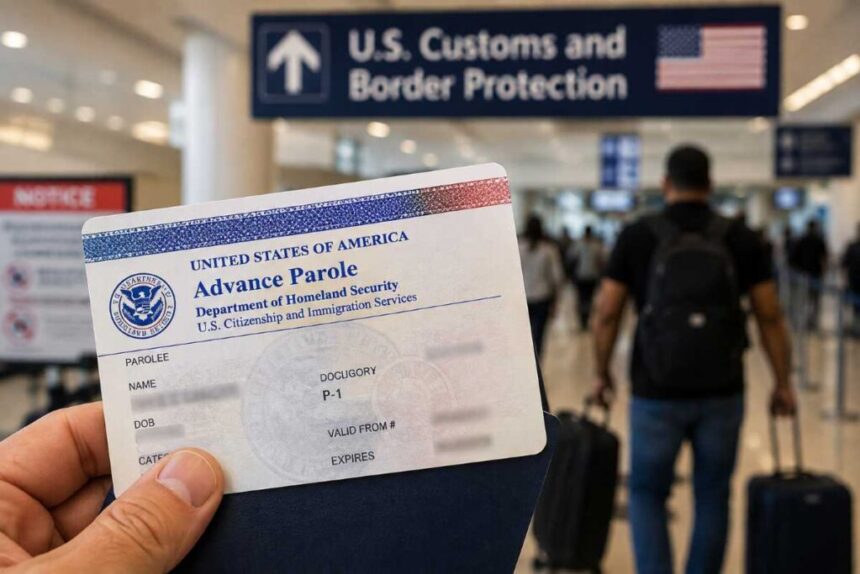
If you are in the United States with a pending immigration status—such as an adjustment of status application based on family ties or TPS—and have considered using Advance Parole (Form I-132) to visit family in your home country due to an emergency or personal reason, pause for a moment. What was once considered a relatively safe right to leave and re-enter the country legally has now become a minefield of catastrophic consequences.
- The anatomy of the jurisprudential change: What exactly did the BIA rule?
- Table: The legal before and after of traveling with Advance Parole
- Practical guide: What should you do if you plan to travel with Advance Parole?
- 1. Count every day of accumulated unlawful presence: Forensic audit of your immigration history.
- 2. Avoid the danger of informal advice: Mandatory consultation with a specialized attorney.
- 3. The harsh reality of emergencies versus the law: Weighing the balance: Is the trip worth the risk of being kept out?
A recent decision by the Board of Immigration Appeals (BIA) has reinterpreted in a restrictive manner how inadmissibility laws apply to those who leave U.S. territory, even with official government authorization. The truth is that thousands of immigrants who trusted the Advance Parole travel document now discover that their departure from the country may have reactivated the feared 3- or 10-year ban for prior unlawful presence. How is this possible, and who is directly affected? Let’s get to the point.

The pulse of the legal change (Snippet Bait): In a drastic jurisprudential shift, the Board of Immigration Appeals (BIA) has determined that the use of Advance Parole by individuals with a history of prolonged unlawful presence in the U.S. does not automatically erase their immigration past upon re-entry, which may trigger the 3- or 10-year inadmissibility ban when applying for permanent residency (Green Card) before a consular or USCIS officer. This ruling shatters the false legal security that leaving with government permission erased the accumulated time of undocumented status.
The anatomy of the jurisprudential change: What exactly did the BIA rule?
To understand the magnitude of this legal blow, we must review how the traditional criterion worked compared to this new and restrictive interpretation of federal immigration law (INA).
1. The false myth of “inspection and admission”
Historically, immigration attorneys advised many applicants that one of the major advantages of Advance Parole was that, upon returning to a U.S. port of entry, the petitioner was “inspected and admitted” (paroled).
- The previous criterion: For certain immigration categories (such as spouses of U.S. citizens who entered without papers), this legal re-entry via Advance Parole met the technical requirement of having been “inspected,” greatly facilitating the adjustment of status process within the country (Form I-485) without needing to leave for their home country’s consulate to request complex waivers (such as the I-601A).
- The BIA’s radical shift: The new legal interpretation establishes that, although Advance Parole allows physical re-entry into the country without immediately violating border control rules, leaving the country materializes the “accumulated unlawful presence” prior to departure, which may directly conflict with the inadmissibility grounds under Section 212(a)(9)(B) of the Immigration and Nationality Act. In simple terms: the system lets you back in with the document, but when reviewing your final eligibility for the Green Card, the officer may argue that your departure broke continuity and triggered the ban.
2. The maze of exceptions and precedents
The BIA’s decision does not affect all immigrants equally but creates a highly confusing and dangerous dividing line between different categories of immigration relief.
- DACA and TPS beneficiaries: Those with Temporary Protected Status or DACA have used Advance Parole extensively to obtain a lawful entry. While some circuit courts have historically protected certain derived rights, this new BIA directive gives adjudicating officers ammunition to question the validity of that re-entry in light of bans for prior unlawful presence.
- The trap of hidden risk: Many immigrants apply for Advance Parole, pay USCIS fees, receive official approval in their mailbox, travel, embrace their families abroad, and return happily through the airport believing everything is in order. Months later, when the permanent residency interview arrives, the immigration officer issues a sudden denial based on the departure having triggered the temporary ban. The emotional and financial blow is devastating.

Table: The legal before and after of traveling with Advance Parole
To visualize with absolute precision the change in scenario facing applicants, we contrast the previous legal reality with the current landscape following the BIA’s ruling:

| Legal/Procedural Criterion | Historical Criterion (Operational Trust) | New Jurisprudential Reality (BIA Ruling) |
| Effect of Departure | Was considered an authorized trip that “froze” penalties for unlawful presence upon return. | Risk of ban activation: Departing abroad materializes the 3- or 10-year ban for previously accumulated time. |
| Guarantee of Internal Adjustment | It was assumed that re-entry with Advance Parole guaranteed the ability to process the Green Card within the U.S. | Discretion and denial: Officers may deny adjustment by arguing inadmissibility upon re-entry. |
| Need for Waivers | In many cases, the provisional waiver I-601A was avoided thanks to legal inspection. | Mandatory complex defenses: The need to demonstrate exceptions or process complex waivers before risking travel increases. |
| Applicant Security | High institutional certainty based on prior USCIS approvals (the physical permit). | Critical uncertainty: Having USCIS approval to travel is no longer a guarantee that the ban will not be applied in the final phase. |
Practical guide: What should you do if you plan to travel with Advance Parole?
If you or a family member has an Advance Parole approval in hand or is considering applying for one due to a family or medical emergency abroad, the current golden rule is just one: Do not travel without a thorough legal audit. Here are the essential self-defense steps.
1. Count every day of accumulated unlawful presence: Forensic audit of your immigration history.
Before setting foot on a plane, you and your attorney must calculate with mathematical precision your history in the United States. How much time exactly did you live in the country without formal legal status before turning 18, or before obtaining DACA, TPS, or a pending petition? If you accumulated more than 180 days or one year of unlawful presence before processing your current protection, your trip with Advance Parole could trigger a 3- or 10-year ban upon return, according to this new BIA interpretation.

2. Avoid the danger of informal advice: Mandatory consultation with a specialized attorney.
This is not the time to consult social media groups or informal processors who say, “my cousin traveled last year and was fine.” The rules have changed drastically. You need a senior immigration attorney specializing in BIA litigation and federal appeals to assess whether your specific case is in a favorable judicial jurisdiction or if the risk of departure is unacceptable.
3. The harsh reality of emergencies versus the law: Weighing the balance: Is the trip worth the risk of being kept out?
Understand an uncomfortable truth about the current immigration system: the Advance Parole document is authorization to request re-entry, but it is never an absolute guarantee of admission. If, after a legal evaluation, it is determined that you have a high risk of inadmissibility due to prior unlawful presence, the unanimous recommendation from experts is to cancel the trip abroad, no matter how painful the family emergency, to avoid being trapped outside the United States and indefinitely separated from your home and children.
The truth is that the BIA’s ruling on Advance Parole adds another layer of hostility and complexity to a U.S. immigration system that already seemed to have reached the limit of comprehensibility. For our Hispanic community, the lesson is clear: trust in traditional bureaucratic processes must be replaced with extreme caution and top-tier professional legal advice. Do not risk your family’s stability without first knowing every corner of the law.
Image: ElHispanoParaTodos/PRESS