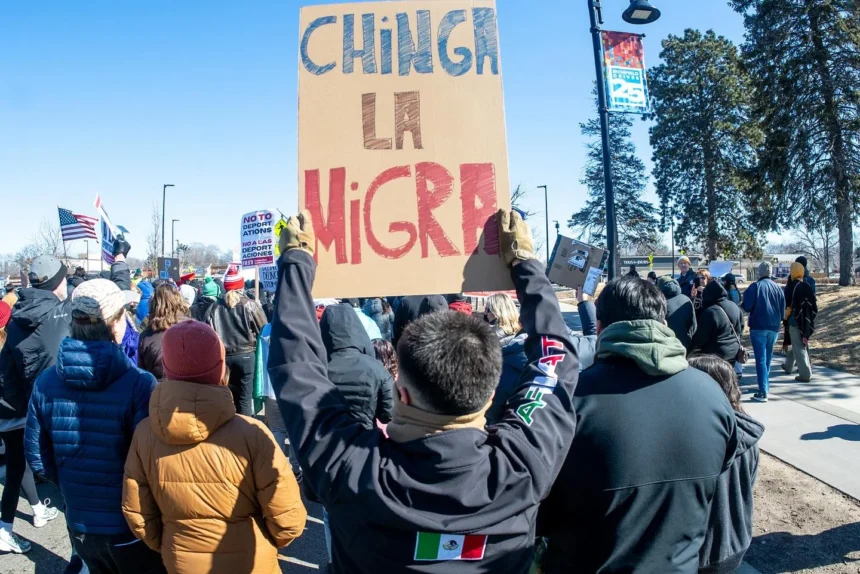
Minnesota on Alert: It’s Not Just a March, It’s a Show of Force
Let’s be honest: the air feels heavy lately. It’s not just the winter chill from the lakes; it’s the political uncertainty. With the change in administration in Washington and promises of mass deportations echoing in the news, the immigrant community in Minnesota has decided it won’t sit idly by waiting for the blow.
- Minnesota on Alert: It’s Not Just a March, It’s a Show of Force
- The ‘Economic Blackout’: Why the Silence of Your Wallet Speaks Louder Than a Shout
- Coordinates of Resistance: The March Against ICE
- The Elephant in the Room: Fear of Raids
- Your Constitutional Rights (Regardless of Your Immigration Status)
- Why Does This Matter NOW?
- Conclusion: Unity Is the Only Strategy
If you live in the Twin Cities or surrounding areas, you’ve probably already seen the flyers or messages on WhatsApp. But this goes beyond walking with a sign.

What will happen this January 23 in Minnesota is a strategic double blow: a physical mobilization in the streets and, most painful for the system, a total withdrawal of our economic power. Does it work? History says yes. Is it risky? It always is. But do we have another option?
Here’s everything you need to know to navigate this day with safety and accurate information.

⚡ What Exactly Is Going to Happen? (Snippet Bait)
In short: This January 23, various pro-immigrant organizations (led by groups like the Minnesota Immigrant Rights Action Committee – MIRAC) have called for a day of civil resistance.
The plan has two pillars:
- The Economic Blackout: No going to work, no sending children to school, and no spending money (zero gas, zero shopping, zero online transactions) for 24 hours.
- The March: A physical gathering to demand an end to local collaboration with ICE and to protect families from forced separation.
The ‘Economic Blackout’: Why the Silence of Your Wallet Speaks Louder Than a Shout
Let’s be clear. You can shout at politicians, and sometimes they don’t even blink. But if you hit big corporations in the pocketbook, the reaction is immediate.
The ‘Economic Blackout’ strategy (or Economic Blackout) isn’t new, but in this political climate, it’s vital. The premise is simple but devastating: demonstrate that Minnesota doesn’t function without immigrants.

The Logic Behind ‘A Day Without Immigrants’
Imagine for a second what would happen if the 250,000+ Latinos and immigrants from other nationalities in Minnesota disappeared for 24 hours.
- Restaurant kitchens in Minneapolis would shut down.
- Construction sites in St. Paul would fall silent.
- Farm fields in the southern part of the state would lose their workforce.
- Supermarkets would see their sales plummet dramatically.
That’s the point. (And it hurts when it happens).
By not spending anything on January 23, you’re sending a direct message to the Chamber of Commerce and local legislators: ‘If you don’t protect us, the state’s economy bleeds.’

What Does Participating in the Consumer Boycott Entail?
For this to work, discipline must be ironclad. It’s not just about missing work (we know that for many it’s impossible due to fear of being fired, and that’s understood); it’s about not spending.
- Avoid: Gas stations, big supermarkets (Walmart, Target), convenience stores, Amazon purchases.
- Alternative: Buy everything you need the day before. Fill up your tank on the 22nd. Stock your pantry.
Coordinates of Resistance: The March Against ICE
While the economic boycott happens silently in homes and businesses, the streets must speak. The physical mobilization seeks media visibility. They want cameras to see faces, families, and unity—not just statistics.
Key Event Details (Verified by Local Organizers)
Although schedules may change at the last minute (always check MIRAC’s social media before heading out), the general structure usually focuses on key areas in Minneapolis.
- Date: Thursday, January 23.
- Focus: Protest against the new federal administration’s deportation agenda and ICE’s presence in local courts and jails.
- The Message: ‘No to collaboration with ICE.’ Minnesota has ‘sanctuary’ laws and ordinances (or separation ordinances), but the community feels they aren’t respected enough.
Who’s Behind This?
This isn’t an improvised event. Behind it is a coalition of veterans in the struggle:
- MIRAC (MN Immigrant Rights Action Committee): Historically the most active in the area.
- Local Unions: Supporting essential workers.
- Student Groups: Often leading ‘walk-outs’ (school strikes).
Editor’s Note: It’s curious how in times of crisis, the community unites in ways that seem impossible in times of ‘peace.’ Adversity is the strongest glue there is.
The Elephant in the Room: Fear of Raids
We can’t ignore the obvious. People are afraid. And they have reason to be. The current political rhetoric promises a hard line, and mass events like this sometimes raise the question: ‘Is it safe to go?’
This is where preparation comes in. Don’t let panic paralyze you, but don’t be naive either.
Safety Protocol for Protesters
If you decide to attend the march, please follow these golden rules. (Memorize them).
| WHAT YOU SHOULD DO (DO’S) | WHAT YOU SHOULD NEVER DO (DON’TS) |
| Go with a buddy: Never go alone. Use the buddy system. | Don’t carry weapons: Not even a Swiss Army knife. Nothing the police can use as an excuse. |
| Document everything: Have your phone charged and ready to record any police interaction. | Don’t provoke: Keep the protest peaceful. Violence undermines the message and puts you at risk. |
| Identification: Carry valid ID (if you have it) or the red ACLU rights card. | Don’t reveal your status: If detained, DO NOT talk about your place of birth or sign anything without a lawyer. |
| Plan B: Write a lawyer’s or trusted family member’s number on your arm (with a marker). | Don’t run: If police approach, stay calm. Running can be interpreted as guilt. |
Your Constitutional Rights (Regardless of Your Immigration Status)
This is the most important thing you’ll read today. The U.S. Constitution protects people, not just citizens, when they are on American soil. The First Amendment gives you the right to freedom of speech and peaceful assembly.
If ICE or the Police Detain You:
- Remain Silent: You have the right to remain silent. Say out loud: ‘I am exercising my right to remain silent.’
- Don’t Sign Anything: They can pressure, lie, or threaten you into signing your own voluntary deportation. Don’t do it without a lawyer reviewing the document.
- Ask if You’re Free to Leave: ‘Am I free to go?’ If they say yes, walk away slowly. If they say no, ask for a lawyer immediately.
- Your Home’s Door: If ICE comes to your home, DO NOT OPEN. They must show you a judicial warrant signed by a JUDGE (not by ICE) under the door or through a window.
Important Note: Most ICE administrative orders don’t give them the right to enter your home without your consent. They’re counting on you not knowing this and opening the door out of fear.
Why Does This Matter NOW?
We’re at a turning point. January 20 marks the start of a new political cycle in the U.S., and Minnesota, as a state that has traditionally welcomed refugees and immigrants (Somali, Hmong, Latino), becomes an ideological battleground.
State laws in Minnesota have advanced (like the ‘Driver’s License for All’), but the fear is that federal pressure will try to revoke or ignore these local advances.
This march on January 23 is a preventive message. It’s the community saying: ‘We’re here, we’re essential, and we’re not going to hide in the shadows again.’
Impact on Schools
You’ll likely see empty classrooms. Many parents have decided not to send their children to school that day as part of the boycott. If you’re a parent, communicate your decision to the school, but be aware of your district’s attendance policies. Many school districts in Minneapolis and St. Paul are understanding of these causes, but it’s always best to verify.
Conclusion: Unity Is the Only Strategy
At the end of the day, a few hours of marching or a one-day boycott won’t magically change federal laws. But it changes the narrative. It reminds us that we’re not invisible.
If you can march, march. If you can’t march due to work or health, join the economic blackout. If you can’t do either, share this information.
The history of civil rights in this country wasn’t written by asking for permission; it was written with worn-out shoe soles on asphalt and voices united in the cold. Minnesota, on January 23, the world is watching you.
Image: ElHispanoParaTodos/PRESS