

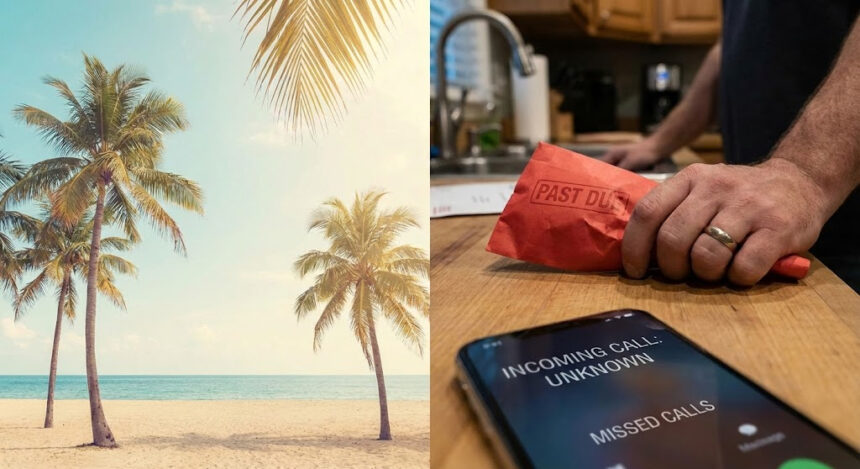
Florida climbs to the #7 spot for debts in collections according to WalletHub. Discover why bills are overwhelming the state and a step-by-step guide to clean up your credit today.
- Is your phone constantly ringing? You’re not alone: Florida sinks into delinquency due to high debts in collections
- The Shameful Ranking: What do the numbers say?
- Why Florida? The Perfect Storm
- Impact Table: Debt vs. Consequence
- Survival Guide: What to do if you’re part of the statistic
- Step 1: The Golden Rule (Don’t talk on the phone)
- Step 2: Demand Validation (Your federal right)
- Step 3: Know the “Statute of Limitations” in Florida
- Conclusion: A call for financial education
Is your phone constantly ringing? You’re not alone: Florida sinks into delinquency due to high debts in collections
Let’s be honest: living in Florida, the “Sunshine State,” has become a financial nightmare for many. Between rent, which rises faster than foam, and auto insurance that feels like a mortgage, paychecks just don’t stretch far enough.

If you’ve had to choose between paying your credit card or buying groceries this month, you’re not alone. And now, we have the data to prove it.
A new report has set off economic alarms: Florida officially ranks seventh in the nation for the highest number of accounts in the hands of collection agencies.
According to the latest study by financial platform WalletHub, the high volume of Floridians with accounts “in the red” signals a severe liquidity crisis. It’s not that people don’t want to pay; it’s that they can’t.
In this in-depth report, we’ll break down what this means for your financial future, why Florida is suffering more than other states, and—most importantly—what legal tools you have to defend yourself if creditors come knocking.

The Shameful Ranking: What do the numbers say?
WalletHub compared all 50 states using proprietary (anonymized) credit data from users to determine where consumers are struggling the most. The key metric was the “average number of accounts in collection per person.”
The result for Florida is discouraging. Ranking #7 means we’re worse off than the vast majority of the country.
What does it mean to have an account in “collections”? It’s not just a late payment. It’s the final link in the chain of financial disasters:

- You stop paying for 90 to 180 days.
- The original creditor (the bank, the hospital, the utility company) gives up on collecting.
- They sell your debt to an outside agency for pennies on the dollar.
- That agency now hounds you to collect the full amount.
The reality of the system: Once your debt goes to collections, your credit score can drop by 50 to 100 points overnight. It’s a stain that lasts 7 years on your report. And with Florida in the top 10, this suggests thousands of Hispanic families are seeing doors close on buying a home or renting a decent apartment.
Why Florida? The Perfect Storm
Why are we ranked #7 instead of #40? What makes Florida so difficult for staying current? Analyzing the local economic context, we find three main culprits that WalletHub implicitly mentions in its cost-of-living analyses:
1. Housing Inflation
In cities like Miami, Tampa, and Orlando, the cost of housing has far outpaced wage growth. When 50% or more of your income goes to rent, any unexpected expense (a flat tire, a doctor’s visit) goes straight to the credit card. Eventually, that card stops getting paid.
2. Insurance Out of Control
Florida has the highest auto and home insurance premiums in the nation. This is a “phantom expense” that eats away at savings.
3. Stagnant Wages
Unlike states in the Northeast or California, Florida has historically had lower wages in the service, tourism, and construction sectors—industries where the Hispanic community is a driving force.
Impact Table: Debt vs. Consequence
To understand the severity of WalletHub’s report, look at this comparison of how the problem evolves:
| Account Status | Credit Impact | Bank Action | Easy Fix? |
| Current | Positive | Increases limit | Yes (Maintain) |
| Late (30-60 days) | Mild (-20 pts) | Calls and fees | Yes (Pay quickly) |
| Default (+90 days) | Serious (-50 pts) | Account closure | Difficult (Negotiate) |
| In Collections (FL Ranking) | Devastating (-100 pts) | Sold to third parties / Lawsuit | Complex (Legal) |
Survival Guide: What to do if you’re part of the statistic
If you’re contributing to Florida’s #7 ranking, don’t panic. Fear paralyzes, and that’s what collectors want. Here’s a three-step, ironclad strategy.
Step 1: The Golden Rule (Don’t talk on the phone)
Collection agencies record everything. If you admit to the debt over the phone, you could restart the “statute of limitations” clock, making an old debt legally collectible again.
- Pro Tip: Say: “Please send me all information by mail. I do not discuss financial matters over the phone.” Then hang up.
Step 2: Demand Validation (Your federal right)
Under the Fair Debt Collection Practices Act (FDCPA), you have the right to request proof. Often, these agencies buy debts without the original paperwork.
- Send a “Debt Validation Letter” via certified mail. If they can’t prove the debt is yours within 30 days, they must remove it from your credit report.
Step 3: Know the “Statute of Limitations” in Florida
This is crucial. In Florida, the statute of limitations for most debts (written contracts like credit cards) is 5 years.
- If the debt is older than that, they cannot sue you legally to collect, though they may still call. (Note: The debt still exists, but they lose the power of the court.)
Conclusion: A call for financial education
Florida ranking seventh in delinquent accounts is a wake-up call, but also an opportunity to take action. The economy may be tough, but financial ignorance is even more costly.
Don’t let a statistic define your future. Check your credit report today (it’s free at AnnualCreditReport.com), identify accounts in collections, and tackle them one by one.
Remember: Having debt isn’t a crime, and being broke isn’t the end of the world. It’s just a math problem with legal solutions.
Image created with artificial intelligence for informational purposes





