


The war against Iran now has faces and names on American soil. The Pentagon has broken its institutional silence to identify four of the six service members who lost their lives last Sunday in a drone attack in Port Shuaiba, Kuwait. As the country processes the news, a burning question emerges in the halls of Washington: How could a single drone evade the cutting-edge technology of the world’s most powerful military?
The truth is, they were not on the front lines; they were reservists dedicated to logistics, the “nervous system” that keeps any military operation standing. Here’s who they were and why this attack marks a before and after in Operation Epic Fury.

Incident Summary: On March 1, 2026, an Iranian drone struck a tactical operations center at the port of Shuaiba, Kuwait. The attack left 6 U.S. soldiers dead (4 already identified) and several wounded, after early warning systems failed.
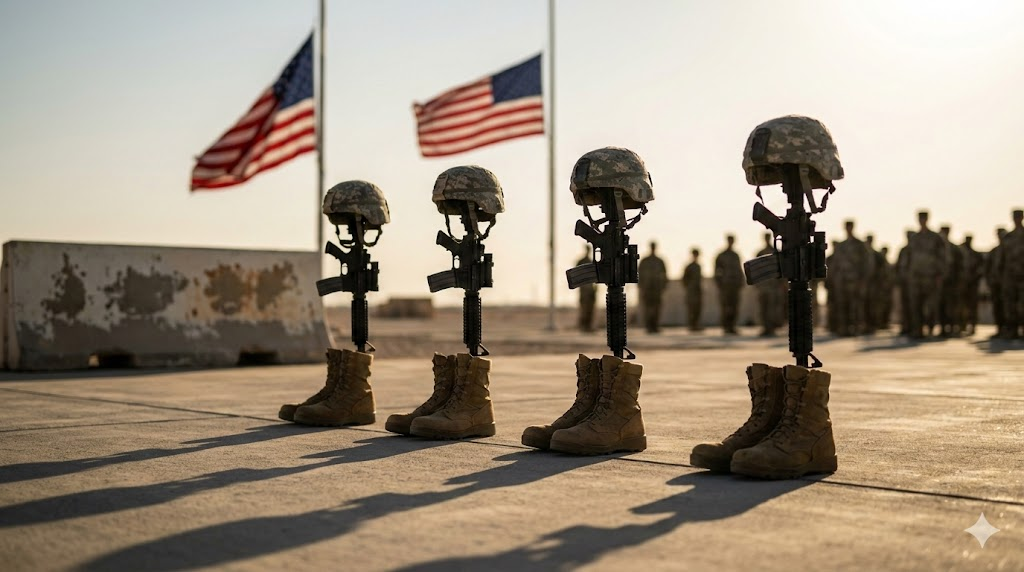
Credit: ElHispanoParaTodos/PRESS
Faces of Sacrifice: Who Were the Fallen?
All those identified belonged to the 103rd Sustainment Command, an Army Reserve unit based in Des Moines, Iowa. They were not rookies; they were men and women with civilian lives, families, and a service record that today mourns four different states.
1. Captain Cody A. Khork (35)
From Winter Haven, Florida. Khork was a veteran officer with previous deployments in Saudi Arabia, Guantanamo Bay, and Poland. His experience was vital for coordinating the flow of supplies in the region.
2. Sergeant First Class Noah L. Tietjens (42)
From Bellevue, Nebraska, Tietjens was a pillar of the unit. He had previously served in Kuwait on two occasions (2009 and 2019). His return to the Persian Gulf in 2026 was his final act of service.
3. Sergeant First Class Nicole M. Amor (39)
Mother of two and a resident of White Bear Lake, Minnesota. According to her husband, who spoke to local media, Nicole was just days away from completing her deployment and returning home. Her death has sparked particular outrage due to details about her location at the time of the strike.

4. Sergeant Declan J. Coady (20)
The youngest of the group, from West Des Moines, Iowa. Coady was posthumously promoted from specialist to sergeant. He was studying cybersecurity and was considered one of the unit’s rising stars.
The Security Failure: “No Sirens, No Warnings”
Here’s what should truly concern us. According to sources close to the investigation and testimonies from family members like Joey Amor (Nicole’s husband), the soldiers had been moved shortly before the attack to shipping-container-style structures outside the main base.
The reason? To disperse the troops to prevent a massive attack on the central base from causing multiple casualties. Paradoxically, this “security measure” left them vulnerable.

- Lack of armor: The containers had no reinforced protection against aerial strikes.
- Deadly silence: No alarms sounded. The Iranian drone evaded radars and Patriot defense systems, striking directly where the soldiers were resting or working.
- The element of surprise: Iran has launched over 500 missiles and 2,000 drones in this counteroffensive, but this attack in Kuwait demonstrates that its precision capability is greater than the Pentagon initially admitted.
Table: Casualties and Identification Status (March 2026)
| Rank and Name | Age | State of Origin | Notification Status |
| Capt. Cody A. Khork | 35 | Florida | Confirmed |
| Sgt. 1st Class Nicole M. Amor | 39 | Minnesota | Confirmed |
| Sgt. 1st Class Noah L. Tietjens | 42 | Nebraska | Confirmed |
| Sgt. Declan J. Coady | 20 | Iowa | Confirmed |
| Not disclosed | — | — | Pending family notification |
| Not disclosed | — | — | Pending family notification |
What’s Next for Operation Epic Fury?
President Donald Trump has already warned that these will not be the last casualties. In an unusually somber tone, he called the fallen “true patriots” but made it clear that the mission continues. However, internal pressure is growing.
The Hispanic community in the U.S., which has a disproportionately high representation in the armed forces, is closely watching how this conflict unfolds. Many are questioning whether the human cost is worth it in a scenario where technology seems to be failing those who need it most.
The truth is… if the Pentagon cannot adjust its defenses against low-cost, high-precision drones, the flow of coffins to Dover Air Force Base will not stop anytime soon. Logistics, once the “safe” zone behind the lines, is now the primary target.
Image: ElHispanoParaTodos/PRESS





