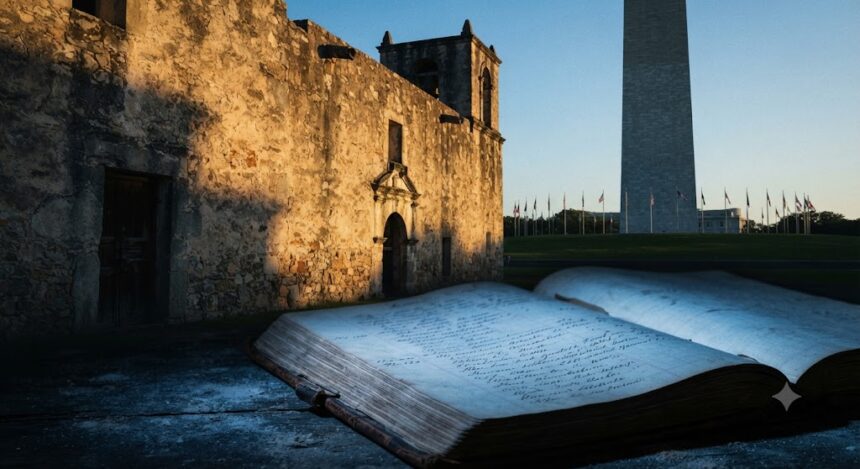
The celebration of the United States’ 250th anniversary feels, for millions of Hispanic families, like a party they were invited to—but whose hosts seem to have forgotten they helped build the house. While screens and textbooks prepare to highlight the epic of the thirteen British colonies, the historical map conveniently narrows, ignoring centuries of Spanish and Mexican presence, blood, and sweat that preceded July 4, 1776.
The truth is, this isn’t just an accidental omission; it’s a narrative architecture designed to uphold the myth of a nation forged exclusively by Anglo-Saxons.

The Verdict of Omission (Snippet Bait): As the U.S. approaches its 250th anniversary, Hispanic history remains marginalized in official celebrations, deliberately hiding that before the arrival of the Mayflower, Spanish explorers and settlers had already established cities, missions, and trade routes—from St. Augustine to Santa Fe—that served as the geographic and strategic foundations upon which the young republic expanded.
The Myth of the “Anglo-Saxon Nation”: Who Arrived First?
The official narrative tells us that U.S. history is a straight line from Jamestown to Philadelphia. But is that really the case? Hispanic history in this territory isn’t a “footnote”; it’s the prologue that many prefer to tear out of the book.
- St. Augustine (Florida, 1565): It’s the oldest continuously inhabited European-founded city in the U.S., established 42 years before Jamestown. Yet, in the 250th-anniversary narrative, it’s often mentioned as a tourist curiosity, not as the origin of European administration on the continent.
- The Southwest and the West: Before the “Westward Expansion,” organized Spanish governorships existed. Cities like Santa Fe (New Mexico) were centers of trade and culture decades before U.S. independence was even a whisper.
- The Contribution of Bernardo de Gálvez: Without the military and logistical support of this Spanish general, who blocked British supply lines and opened the Mississippi, Washington’s victory in the Revolutionary War would have very likely been an impossible dream. Is he given this prominence in national celebrations? Rarely.
The Architecture of Forgetting: Why Is Our History Invisible?
Here’s the interesting part: It’s not that the data doesn’t exist. The archives are there. Invisibility is an editorial decision by the educational and cultural establishment.
The Problem with the Narrative: If we accept that Hispanic influence is foundational, the myth of “American exceptionalism” based purely on British heritage crumbles. A linear and “white” history is preferred because it’s easier to sell as national cohesion, even if it’s a historical fallacy.
The Segregation of the Narrative
For Hispanic readers, this has real consequences:
- Identity Disconnection: Many young Latinos grow up feeling like “guests” in a country that, in reality, has deep roots in their own culture.
- Prejudice Validation: If the official history says Hispanics arrived “yesterday” as immigrants, it’s easier to treat them as second-class citizens. Historical invisibility is the first step toward political marginalization.

Table: Timeline the Official Narrative Prefers to Ignore
So you can debate with facts, here’s a comparison of what the 250th anniversary will remember versus historical reality.

| Milestone | Official Narrative (The “Myth”) | Historical Reality (The “Fact”) |
| Start of Colonization | 1607 (Jamestown, English) | 1565 (St. Augustine, Spanish) |
| Independence | Purely Anglo-Saxon achievement | Key support from Spain (Gálvez) and France |
| Structure of the West | The “Wild Frontier” | Spanish colonial routes and missions |
| National Identity | British heritage | Melting pot of cultures (often erased) |
How to Reclaim Our History in These 250 Years
We can’t wait for institutions to change the script on their own. Reclaiming our narrative is a militant task for every family.
1. Critical Education at Home: Demystification.
Don’t accept the simplified version in your children’s textbooks. Seek primary sources on the role of missions, the Royal Road, and the participation of Hispanic soldiers in the Revolutionary War.
2. Visit Historical Sites: Local Memory.
Go to St. Augustine, the Alamo, or the California missions. Learn about the architecture, language, and history. When you’re there in person, the official narrative can’t erase the physical evidence of our existence.

3. Demand Representation: Civic Presence.
In this 250th anniversary, ask your local representatives: What events will be held to honor the Hispanic heritage in our community? Visibility isn’t requested—it’s demanded through participation in local events.
The celebration of the United States’ 250 years should be the perfect moment for brutal honesty. If this country truly wants to be a union, it must start by recognizing that its history didn’t begin in 1776, nor was it written only by English-speaking men. Staying silent is allowing others to write our part of history.
Image: ElHispanoParaTodos/PRESS