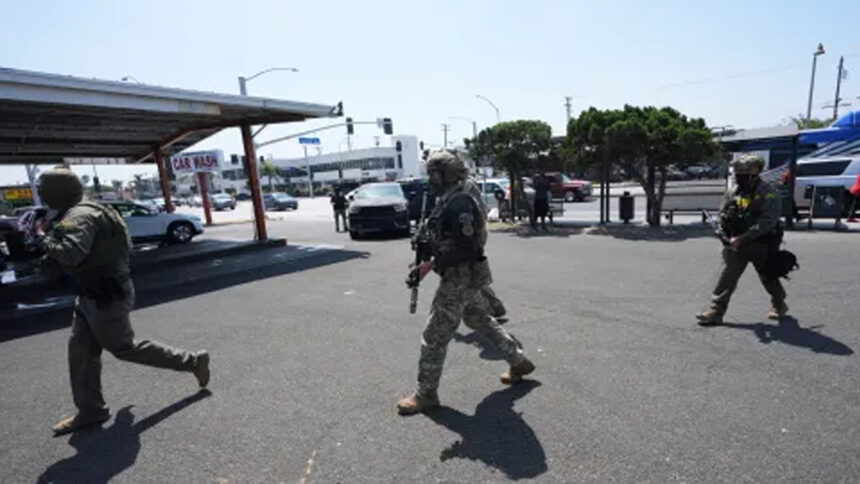
The excitement of back-to-school has been replaced by fear. With raids in many communities across the country, children face terror not knowing if their parents will be home when they return from school or if immigration agents will arrest them when dropping them off at class.
During a press conference organized by America’s Voice, Alberto Carvalho, superintendent of the Los Angeles Unified School District (LAUSD), said they have implemented protection protocols like nowhere else in the country, with a family preparedness guide that helps parents navigate these uncertain times, even empowering a trusted neighbor or family member with the ability to care for their children.

This includes coordinating with local, municipal, and mayoral entities, agreements, and support and protection perimeters for children, particularly on their journey from home to school and back.
“We have requested federal entities create exclusion zones two blocks from schools, one hour before the start of the school day and one hour after, to ensure our children do not face the unimaginable.”
He noted that most adults are shocked to see armed federal agents jumping out of vehicles and detaining adults.
“Imagine the social and emotional impact those same images have on the children we serve. That’s why we’ve trained every member of our staff and refused entry to national security agents at two of our schools because they wanted to speak with a first- and second-grade child.”

He pointed out that the work is not over, and in fact, just a couple of weeks before the first day of school, they had a 15-year-old child with disabilities temporarily detained, presumably due to an identity mix-up.
“This is not right. Our children should not be pawns of political powers that undermine their rights, dehumanize them, and, in the process, terrorize families.”
Slight Decline in Enrollment
The superintendent acknowledged they have seen a slight decrease in enrollment, partly due to immigration issues in families with one or both parents in a fragile immigration status, but whose children are citizens by birth.

“Twenty weeks before the start of the school year, we brought in social workers, psychiatrists, and counselors, and began calling households.”
He said he did so himself, seeking to understand the circumstances and provide resources to explain parents’ rights and stabilize their situation.
“But we didn’t stop there. We added additional bus routes and guaranteed free transportation for everyone in the community, avoiding what could be a dangerous trip from school to home or vice versa.”
They also have rapid response and crisis teams that, after the school day, address parents’ needs.
“These counselors and psychiatric social workers also offer free legal assistance to families. So far, we’ve called a total of 14,000 households and visited the doors of more than 2,000.”
However, he said they have called some families and received no response.
“When we visited the neighborhood, some neighbors told us the family had self-deported out of fear.”
Without a doubt, he said this has impacted enrollment, though he believes that due to the number of protection protocols they’ve implemented, they are likely better off than other communities that haven’t necessarily adopted a collaborative approach with labor entities, community organizations, advocacy groups, local mayors, and schools.
Fear and Uncertainty
Clinical psychologist Allison Bassett Rado said the way immigration policies are enforced causes intense anxiety, stress, and even trauma.
“This is because when children see immigrants detained—whether directly in their homes and communities, on the news, or online—they don’t see violent criminals being detained by uniformed police but their classmates, family members, and neighbors being violently arrested while picking up their children from the bus stop or going to work. This creates the feeling that no one and nowhere is safe.”
She stated that this impact isn’t limited to the children of immigrants but extends to all children, even those in families not at risk of deportation.
“Young children, in particular, often don’t understand what they see, which generates fear and worry that they or their families could be next.”
She said that as a child psychologist and mental health professional, she is especially concerned that the stress, anxiety, and trauma developing in children in this climate of fear and uncertainty around immigration enforcement could become chronic.
“Children growing up in this climate are vulnerable to continuous trauma, so they are never able to confront what they’re experiencing or recover.”
She maintained that this is even more harmful to children with disabilities and mental health issues who are struggling because they are particularly vulnerable to anxiety and trauma and have a lower capacity to recover.
“They are also even more affected as they lose access to essential services for their health, development, and well-being.”
Safe Zones
Noel Candelaria, special education teacher and secretary-treasurer of the National Education Association, which represents over three million teachers, revealed they are adopting Safe Zone policies with school board members and superintendents.
“Not only so students know they are safe but also to send a public message to communities across the country: you are welcome in our public schools.”
At the same time, he said, they are distributing “know your rights” cards and developing resources to support immigrant students.
While he noted that the Trump Administration should never have put students, families, and educators in this situation, they are united to protect one another.
“Every school leader and educator has the responsibility to ensure their school is a safe zone. As educators, we will not stand idly by while our children suffer trauma, and we will continue fighting for a future where every student, regardless of their background, can learn and thrive in a safe and welcoming environment.”
The Hidden Cost
Vanessa Cárdenas, executive director of America’s Voice, said the hidden cost of Trump’s mass deportation agenda is not just economic devastation but also educational chaos and psychological trauma.
“Let’s remember there are over 5 million children born in the United States who have an undocumented parent.”
Image: Opinion