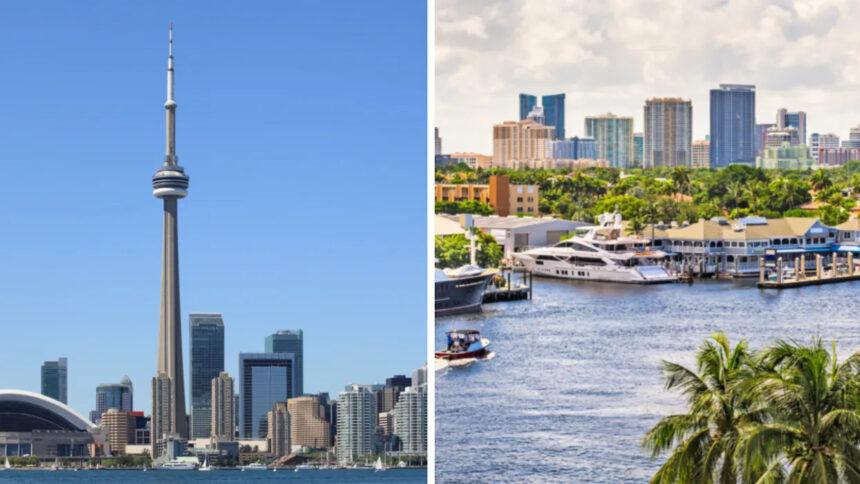
For years, Canadian visitors have been a vital stream for Florida’s tourism industry, but their declining numbers—along with the threat of retaliatory tariffs on iconic Florida products—have sparked growing concern across multiple economic sectors.
A persistent trade and tariff war between the United States and Canada is beginning to have a tangible impact on Florida’s economy, affecting two of its cornerstones: tourism and agriculture.

Two-thirds of Canadians said they had significantly reduced their purchases of U.S. products in physical stores (68%) and online (65%), while 59% said they were less likely to visit the United States in 2024, according to a 2025 survey by Canadian market research firm Leger. About 36% of Canadians with travel plans to the U.S. said they had already canceled them.
The decline in Canadian visitors, long a vital stream for Florida’s tourism industry.
Along with the threat of retaliatory tariffs on iconic Florida products, this has generated growing concern across multiple economic sectors.
Canadians visited the United States 20.4 million times last year, a figure expected to increase by over a million in 2025, according to the U.S. Travel Association.
However, the industry group warned last month that even a 10% reduction in those visits would cost $2.1 billion in lost spending and 14,000 jobs.

Statistics Canada already reported a 23% drop in Canadian road trips to the U.S. last month compared to February 2024, along with a 2.4% decrease in round-trip air travel by residents.

The Decline in Tourism from Canada
Florida, a top destination for Canadians seeking to escape the cold, has seen a notable drop in interest and travel bookings from Canada. While the state celebrated a record number of visitors in 2024, with 3.3 million Canadians contributing to that total, projections for 2025 paint a grim picture.
Early and mid-2025 travel industry reports indicate a sharp reduction in flight bookings between Canada and the U.S., with some figures showing up to a 70% decline for the April-to-September period compared to the previous year. This trend is directly attributed to the tense political climate and economic uncertainty caused by the tariff dispute.

The U.S. Travel Association has warned that a 10% decrease in Canadian tourism nationwide could result in a $2.1 billion loss in revenue and the elimination of 14,000 jobs. Florida, as one of the primary recipients of these tourists, is among the states most vulnerable to this economic impact. Small and medium-sized businesses in popular destinations like Fort Lauderdale, Hollywood, and Pompano Beach—heavily reliant on Canadian “snowbirds”—are already reporting lower foot traffic, affecting hotels, restaurants, and retail stores.
Threats to the Economy and Trade
Beyond tourism, Florida’s economy faces a direct threat to its exports. In response to U.S. tariffs, the Canadian government has threatened to impose retaliatory tariffs on a range of American products, including Florida orange juice.
This Canadian protectionist measure could devastate the state’s citrus industry, a sector already facing significant challenges. New tariffs would hinder the competitiveness of one of Florida’s most iconic products in one of its most important export markets.
In addition to citrus, other sectors like agriculture and fishing are also considered vulnerable in this trade dispute. The uncertainty created by the tariff war affects long-term planning for Florida’s producers and exporters, who could see reduced profit margins and limited access to the Canadian market.
While the effects on Canadian businesses operating in Florida have not yet been quantified, the hostile trade environment creates instability that could discourage future investments and complicate existing cross-border operations.
In short, the trade and tariff war has shifted from an abstract policy issue to a tangible economic reality for Florida. The decline in Canadian visitors and capital, combined with trade barriers on its products, poses a significant challenge to the prosperity of the “Sunshine State.”