
Palm Beach and the Treasure Coast lead Florida’s economic and Latino boom, but rising housing and insurance hit working families.
- Palm Beach and the Treasure Coast lead Florida’s economic and Latino boom, but rising housing and insurance hit working families.
- Prosperity for some, survival for others: the Palm Beach and Treasure Coast boom makes the Latino family dream more expensive
- An unprecedented economic and population boom
- The Latino face of the northward expansion
- The “K‑shaped economy”: full‑time work no longer suffices
- The housing wall, rents and insurance
- The challenge of growing without displacing the community
While billionaires, new subdivisions and businesses turn Southeast Florida into a wealth hub, nearly half of working households in Palm Beach, Martin and St. Lucie face a widening gap between wages and the true cost of living.

Prosperity for some, survival for others: the Palm Beach and Treasure Coast boom makes the Latino family dream more expensive
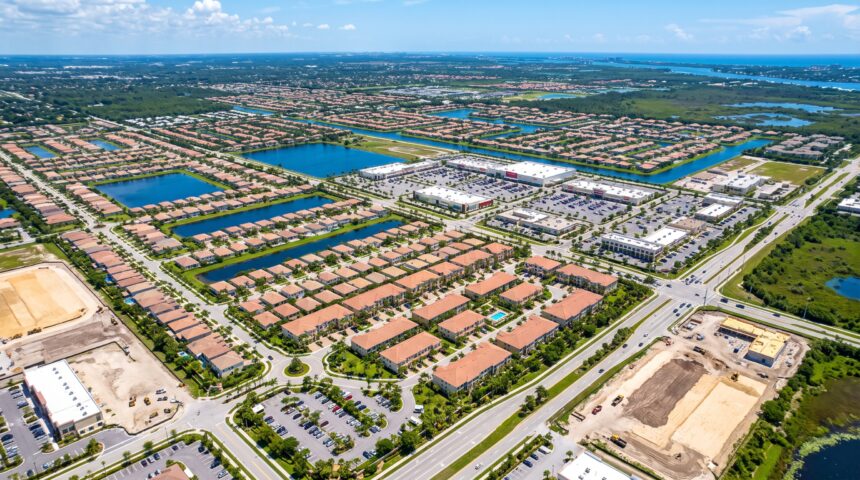
PALM BEACH AND TREASURE COAST, FL — Construction cranes along Interstate 95, the constant opening of residential developments and the influx of large capital paint an unmistakable picture of boom in Southeast Florida. Yet behind the headlines of economic records lies a far more complex reality for the average resident: growth in Palm Beach and the Treasure Coast creates visible prosperity, but it is deeply unequal.
In recent years, thousands of Latino families have chosen these communities — from West Palm Beach and Lake Worth to Stuart, Fort Pierce and Port St. Lucie — to put down roots, start businesses and seek greater stability. Today, many discover that staying afloat and advancing requires increasingly exhausting labor.
An unprecedented economic and population boom
Florida solidified last year as an expanding economic power, with 6.3% growth and a Gross Domestic Product near $1.8 trillion. Within that map, Palm Beach County has become the great magnet for the nation’s largest fortunes: Florida added 47 billionaires from 2022 to reach 138 high‑net‑worth residents, and only Palm Beach attracted about $22.7 billion net in capital transfers.
That northward push has spurred the Treasure Coast’s surge. According to U.S. Census data, Port St. Lucie topped 268,000 residents — an increase of almost 31% since 2020 — making it the fastest‑growing large city in the nation by percentage. Together, the Port St. Lucie metropolitan area (covering St. Lucie and Martin counties) reached 568,700 residents, growing more than three times the national average since 2010.

The Latino face of the northward expansion
A large part of this demographic transformation carries a Spanish accent. Driven out by prohibitive prices in Miami‑Dade and Broward, thousands of working‑ and middle‑class Hispanic families have moved to Palm Beach and, progressively, to the Treasure Coast in search of space and less aggressive prices.
The numbers confirm this community weight: in Palm Beach County, Hispanic residents now represent 24.4% of the population (about 375,000 people), and 28.3% of its inhabitants were born outside the United States, almost double the national average. Further north, in the city of Port St. Lucie, the Latino community already makes up 24.0% of residents, with projections anticipating a sustained increase of over 11% in the region in the coming years.
The “K‑shaped economy”: full‑time work no longer suffices
Economic analysts describe the current moment in South Florida as a “K‑shaped economy”: while high‑income sectors multiply wealth and the luxury market flourishes, the purchasing power of everyday workers stalls or retreats. Although the state minimum wage reached $15 per hour on September 30 2026, that increase is insufficient against the accumulated rise in housing, insurance, electricity and food costs.

The United Way ALICE 2026 report — which measures households that are employed and earn above the federal poverty line but still cannot meet basic needs — illustrates the magnitude of the pressure:
- In Palm Beach County, 49% of households (11% in poverty and 38% in the ALICE category) cannot cover basic living costs.
- In St. Lucie County, 46% of families live in poverty or earn below the threshold needed to cover essential expenses.
- In Martin County, 42% of households (10% in poverty and 32% ALICE) face the same financial vulnerability.
Statewide, 78% of renters below this threshold spend 30% or more of their income solely on rent and utilities.
The housing wall, rents and insurance
Housing has become the biggest obstacle to social mobility in both markets. In Palm Beach County, the median price of a single‑family home reached $656,000 in fall 2026, implying an estimated monthly outlay of $5,025 for mortgage, taxes and insurance, not including HOA fees or flood insurance. To shoulder that cost without financial suffocation, a family would need to earn $215,400 per year — more than double the county’s real median income, which ranges between $83,581 and $90,359. For renters, the median gross rent hits $2,173 per month, the third‑highest in all of Florida.
Even in St. Lucie County, traditionally seen as the last affordable refuge in the Southeast, the margin has narrowed dramatically. With a median home valued at $395,000 and an estimated monthly payment of $3,086, a household needs at least $74,100 annually at the limit of its debt capacity, or $132,300 to live with financial cushion. Against a median income of $80,648 in Port St. Lucie, any rise in homeowners’ insurance, car costs or a medical emergency can destabilize the family budget.
The challenge of growing without displacing the community
While employment projects like the Southern Grove corridor in Tradition project generating more than 22,500 jobs in the future, local economists warn that the creation of well‑paid jobs still lags behind the influx of new residents and the real‑estate surge.
For thousands of Latino families who sustain essential sectors such as construction, hospitality, health care, transportation and local commerce, the daily dilemma is no longer just finding opportunities in a vibrant region, but making the fruit of long hours — often with two jobs per household — enough to build a dignified future in the same land they help raise.
- 49% of households in Palm Beach and 46% in St. Lucie cannot cover basic living costs despite working.
- $5,025/month is needed to sustain a median home in Palm Beach and $3,086/month in St. Lucie (without HOA).
- 1 in 4 residents in Palm Beach (24.4%) and Port St. Lucie (24.0%) is Hispanic or Latino.
- +31% population growth in Port St. Lucie since 2020, the fastest rate among large U.S. cities.