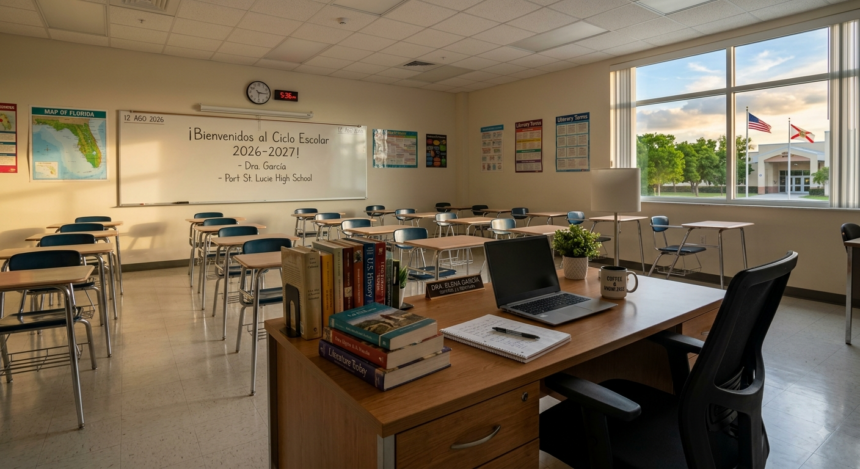
A concerning equation is sounding alarms in South Florida’s education system: fewer students in classrooms directly translates to less money for schools.
School districts in Palm Beach County and the Treasure Coast region (which includes Martin, St. Lucie, and Indian River counties) are facing a demographic and economic challenge that threatens to radically transform local public education.

Declining enrollment is not an isolated phenomenon. Factors such as the rising cost of living, which pushes families toward other regions, lower birth rates, and a growing preference for alternative education options (such as charter schools and state-funded voucher programs) are gradually emptying the desks of traditional schools.
Why fewer students mean less money
In the state of Florida, public school funding is tied almost exclusively to student headcounts, a system known as “Full-Time Equivalent” (FTE). For every student who leaves the district, the school loses thousands of dollars in state and federal funding.
For large districts like Palm Beach or historically growing districts like those on the Treasure Coast, the loss of hundreds or thousands of students creates a million-dollar deficit overnight.
“A school’s operational costs, like air conditioning, electricity, and building maintenance, don’t decrease just because there are three or four fewer students in a classroom, but the budget does,” explains a school finance expert.
The direct impact on students
When dollars follow the students who leave, those left behind face the consequences of a shrinking budget. Cuts are typically felt immediately in the most vulnerable areas of the school ecosystem:

- Reduction in academic and extracurricular programs: Art, music, theater classes, and lower-demand sports programs are often the first to disappear.
- Increase in class sizes: To save money, districts may be forced not to replace teachers who retire or resign, consolidating classrooms and reducing personalized attention.
- Less specialized support: Cuts may affect the hiring of counselors, school psychologists, tutors, and support staff for special education.
- Infrastructure and technology: Lack of funds delays the purchase of new books, computers, and vital maintenance of aging facilities.
A domino effect for the entire community
The deterioration of school resources doesn’t stay within campus boundaries; its ripple effects impact the economy and well-being of the entire South Florida and Treasure Coast communities.
- Drop in property values: Strong public schools are one of the main drivers of real estate value. When the perceived quality of a school district declines due to lack of funding, the appeal of surrounding neighborhoods falls, affecting homeowners’ equity.
- Economic and employment impact: Public schools are often the largest employers in their respective counties. Budget cuts mean layoffs or salary freezes, reducing local purchasing power and affecting small businesses.
- Difficulty attracting businesses: Large companies looking to establish themselves in Palm Beach or the Treasure Coast evaluate the quality of the local school system. An underfunded education system makes it harder to attract qualified professionals seeking good schools for their children.
What does the future hold?
Administrators in Palm Beach, Martin, St. Lucie, and Indian River find themselves at a crossroads. To survive this exodus of human and financial capital, districts are being pressured to “compete” as if they were private enterprises: implementing specialized magnet programs, improving the marketing of their academic achievements, and seeking additional subsidies to retain families.
Meanwhile, the community watches closely, aware that the region’s economic future is intrinsically linked to the quality of education happening within those classrooms—now a little emptier.