


The countdown has begun. As the first-ever FIFA Club World Cup kicks off, today, June 11, 2025, marks exactly one year until the twenty-third World Cup of national teams begins. This tournament is special for many reasons. The main one: it will be the World Cup with the most teams in history. For the first time, there will be 48 participants, opening the door to a new global competitive landscape.
Another major novelty is the number of hosts. Never before have three countries shared the role. Canada, Mexico, and the United States will divide 16 venues. Mexico’s case is unique because it will also be the first country to host three World Cups, following those in 1970 and 1986. All this means the tournament will have more matches than ever (104), that many countries (still to be determined) will make their debuts, and that the schedule will be the longest. For the first time, it will last more than a month.

Schedule: June 11 to July 19
The ball will start rolling on Thursday, June 11, 2026, in Mexico City, and the grand final will be played on Sunday, July 19, in New York-New Jersey. This returns to the classic summer World Cup format after the exception of Qatar 2022.
The full match schedule is already set. The group stage will run from June 11 to 27 without interruption. The Round of 32 will take place from June 28 to July 3, and the Round of 16 from July 4 to 8. July 9 will be the first rest day before the quarterfinals from July 9 to 11. There will be another rest day on July 12 and 13 before the semifinals on July 14 and 15. Another two-day break (July 16 and 17) will precede the third-place match on Saturday, July 18, and the grand final on Sunday, July 19.
Now, all that’s left is to finalize the participants and the draw to know the matchups.
What we do know is that Mexico will play in the opening match. It will take place at the iconic Estadio Azteca, where Pelé won his third World Cup and where Maradona lifted the trophy for Argentina in 1986. The match will kick off at 8:00 PM Spanish time.
The following day, the other two host nations will make their debuts. Canada will play at BMO Field in Toronto, and the United States at SoFi Stadium in Los Angeles. The Stars and Stripes will host the most matches. Guadalajara, Vancouver, and Seattle will also host group-stage matches for their respective national teams, reinforcing the home-field World Cup atmosphere.

The first two matchdays of the group stage will be played in four time slots: 1:00 PM, 3:00 PM, 6:00 PM, and 8:00 PM (local time). The third matchday, as well as the Round of 32, Round of 16, and quarterfinals, will be concentrated in two time slots: 4:00 PM and 7:00 PM. The semifinals, to be played in Dallas and Atlanta, will start at 6:00 PM, while the third-place match in Miami will be played at 4:00 PM. The grand final on July 19 at MetLife Stadium in New York/New Jersey will kick off at 5:00 PM, which will be 11:00 PM in Spain.
Format: The Round of 32 Makes Its Debut
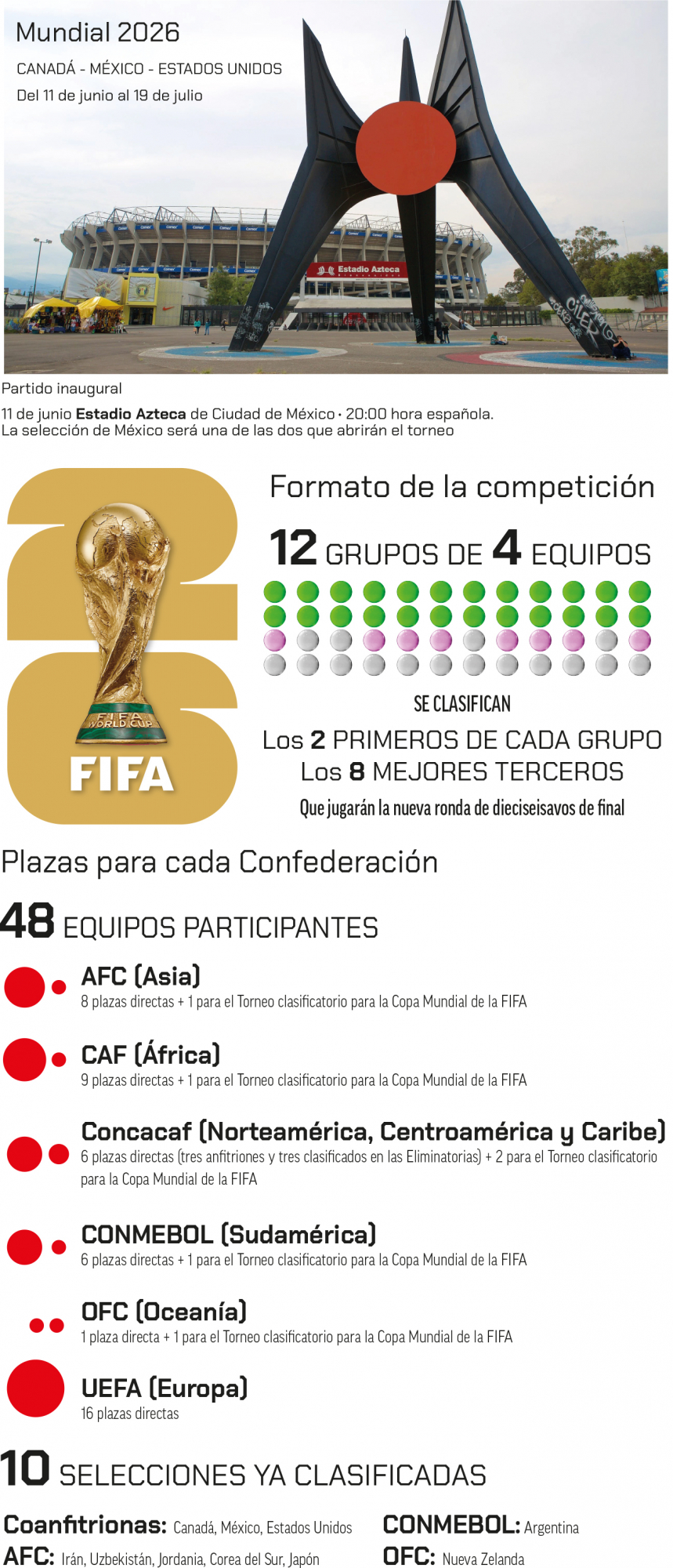
One of the most significant changes will be the expansion of the competition format. Initially, the first phase was set to consist of 16 groups of three teams each, but this controversial decision was unanimously revised by the FIFA Council in 2023, prioritizing the tournament’s competitiveness and fairness.
Ultimately, the tournament will be structured into 12 groups of four teams (instead of the eight that have been used since the 1998 World Cup in France). Each team will still play at least three matches. The change comes afterward. No longer will only the top two teams from each group advance, but also the eight best third-place finishers. As a result, 32 of the 48 teams will advance to the knockout stage.

This introduces an additional round. The qualifiers will not enter the Round of 16 but the Round of 32. This increases the number of matches a champion must win from seven to eight, extending the path to the title.
Opening Match
The kickoff will be on June 11 at Estadio Azteca in Mexico City at 8:00 PM Spanish time. The Mexican national team will be one of the two teams opening the tournament. It will be the first stadium to host three World Cup opening matches. It also hosted the finals in 1970 and 1986.
Currently, the stadium hosts matches for Club América and Cruz Azul, as well as the Mexican national team, while Pumas, Atlante, Atlético Español, and Necaxa have also played there.
In addition to the opening match, it will host two other group-stage matches, one Round of 32 match, and one Round of 16 match.
Final
The final will be on July 19 at MetLife Stadium in New York/New Jersey at 11:00 PM Spanish time. Opened in 2010 and with a capacity of 82,500, this multi-purpose stadium is home to the NFL’s New York Giants and New York Jets, as well as the XFL’s New York Guardians. It will also host five group-stage matches, one Round of 32 match, and one Round of 16 match.
It was the venue for the 2016 Copa América Centenario final, where Chile defeated Argentina, and the XLVIII Super Bowl in 2014, where the Seattle Seahawks beat the Denver Broncos. It will also be the site of the Club World Cup, hosting nine matches, including both semifinals and the final.
Venues: Three Countries, 16 Cities, and Colossal Stadiums
The 2026 World Cup will be the most geographically expansive in history. In total, 16 cities across three different countries will host matches.
Choosing New York-New Jersey as the final’s host and the Azteca as the starting point are two of the tournament’s major symbolic nods, blending tradition and modernity.
From the Azteca, which will make history by hosting its third World Cup, to the imposing U.S. venues like MetLife Stadium, SoFi Stadium in Los Angeles, and Mercedes-Benz Stadium in Atlanta, the tournament will feature top-tier infrastructure.
In total, 16 stadiums will host matches. Canada will have BC Place in Vancouver and BMO Field in Toronto, while Mexico will contribute the colossal stadiums in Mexico City, Guadalajara, and Monterrey. The United States, with 11 host cities, will bring together an unprecedented lineup of venues in terms of capacity and technology.
Dallas will be the city hosting the most matches in the entire tournament, with nine games, underscoring its key role in the 2026 World Cup’s organizational structure. Los Angeles, New York/New Jersey, and Atlanta will each host eight.

- Canada
- Toronto: BMO Field (30,000 spectators)
- Vancouver: BC Place (54,500 spectators)
- Mexico
- Guadalajara: Estadio Akron (46,232 spectators)
- Mexico City: Estadio Azteca (83,264 spectators)
- Monterrey: Estadio BBVA Monterrey (51,348 spectators)
- United States
- Atlanta: Mercedes-Benz Stadium (71,000 spectators)
- Boston: Gillette Stadium (65,878 spectators)
- Dallas: AT&T Stadium (80,000 spectators)
- Houston: NRG Stadium (71,795 spectators)
- Kansas City: Arrowhead Stadium (76,416 spectators)
- Los Angeles: SoFi Stadium (70,000 spectators)
- Miami: Hard Rock Stadium (75,540 spectators)
- New York/New Jersey: MetLife Stadium (82,500 spectators)
- Philadelphia: Lincoln Financial Field (69,596 spectators)
- San Francisco Bay Area: Levi’s Stadium (68,500 spectators)
- Seattle: Lumen Field (68,764 spectators)
Qualified Teams: First Tickets Distributed
With one year to go, 10 teams have already secured their spots, two of which (Uzbekistan and Jordan) will be making their debuts.
- Hosts: Canada, Mexico, and the United States (automatically qualified)
- AFC (Asia): Japan, South Korea, Iran, Uzbekistan, and Jordan
- CONMEBOL: Argentina
- OFC (Oceania): New Zealand
The remaining confederations are still in their qualification phases, which will conclude throughout 2025 and early 2026. With the expansion to 48 teams, the new World Cup offers more opportunities to regions traditionally underrepresented. Here’s the breakdown of direct berths:
- UEFA (Europe): 16
- CAF (Africa): 9
- AFC (Asia): 8
- CONMEBOL (South America): 6
- Concacaf (North America and Caribbean): 6 (including the 3 hosts)
- OFC (Oceania): 1
Additionally, there will be six extra spots (one each from Africa, Asia, South America, and Oceania, and two from North America and the Caribbean) to be decided in an intercontinental playoff, allowing more teams to dream of the big event.
365 days to wait. One year until the world’s biggest soccer event begins. And one great dream: to see Spain lift the World Cup trophy again.
Image: Marca





