Can you imagine a 64-team World Cup where no one is left out? The idea sounds like a soccer utopia, but Alejandro Domínguez, president of Conmebol, has put it on the table with the force of a hurricane. The argument is simple but explosive: If South America has the toughest World Cup qualifiers on the planet, why not reward all its members at the Centennial celebration?
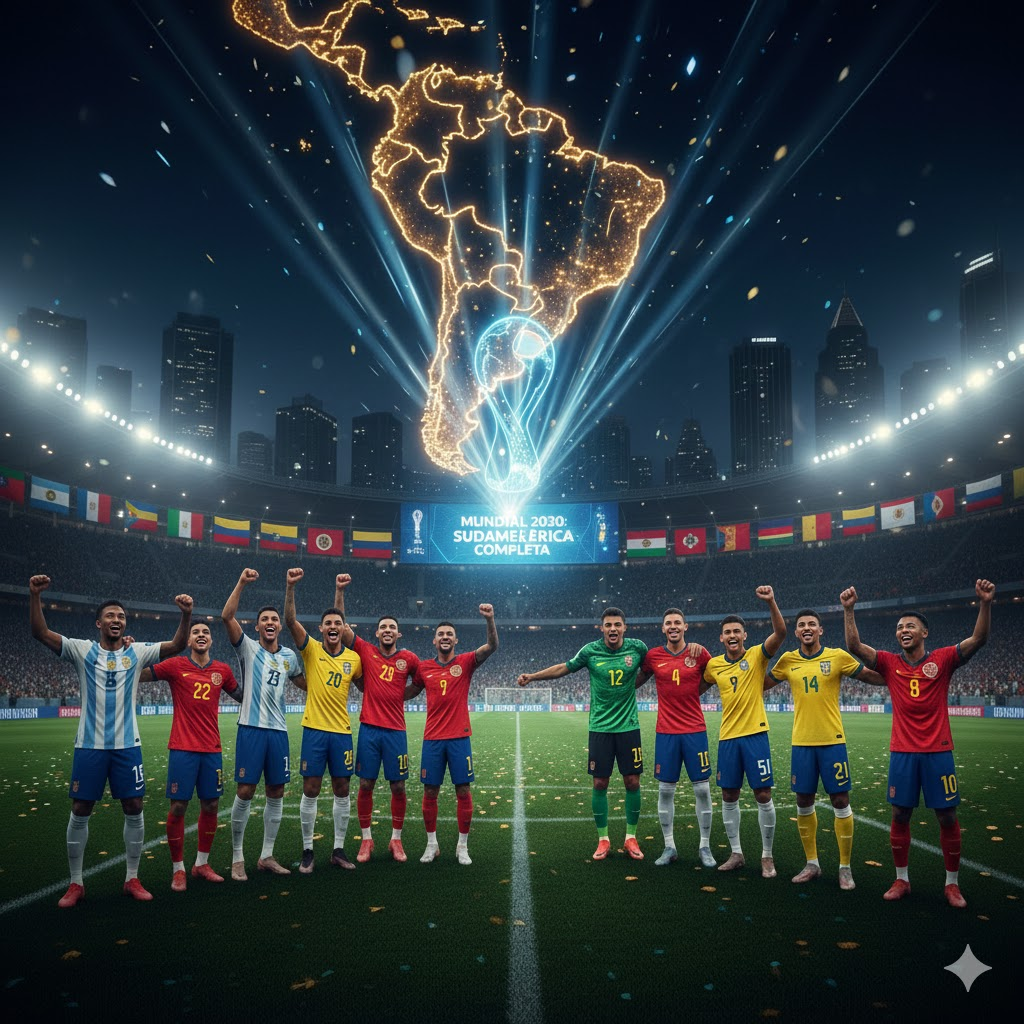
Conmebol’s president wants all 10 South American national teams to qualify directly for the 2030 World Cup, pushing for an expansion of the tournament to 64 teams. According to Domínguez, the current 6.5 spots for 2026 are “barely fair,” and for the 100th-anniversary edition, the continent deserves an “inclusive celebration” where Argentina, Uruguay, and Paraguay (already hosts) aren’t the only beneficiaries.

Credit: ElHispanoParaTodos/PRESS
The “64 Revolution”: Why Now?
Domínguez’s proposal isn’t just an offhand comment. It’s a seismic shift in FIFA’s politics. Currently, the 2026 World Cup will already jump from 32 to 48 teams, but for the Paraguayan executive, that’s not enough for the historic magnitude of 2030.
“The world knows the toughest qualifiers are played here. We want the World Cup to be a participatory celebration, and for all 10 of our nations to be included,” Domínguez said after signing an agreement in Paraguay.
The 3 Pillars of the Proposal:
- Sports Justice: To compensate for the region’s extreme competitiveness.
- Total Inclusion: So that teams that have historically struggled (like Venezuela or the current processes of Chile and Peru) can experience the World Cup.
- Political Weight: South America already ceded most of the 2030 World Cup to Spain, Morocco, and Portugal, keeping only three opening matches. This would be FIFA’s “compensation” for that gesture.
Goodbye to Qualifiers? The New Format in Play
If all 10 countries qualify, the “everyone against everyone” format we’ve known since 1996 would disappear. What would happen to the schedule then?
- The South American “Nations League”: Rumors suggest creating a tournament similar to the Nations League to maintain the competitive rhythm of the powerhouses without losing the pressure of earning points.
- Loss of Competitiveness: Critics (including UEFA’s Aleksander Čeferin) argue that a 64-team World Cup would dilute the quality of soccer and reduce the drama of the qualifying process.
Comparison: The Growth of the World Cup
| Year | Hosts | Number of Teams | Conmebol Spots |
| 2022 | Qatar | 32 | 4.5 |
| 2026 | U.S./Mexico/Canada | 48 | 6.5 |
| 2030 (Proposal) | Global (6 countries) | 64 | 10 (Total) |
The “Chile Effect” and the Relief for Teams in Crisis
For countries like Chile, which are currently undergoing a painful generational transition and see 2026 as an uphill battle, this news is a breath of fresh air. It’s not just about soccer—it’s about the economy that comes with qualifying for a World Cup: sponsorships, jersey sales, and the social morale of an entire country.
But is it ethical to qualify “by decree”? The truth is, in modern soccer, TV rights rule. A World Cup with more matches (increasing from 104 to 128 games) means billions in revenue that FIFA is unlikely to ignore if the numbers add up.

3. Technical SEO and Tags
- Tags: 2030 World Cup, Conmebol, Alejandro Domínguez, FIFA, South American Qualifiers, South American Soccer, Argentina National Team, Chile National Team, 64-Team World Cup Expansion, South America World Cup Spots.
- Suggested Interlinking: 1. “2030 World Cup Hosts: Why Is It Being Played Across Three Continents?” 2. “FIFA Rankings: Where South American Teams Stand Today.”