

What is Florida's Amendment 3? What it proposes and what voting yes or no means
Translated with AI from the original article in Spanish. Leer la noticia original en español
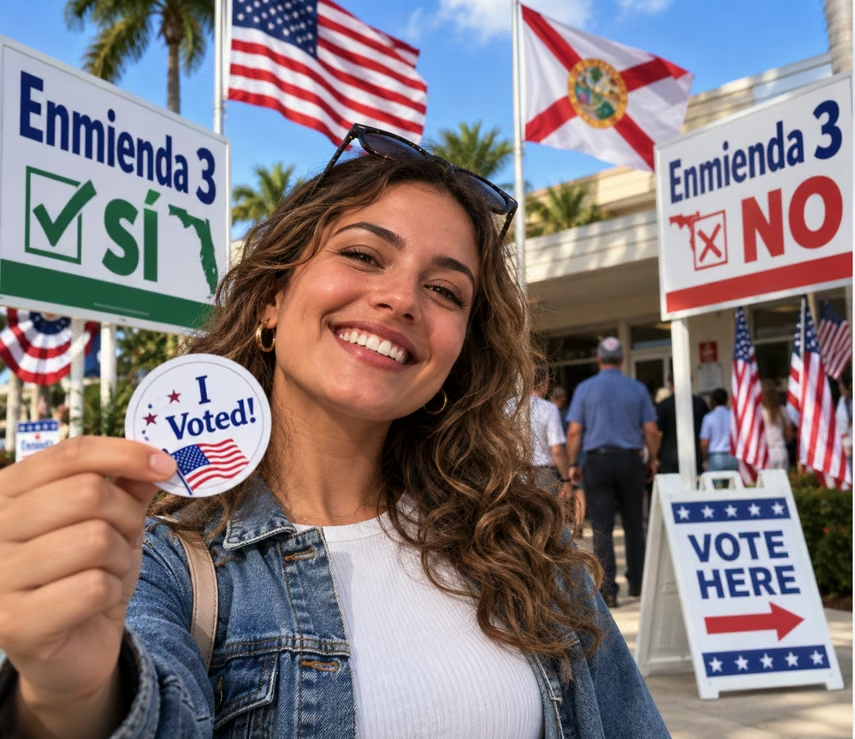
Voters in Florida must decide in November whether they wish to approve Amendment 3 to the state Constitution, which proposes changing how much some homeowners pay in property taxes.
The question will appear on the ballot this November 3, 2026, in its version revised by the Florida Attorney General, which sought to clarify the proposal's language.
According to the Florida Department of Revenue, the maximum homestead exemption in 2026 is $51,411, although not all of it applies to school taxes. With the amendment, the homestead exemption would increase to $150,000 in 2027 and $250,000 in 2028.
For it to be approved, the amendment must obtain at least 60% of the vote, but what does its approval imply?
Amendment 3: property taxes
It would raise the homestead exemption for non-school taxes to $150,000 in 2027 and $250,000 in 2028, with adjustments for inflation thereafter. It would also reduce the annual cap on assessment increases for properties without a homestead exemption from 10% to 5% and establish new rules for certain new residents and for the use of revenue from property taxes. See official text
Important: Amendment 3 needs at least 60% of the vote to be approved.

If the measure is approved, those who were already Florida residents as of December 31, 2026, could benefit from the expanded exemption if they meet the requirements. Those who were not residents of the state by that date would have to wait until their fifth year of homestead exemption to receive the increase, subject to what the U.S. Constitution allows.
This amendment would not only modify how much some homeowners pay, but would also impact how much property tax money cities and counties receive, which several jurisdictions have labeled a blow to their revenue.
NBC6 investigative reporter Sasha Jones reported that, at the municipal level, that reduction in revenue could affect the funding of public safety services, parks, infrastructure, and community programs.
The report identified the city of Coral Springs as one of the jurisdictions that would be affected. According to estimates, the city's revenue could be reduced by approximately $14.5 million in 2028 and about $26.8 million by 2029.
How does the text of the amendment appear on the ballot?
Increased Homestead Exemption; Lower Cap on Assessment Increases for Non-Homestead Real Property
This amendment increases the homestead exemption, for all non-school taxes, to $150,000 in 2027 and to $250,000 in 2028, and thereafter, it will be adjusted based on inflation. This amendment requires the Legislature to establish a uniform procedure for counties and municipalities, with respect to their respective taxes, to increase the homestead exemption up to the total assessed value, and allows special districts, upon approval by referendum, to do the same. Individuals who are not Florida residents on December 31, 2026, will be eligible for the homestead exemption currently in effect at the time they meet the requirements for it, and the expanded exemption will apply starting from the fifth year of the exemption, to the extent permitted by the United States Constitution. This amendment reduces the annual cap on assessment increases for non-homestead properties from 10% to 5%. This amendment requires counties and municipalities to allocate property taxes exclusively to public safety, education and schools, infrastructure, natural resources, bond debt service, employee retirement benefits, and operations and administration. Other expenses may be approved by county officials or county or municipal governing bodies, unless prohibited by general law, notwithstanding the provisions of Article VII, Section 9(a) of the Florida Constitution, which allows counties and municipalities to levy property taxes for their respective purposes. This amendment will take effect on January 1, 2027.
Yes / Sí
No / No
What does voting YES for Amendment 3 mean?
Marking YES on the ballot would mean that you agree to amend the Florida Constitution and that the homestead exemption for non-school taxes increases to $150,000 in 2027 and $250,000 in 2028.
This means that qualifying homeowners could deduct that amount from the taxable value of their primary residence before calculating non-school taxes.
For example, if a home has a taxable value of $300,000, with the $250,000 exemption, non-school taxes would only be paid on the remaining $50,000.
However, homeowners would still pay school taxes, as that part of the bill would not be covered by the increase in the exemption.
The measure also proposes reducing the annual cap on taxable value increases for properties that do not qualify for homestead, such as second homes and rental properties, from 10% to 5%.
This would apply to all qualifying secondary properties, not just one. However, it does not mean that the tax bill can only increase by 5% each year.
What does voting NO for Amendment 3 mean?
Voting NO means that you do not agree to apply the proposed changes to the Florida Constitution.
This would mean that the primary residence (homestead) exemption for non-school taxes would not increase, nor would the annual cap on taxable value increases for properties that do not qualify for homestead be reduced from 10% to 5%.
Current exemptions and caps would remain in place unless modified later.
What do people in favor of Amendment 3 say?
There are officials and political leaders in South Florida who have expressed their support for the measure, including Miami-Dade Property Appraiser Tomás Regalado and County Sheriff Rosie Cordero-Stutz.
The Republican candidate for Florida governor, Byron Donalds, has also said he supports Amendment 3.
According to an exclusive Telemundo 51/NBC6 poll, 55% of voters surveyed support the measure. Among them, 49% noted that property taxes are too high.
What do those against Amendment 3 say?
The Florida Sheriffs Association has spoken out against Amendment 3 and has warned that the reduction in property tax revenue could affect the funding of public safety.
For his part, the Democratic candidate for Florida governor, David Jolly, has also said he will vote NO, due to concerns about the potential impact on law enforcement and other local services.
The Telemundo 51/NBC6 poll also found that, among voters who oppose the amendment, 55% cited potential cuts to local services as their main concern.
If the amendment is approved, the measure would take effect on January 1, 2027.