

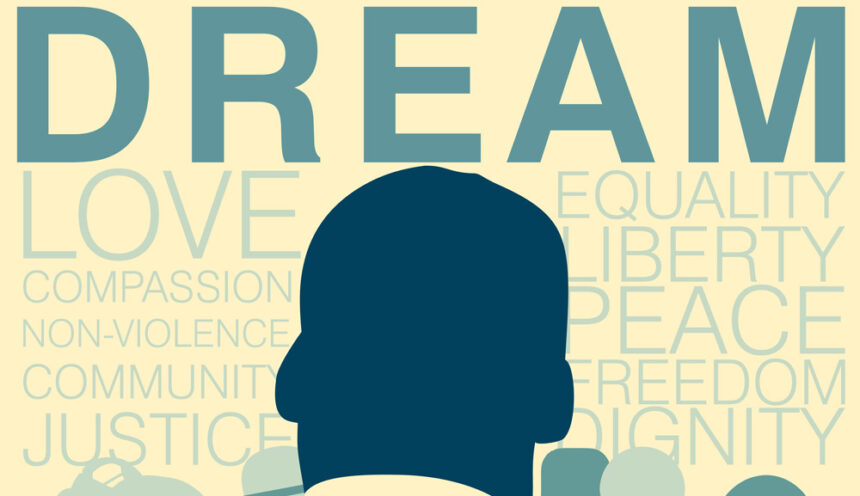
The legacy of freedom of Martin Luther King Jr. centers on the tireless and nonviolent struggle for justice, racial equality, and civil rights for all people, regardless of their skin color.
Some of my African American neighbors who had gathered to watch videos of Martin Luther King Jr. were surprised when I asked them during the meeting what they considered to be the main legacy of this activist against racial discrimination.

Almost in unison, they answered, “the defense of the rights of people of color.”
While it is true that the 1964 Nobel Peace Prize winner, Martin Luther King Jr., is remembered for his fight against racial segregation, his legacy transcends differences in color or race.
His great contribution to history lies in having established an ideological precedent for respecting differences of any kind, tolerance as the foundation for better human relationships with equity and justice, and nonviolence.
Today, respect for differences is the law, and nonviolence is a global movement that promotes the peaceful negotiation of conflicts based on principles such as justice and equity, without physical confrontations.

We must celebrate and remember Martin Luther King by practicing what he taught us: tolerance for differences toward others.
By recognizing others as people equal in rights and duties, yet with differences that may be in ideas, race, language, culture, color, and sexual orientation. As MLK once said, “Only by meeting hate with love can the gap in a community be closed.”
We live in moments of human history filled with uncertainty and chaos, where the boundaries between sanity and madness, and between tolerance and intolerance, are increasingly blurred.

Social divides are now deeper, and ideological divisions have intensified to the point of dehumanization and what some call regression in human relationships.
Legacies are meant to be preserved, and it seems we are forgetting that differences are a condition of human survival, which is why they must be recognized and respected for better coexistence.
It is unacceptable that cases of segregation and exclusion for political, cultural, religious, and ideological reasons continue to intensify today.
May the words of Martin Luther King in “I Have a Dream,” one of the most notable speeches in history, not remain only in memory but transcend into the daily lives of societies
and communities that struggle daily to survive in a world order that seems increasingly ruthless and resists attempting to manage disagreements without violence.
In these times, the true dream of freedom and the aspiration of all, regardless of any difference, should be based on living happily, healthily, and peacefully in equitable and just conditions, without segregation or violence.
Article written by Omaira Martínez Cardona – Colombian Journalist
Image: Omaira Martinez Cardona





