

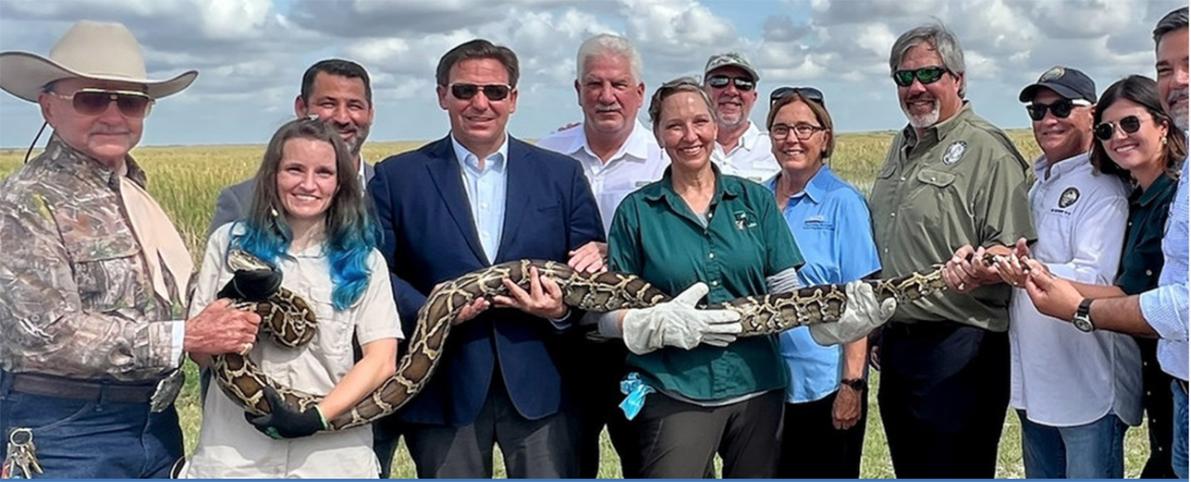
The introduction of the Burmese python in Florida in the 1970s is a clear example of the problems that can arise from introducing exotic species into an ecosystem.
Burmese pythons have become a severe plague in Florida’s Everglades, making them the most problematic invasive species in the region.

This situation began nearly 20 years ago when owners of these exotic snakes released them or allowed them to escape, enabling them to reproduce and spread rapidly throughout the local ecosystem.
Burmese pythons, native to Asia, Australia, and Africa, can grow up to 17 feet long. Their voracious appetite leads them to hunt and consume a wide variety of animals, from small mammals to large wildlife and pets.
Their presence has had a devastating impact on the wildlife of the Everglades, creating significant ecological imbalance.
To combat this invasion, the Florida government implemented the “Florida Python Challenge 2024,” a competition that began on August 9 and ended on August 18.

This challenge offered monetary incentives for those who successfully captured pythons, with a $10,000 prize for each snake caught.
The competition attracted hundreds of participants seeking to develop ingenious traps and use effective methods to control the population of these snakes.
It is important to note that during the challenge, the use of firearms or other animals for capturing or eliminating the pythons was not permitted, ensuring that the strategies used were safe and environmentally respectful.

Additionally, it is mentioned that the issue of invasive species is not exclusive to pythons. Feral cats, for example, are considered one of the most invasive species worldwide due to their impact on local wildlife in various regions.

What makes this situation so problematic?
- Ecological imbalance: Burmese pythons have no natural predators in Florida, allowing them to reproduce and grow in large numbers without control. This disrupts the ecosystem by drastically reducing populations of their natural prey, such as small mammals, birds, and other reptiles.
- Impact on biodiversity: The decline in natural prey populations has a domino effect throughout the food chain, affecting other species and reducing the overall biodiversity of the ecosystem.
- Public health risk: Although Burmese pythons are not venomous, their large size and strength make them a potential threat to humans, especially in areas where interactions between people and these reptiles are more frequent.
What is being done to address this problem?
- Elimination programs: Various programs have been implemented to capture and remove Burmese pythons, including hunting competitions and the use of trained dogs.
- Research: Scientists are studying the biology and behavior of Burmese pythons to develop more effective control strategies.
- Public education: Educational campaigns are conducted to raise awareness about the risks of owning exotic pets and the importance of not releasing animals into the wild.
- Accidental introduction: The irresponsible release of exotic pets has triggered a plague.
- Impact on the ecosystem: Pythons threaten local biodiversity by preying on numerous species.
- Control efforts: The government has implemented incentive programs and competitions to encourage the hunting of these snakes.
- Challenges: The large number of pythons and the lack of professional hunters make population control difficult.
- Comparison with other invasive species: Domestic cats also pose a serious threat to wildlife.
- Additional aspects to consider:
- Python life cycle: The high reproduction rate and longevity of Burmese pythons worsen the problem.
- Suitable habitat: The Everglades provide an ideal environment for these snakes, with abundant food and shelter.
- Economic impact: The python invasion can affect tourism and the local economy by damaging wildlife and ecosystems.
- Risks to human health: Although rare, python attacks on humans have been recorded.
- Long-term solutions: In addition to hunting, long-term strategies are needed, such as researching biological control methods and public education.
Can we learn anything from this situation?
The invasion of Burmese pythons in Florida teaches us the importance of:
- Regulating the exotic pet trade: It is essential to establish stricter laws and regulations to control the import and sale of exotic species.
- Preventing the release of invasive species: Measures must be taken to prevent people from releasing exotic animals into the wild, whether accidentally or intentionally.
- Investing in research and conservation: More resources must be allocated to research on invasive species and the conservation of affected ecosystems.
For more details about the event and the winners, you can visit the official challenge website: FLPythonChallenge.org.
Image: FLPythonChallenge.org





