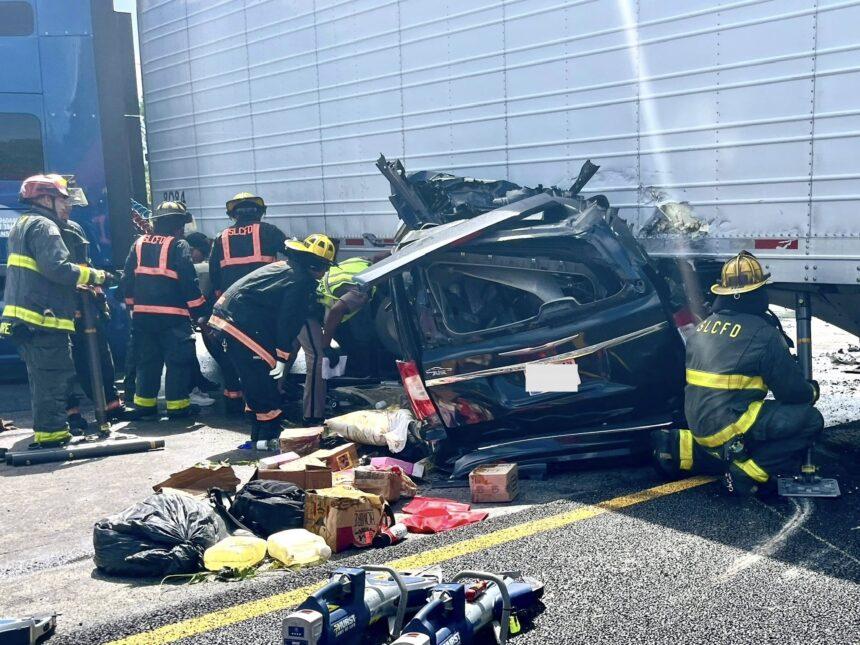
A truck driver with a California commercial license was arrested in Florida after causing a deadly crash that left three people dead on the Turnpike near Fort Pierce in St. Lucie.
The initial investigation, led by the Florida Highway Patrol (FHP), identified “reckless behavior and disregard for the road safety of other users” by the commercial truck driver.

The foreign driver, identified as Harjinger Singh, who entered the United States through the Mexican border in 2018, faces three counts of vehicular homicide and an imminent deportation process.
Harjinder Singh, 28, was arrested following the collision near Fort Pierce on Florida’s Turnpike on August 12 after attempting to turn his trailer in an “unauthorized location,” according to the Florida Department of Highway Safety and Motor Vehicles (FLHSMV).
The Indian citizen entered the United States illegally by crossing the southern border in 2018, the FLHSMV reported. He could now be deported following a criminal proceeding.
According to official information provided by the Florida Department of Highway Safety and Motor Vehicles (FLHSMV), the incident occurred on August 12 when Singh, a foreign national, performed an illegal U-turn at a restricted-access point for official use at mile marker 170 on Florida’s Turnpike.

This action completely blocked the lanes, causing a minivan to be unable to avoid the truck and crash into the left side of the semi-trailer.
The minivan’s driver, a 30-year-old man from Florida City, was airlifted to HCA Florida Lawnwood Hospital, where he later died from the severity of his injuries. Emergency crews extricated the trapped driver from the minivan and coordinated the medical response.
Two other minivan occupants, a 37-year-old woman from Pompano Beach and a 54-year-old man from Miami, also died at the scene of the crash.

The commercial truck driver and his passenger were not injured.
https://www.instagram.com/reel/DNYoOIlAVke/?igsh=OWxuMXYwNmJ0MnZw
The report emphasized that the investigation led to an arrest warrant and the activation of a request for ICE under the federal 287(g) program, which allows local police to collaborate in identifying and detaining individuals with irregular immigration status.
The FLHSMV director stated, “Harjinger Singh is in custody charged with vehicular homicide and immigration violations. He will not have the opportunity to continue harming and destroying lives in Florida.”
Questions are now being raised about how this driver was able to obtain a commercial license in California, as state laws require proof of legal presence, and this individual is in the country illegally.
The California Connection and How the License Was Obtained
The post-crash investigation near Fort Pierce revealed that the driver held a CDL issued in California. While California also requires proof of legal presence for a CDL, the state has a specific law that creates a potential loophole that can be exploited fraudulently.
- California’s AB 60 Law: California, through AB 60, allows state residents to obtain a standard (non-commercial) driver’s license without proving their immigration status. These licenses are marked with the phrase “Federal Limits Apply” and are not compliant with the REAL ID Act, meaning they cannot be used for federal purposes such as boarding a plane.
- The Critical Step to a CDL: This is where the issue arises. To apply for a Commercial Driver’s License (CDL) in California, one must first hold a basic driver’s license from that state. However, the CDL applicant must still separately provide proof of legal presence in the U.S., in accordance with federal regulations that California is required to follow.
- Document Fraud: Since California law is clear in requiring proof of legal status for a CDL, the only way the driver could have obtained one is by presenting falsified or fraudulent documents to the California DMV. This would have allowed him to appear compliant with the legal presence requirement when he was not.
In summary, the driver did not obtain the license through a “legal loophole” that allows undocumented immigrants to get commercial licenses. Instead, he exploited another state’s system to secure a basic license and then allegedly committed fraud by submitting false documents to meet the federal legal status requirement, a mandate that neither Florida nor California can bypass for commercial license issuance. The tragic Florida crash highlighted the consequences of a fraudulently obtained license.