Who survived the Round of 16 massacre? An in-depth analysis of the teams that advanced to the World Cup quarterfinals, the surprises, disappointments, and what no one has told you. Read now!
- The World Cup Funnel: How the Hell Did We Get Here?
- In-Depth Analysis of the 8 Survivors: A Portrait of Authority
- The Most Relevant Facts: The Stories Behind the Results
- 1. Morocco and the African-Arab Revolution
- 2. The Last Dance (and Weight) of the Giants: Messi vs. Ronaldo
- 3. The Confirmation of Mbappé’s Power
- 4. Brazil’s Reinvention and the Weight of History
- 5. The VAR Drama and Refereeing Controversy
- What Awaits in the Quarterfinals: Epic Battles vs. Massive Disappointments
The group stage was an emotional slaughterhouse. The Round of 16, a heart-stopping game of Russian roulette. And now, the world of soccer stands still. The funnel has narrowed, and only eight nations remain standing—eight armies ready for the final battle for immortality. If you’re a true fan, you know this isn’t just any World Cup. It’s been a rollercoaster that shattered brackets and brought giants to tears.

The truth is, at this stage, there are no small enemies. What we’ve seen so far is just the prologue to an ending that promises to be legendary (I don’t know about you, but I’m still missing my fingernails after that penalty shootout…).
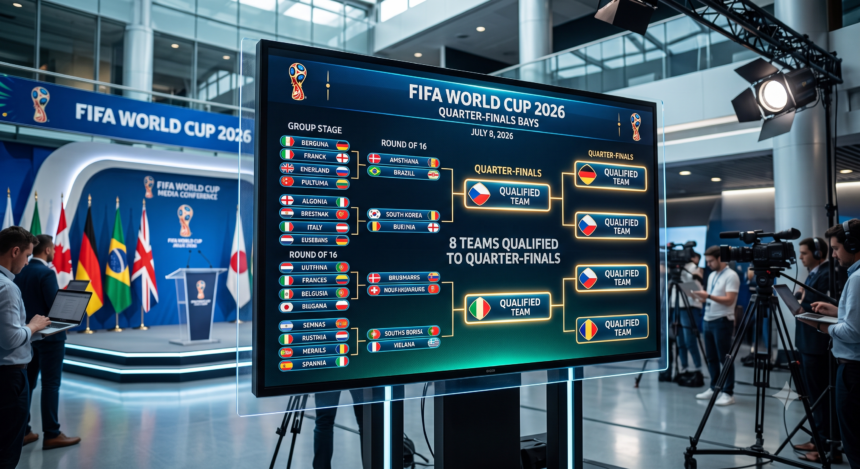
The teams that advanced to the World Cup quarterfinals after intense battles are: Argentina, the Netherlands, Brazil, Croatia, France, England, Morocco, and Portugal. These eight teams have demonstrated a combination of talent, tactics, and unbreakable mental resilience to reach the tournament’s elite.
But let’s get to the point. You’re not here just to see a list of names you could find anywhere. You’re here to understand why they’re here, how they did it, and what seismic events changed the course of soccer history in these frenetic weeks.
The World Cup Funnel: How the Hell Did We Get Here?
To appreciate the merit of the survivors, we must first look at the battlefield littered with illustrious casualties. The knockout stage showed no mercy.
The Group Stage Slaughter: Where Favorites Die
Here’s the interesting part. Before talking about the eight finalists, we must pay tribute (or deliver fierce criticism) to those who didn’t measure up. The big lesson from the first phase was clear: the crest doesn’t win games.

- The collapse of the four-time champions: Seeing Germany eliminated in the group stage for the second consecutive World Cup is still hard to digest. A mix of tactical arrogance and lack of decisiveness sent them home early. Is this the end of an era for German soccer? Probably yes, and the restructuring must be deep.
- The “Golden Generation” that rusted: Belgium arrived as a contender and left as a major disappointment. Internal conflicts and the evident aging of their stars (with a Hazard far from his best and a Lukaku struggling to score in the decisive match) marked the end of a cycle that promised much and delivered little.
- The Hispanic pain: Uruguay fought until the last second, but a last-gasp goal by South Korea in another match left them out on goal difference. The image of Luis Suárez crying on the bench is one of the most painful snapshots of this tournament, marking the farewell of a warrior generation.
Round of 16: From Agony to Tactical Ecstasy
If the group stage was dramatic, the Round of 16 was a lesson in pure survival. This is where the boys are separated from the men.
- The battle of styles: We saw matchups that were true chess games. The Netherlands gave a masterclass in pragmatism by eliminating a young and promising United States. Argentina suffered more than expected against an Australia that made them pay dearly, needing a heroic save from ‘Dibu’ Martínez in the final moments.
- The penalty shootout show: Japan and Croatia gave us the first drama from the spot. Croatian experience and composure (with an imperial Livaković) prevailed over Japanese inexperience. Spain and Morocco took the suffering to the limit; ‘La Roja’ dominated possession but lacked bite, and Morocco, with a perfect defensive plan and a stratospheric Bono in the shootout, achieved a historic qualification.
- Power displays: Brazil, France, England, and Portugal showed no mercy in their respective matchups. They dispatched their rivals with decisive victories, proving they have the heavy artillery ready for what’s coming. Portugal’s 6-1 over Switzerland (with a hat-trick from young Gonçalo Ramos, who had the pressure of replacing Cristiano Ronaldo) was a devastating message to the rest of the world.
In-Depth Analysis of the 8 Survivors: A Portrait of Authority
Now, let’s dissect the teams that advanced to the World Cup quarterfinals. Each has a unique narrative, a key strength, and a weakness their rivals will try to exploit.
| Team | Coach | Key Player So Far | Style of Play | Main Strength | Possible Weakness |
| Argentina | Lionel Scaloni | Lionel Messi | Direct Possession / Emotional | The Messi factor and group cohesion | Excessive dependence on Messi to create danger |
| Netherlands | Louis van Gaal | Cody Gakpo | Tactical Pragmatism / Counterattack | Defensive solidity and effectiveness in transitions | Lack of fluidity in midfield against low blocks |
| Brazil | Tite | Richarlison | Modern Jogo Bonito / High Press | Squad depth and offensive variants | Vulnerability to quick counterattacks if the press fails |
| Croatia | Zlatko Dalić | Luka Modrić | Tempo Control / Mental Resilience | Experience in decisive stages and elite midfield | Lack of a guaranteed goal-scoring center forward |
| France | Didier Deschamps | Kylian Mbappé | Explosive Verticality / Efficiency | The devastating power of Mbappé and Griezmann | Injury absences (Pogba, Kanté, Benzema) that shorten the bench |
| England | Gareth Southgate | Jude Bellingham | Balance / Combinative Play | Talented youth and physical power | Tendency to retreat too much when leading |
| Morocco | Walid Regragui | Achraf Hakimi | Organized Defense / Discipline | The best defensive block of the tournament and collective spirit | Extreme physical wear after high-intensity matches |
| Portugal | Fernando Santos | Bruno Fernandes | Varied Offense / Pressure | Scoring ability and individual talent across all lines | Locker room management with Cristiano Ronaldo’s role |
The Most Relevant Facts: The Stories Behind the Results
This World Cup won’t be remembered just for who won, but for how the events unfolded. Here are the milestones that defined the road to the quarterfinals:

1. Morocco and the African-Arab Revolution
Let’s be honest: no one saw Morocco in the quarterfinals. Absolutely no one. Their feat is the most relevant fact of the tournament so far.
- How they did it: Walid Regragui, who took over just three months before the World Cup, built an impregnable fortress. Led by Bono in goal, an imperial Hakimi in defense, an Amrabat as the midfield engine, and a talented Ziyech in attack, they eliminated Belgium in the group stage and Spain in the Round of 16. They are the first Arab team to reach the quarterfinals and the fourth African team in history. Their success isn’t a fluke; it’s tactical discipline and pure heart.
2. The Last Dance (and Weight) of the Giants: Messi vs. Ronaldo
This tournament almost certainly marks the World Cup farewell of the two players who defined an era. The way they are experiencing this process is contrasting and fascinating.
- Lionel Messi (Argentina): He has taken on the role of absolute leader, captain, and savior. At 35, Messi is playing with fierce determination, scoring decisive goals (like against Mexico and Australia) and assisting with his usual magic. The ‘Scaloneta’ moves to his rhythm, and the bond with the Argentine fans is total. Every match could be his last, and the pressure to win the third star is immense.
- Cristiano Ronaldo (Portugal): His World Cup has been an emotional rollercoaster and a source of controversy. He scored a historic penalty in the opener (becoming the first player to score in five World Cups), but his level of play and his attitude after being substituted against South Korea drew criticism. In the Round of 16, Fernando Santos made the bold decision to leave him on the bench. Portugal shone without him, and his replacement, Gonçalo Ramos, scored a hat-trick. Cristiano came on late, but the narrative changed: Is he a leader on the bench or a media distraction? Managing this situation is key to Portugal’s future.
3. The Confirmation of Mbappé’s Power
If there were any doubts about who is the heir to the world soccer throne, Kylian Mbappé erased them all. At just 23, he is already a World Cup legend.
- Devastating Impact: Mbappé is playing at another level. His speed is unstoppable, his finishing is clinical, and his ability to decide matches is unique. He has five goals in the tournament (more than Ronaldo or Messi had scored at his age in World Cups) and already has nine in total in just two appearances. He leads a France that, despite absences, looks solid and intimidating. He is the nightmare of any defender who has to face him in the quarterfinals.
4. Brazil’s Reinvention and the Weight of History
Brazil arrived as the big favorite and has delivered so far. But they’ve done it in a way that combines traditional joy with modern discipline.
- Balance and variants: Tite has built a team that is solid defensively (led by Casemiro and Marquinhos) and allows their “dancers” to shine up front. Richarlison has been the No. 9 Brazil needed, scoring spectacular goals (including the best of the tournament so far, a bicycle kick against Serbia). Neymar’s return from injury in the Round of 16 was a key emotional and soccer boost. The 4-1 over South Korea was a samba soccer exhibition that scared everyone. However, Brazil hasn’t won the World Cup in 20 years, and the pressure for the ‘Hexa’ is a ghost that always looms.
5. The VAR Drama and Refereeing Controversy
Really, we can’t talk about the World Cup without mentioning technology and refereeing decisions, which remain the eternal debate.
- Millimeter decisions and offside: Seeing goals disallowed for a shoulder or a knee a millimeter offside continues to frustrate many fans. The semi-automated offside works, but at the cost of the game’s fluidity.
- Controversial penalties: We saw penalties awarded for minimal contact (like Argentina’s against Saudi Arabia or Poland’s) and others not awarded that seemed clear. Refereeing consistency remains the Achilles’ heel, and even with VAR, human interpretation continues to generate controversy. In the quarterfinals, where one mistake can cost an elimination, the pressure on referees will be brutal.
What Awaits in the Quarterfinals: Epic Battles vs. Massive Disappointments
We already know the teams that advanced to the World Cup quarterfinals. The upcoming matchups are train wrecks, games that promise drama, tactics, and unforgettable moments.
- Argentina vs. Netherlands: A historic rivalry that has given us finals and legendary matches. It will be a battle between Messi’s inspiration and Van Gaal’s defensive pragmatism. Can the Dutch defense contain the Argentine genius? Can Argentina overcome the Europeans’ tactical block? A match that promises maximum tension and will likely be decided by a single detail.
- Brazil vs. Croatia: Modern ‘Jogo Bonito’ against mental resilience and a luxury midfield. Croatia knows how to suffer and has experience in these stages (they were finalists in 2018), but Brazil has too many offensive variants. If Modrić and company can slow the game and control the tempo, they’ll have a chance. But if Brazil imposes their fast pace, it could be a long night for the Balkans.
- France vs. England: A clash of European powerhouses. Two young, talented squads hungry for glory. It will be fascinating to see the duel between Mbappé’s verticality and England’s defensive solidity (especially Kyle Walker, if he recovers). Bellingham vs. Griezmann in midfield will be another key battle. A match that could easily be an early final.
- Portugal vs. Morocco: Varied offense against an impenetrable defensive block. Portugal arrives with high morale after thrashing Switzerland, but Morocco has already shown they fear no one. It will be a game of patience for Portugal, trying to find cracks in the Moroccan defense without neglecting their own. And of course, there’s the question: Will Cristiano start or come off the bench? A last-gasp goal or a penalty shootout drama wouldn’t surprise anyone.
The World Cup has been an unforgettable spectacle so far. It has given us joy, sadness, controversy, and, above all, plenty of high-quality soccer. The eight survivors are just three steps away from eternal glory. Get the snacks ready, gather the family, and prepare to experience the most intense quarterfinals in recent memory. Let the ball roll and may the best team win!
Image El Hispano para todos